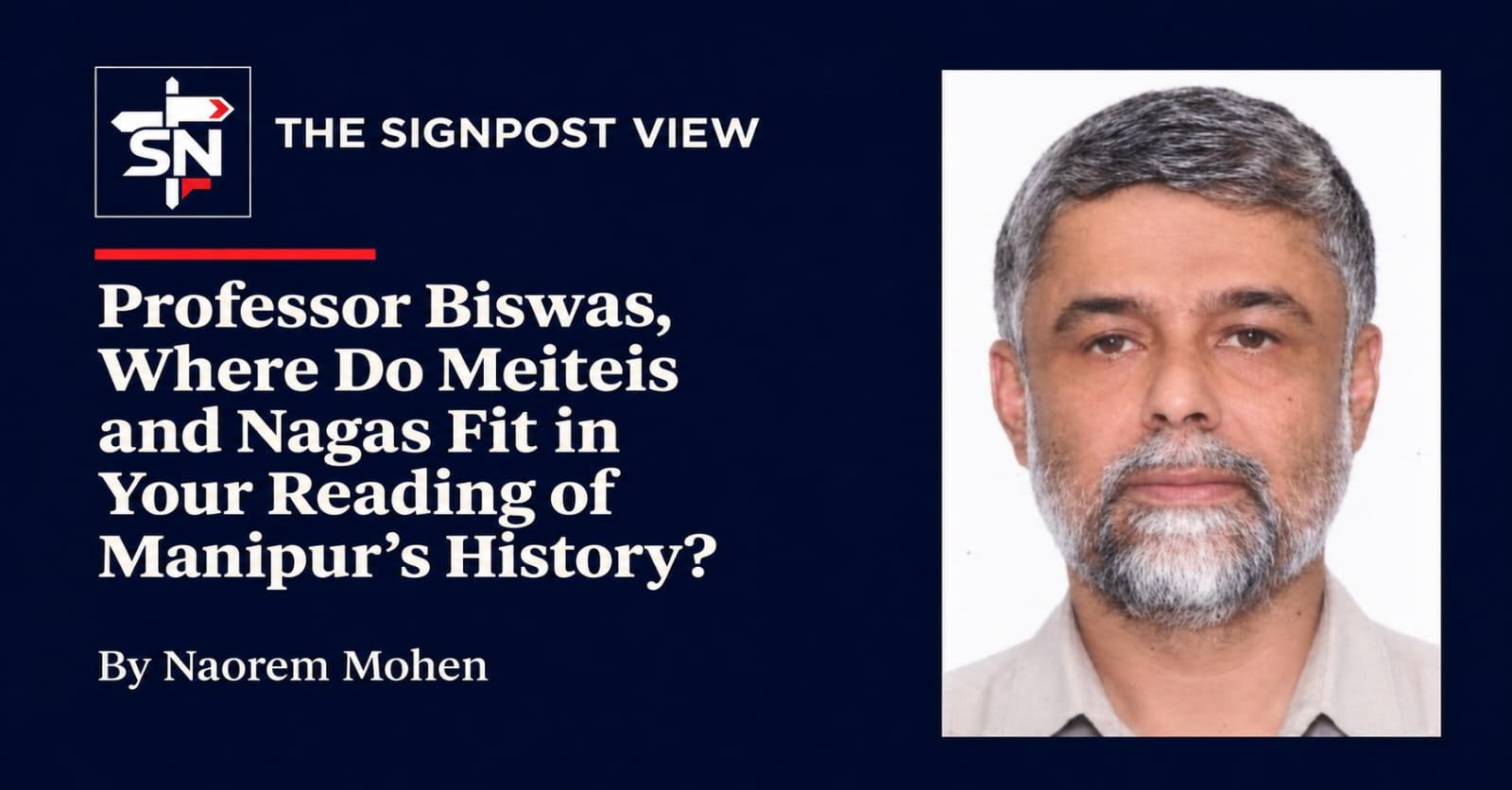
On the day six Liangmai Naga civilians were laid to rest, Prasenjit Biswas made the case in Delhi for a separate administrative arrangement. He should explain what it would mean for Naga villages, displaced Meitei families and the land both communities are asking to protect.
On November 16, six Liangmai Naga civilians were finally laid to rest in Konsakhul. They had been abducted in May, and their bodies were found in June. That same day, at a programme in New Delhi organised by the Kuki-Zo Women’s Forum, North-Eastern Hill University academic Prasenjit Biswas argued for a separate administrative arrangement for Kuki-Zo-inhabited areas. He said Manipur could remain intact and the interests of other communities could be safeguarded. What would that promise mean to the families burying their dead in Konsakhul? What would it mean to the Meitei families still asking when they can go home?
Prasenjit Biswas, you raised serious concerns about violence, displacement and inadequate public services in the hills. Your proposal asks people to accept a change in who could govern parts of Manipur. That makes it reasonable to ask whose experiences informed your conclusion. Which Meitei and Naga families did you hear from, and what changed in your proposal because you heard them?
Seventy years outside the Scheduled Tribes list
The 1956 revision listed 29 Scheduled Tribes in Manipur. The Meitei community as a whole was outside that list then and remains outside it seven decades later. The demand for recognition has a documented political history of its own. It was discussed in the Manipur Assembly in 1981. An organised campaign submitted a memorandum to the governor in 2012, and the Union Ministry of Tribal Affairs wrote to the state the following year. What weight did you give this longstanding grievance before making the case for a new constitutional arrangement?
For many Meiteis, the future of their community is tied to the political continuity of Manipur. Meitei kings governed the kingdom for centuries, and the princely state merged with India in 1949. Today that history sits alongside a practical fear. Displaced Meitei families from Churachandpur, Moreh, Torbung and Kangpokpi have asked to return to their original homes. They want to know whether their land and property claims will be heard and whether they can rebuild their lives where they once lived. If your proposal changes who governs those places, would those families have a say before decisions about their towns and villages are made?
What does your idea of justice offer the Naga families?
Violence flared around Litan in February 2026. In March, Naga passengers travelling on the Ukhrul–Imphal road were reportedly abducted by suspected armed Kuki volunteers. In the separate May abduction case, the National Investigation Agency’s case summary alleges the involvement of Kuki militants. Six Liangmai Naga civilians were subsequently found dead. Kuki Inpi Manipur expressed condolences to their families and rejected allegations made by the United Naga Council. The families deserve an investigation that establishes who was responsible and brings those responsible to justice.
Prasenjit Biswas, you study the philosophies of Northeast India’s tribal communities. You asked the country to take the suffering of Kuki-Zo civilians seriously. Where, in the published account of your case for separate administration, do the Naga families of Konsakhul find an answer to their grief? What principle of justice would you offer them? What would it require of the authorities when a Naga passenger is abducted on a public road, or when those suspected of a crime come from the community that holds power locally? These families should be able to expect safe passage, an independent investigation and protection from intimidation. Which institution in your proposal would guarantee those rights?
Prasenjit Biswas, who gets a say when land is on the table?
COCOMI’s November 18 statement raises a question that goes to the heart of your argument. What evidence shows that granting separate administration would end the violence? You called for constitutional protection of community rights over forests, rivers and minerals. At the same Delhi event, Kuki National Organisation spokesperson Seilen Haokip told PTI that land, forests and resources were already among the subjects discussed with the Centre. The United Naga Council and other Naga organisations had asked the Prime Minister for a guarantee that any new territorial arrangement would leave Naga ancestral lands outside its jurisdiction. The people affected are entitled to know which lands are under discussion, who is being consulted and how objections will be decided.
The organisers in Delhi called for a Union Territory with a legislature. You proposed drawing on Articles 239A and 244A and the Sixth Schedule while keeping Manipur intact. Article 239A’s text concerns a legislature or council of ministers for Puducherry. Article 244A provides for an autonomous state within Assam. The Sixth Schedule applies to tribal areas in Assam, Meghalaya, Tripura and Mizoram. Manipur has its own Hill Areas Committee under the Article 371C framework and district councils under a separate law. Spell out which powers you would transfer, which legal changes would be required and why strengthening Manipur’s existing institutions would fall short.
The government owes an answer on civilian safety
COCOMI also pressed the government on the Suspension of Operations pact. Manipur Home Minister Govindas Konthoujam said the pact expired on September 4. Haokip told PTI it had not been formally extended but continued in practice. The Centre and the state should explain what arrangements they are applying, who monitors compliance and what action follows when civilians are attacked. A Naga passenger taking the Ukhrul–Imphal road or a Meitei family trying to return home needs to know which authority will keep them safe and act if they are threatened.
The Signpost View opposes an ethnically defined separate administration as the answer to Manipur’s conflict. Redrawing boundaries while families are displaced risks making their absence count against them. The Centre and the state should investigate attacks on civilians, protect travel on public roads, set up a credible process for property claims and publish village-level plans for safe, voluntary return. They owe the Meiteis an evidence-based response to their demand for safeguards and the Nagas a direct answer on civilian security and ancestral land.
Prasenjit Biswas, put your proposal in writing. Show which villages it would cover, whose consent it would require and what protections residents could enforce. Tell the Naga families of Konsakhul what your idea of justice offers them. Tell displaced Meitei families who will hear their claims and guarantee their safety if they go home. Until you can answer those families, you have yet to make the case that your proposal would bring peace to Manipur.