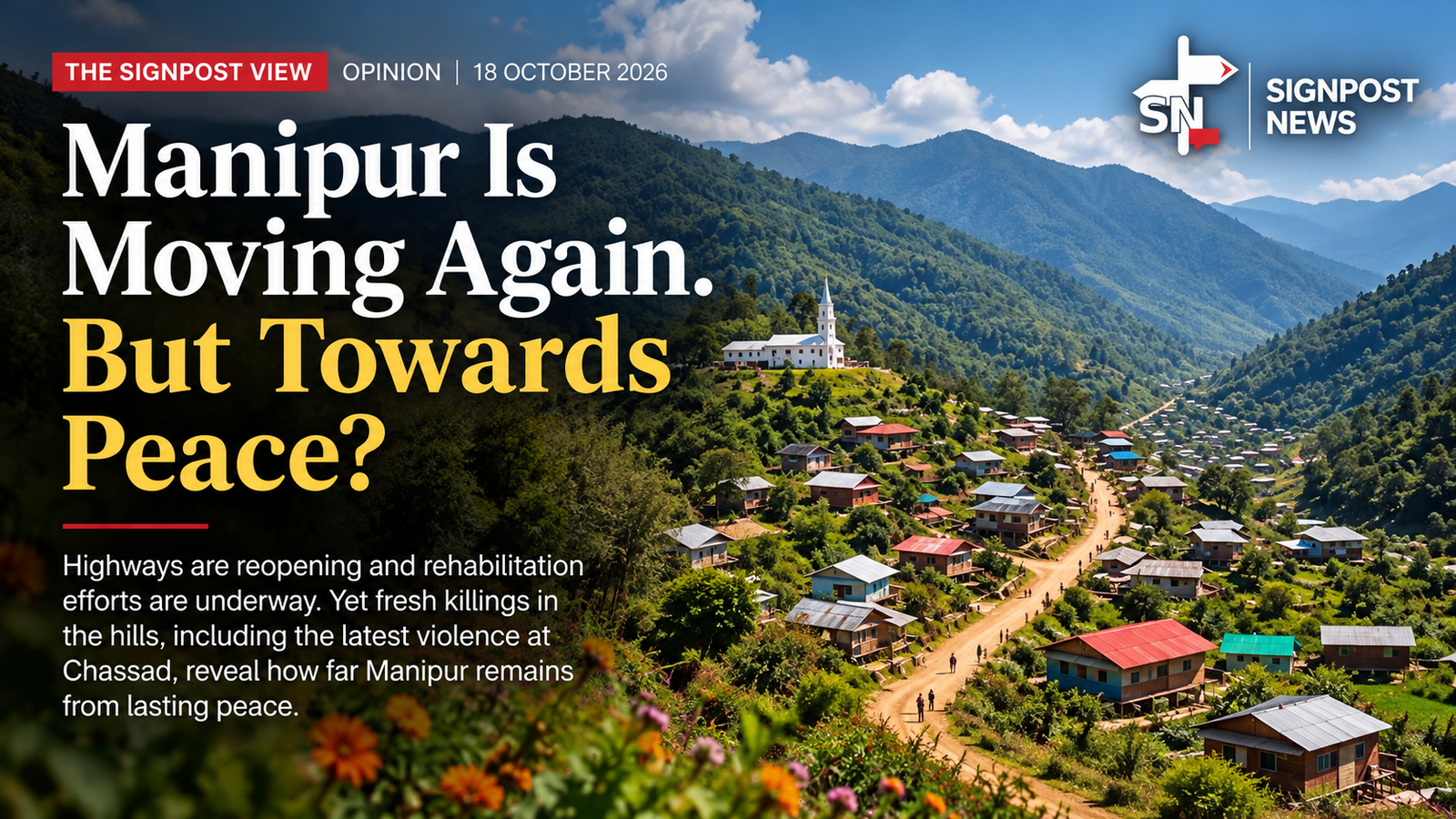
Highways are reopening, government programmes are reaching communities and efforts to rehabilitate displaced families are underway. However, fresh killings in the hills, including the latest violence at Chassad, reveal how far Manipur remains from lasting peace.
Manipur is moving again. Buses are returning to roads that remained uncertain for years. Government officials are travelling to places that had become difficult to reach. Development programmes are being announced, welfare assistance is being distributed, and political leaders are speaking with renewed confidence about reconciliation and the return of normal life.
But on Saturday, October 17, another family in Manipur lost a loved one to gunfire.
At Chassad village in Kamjong district, Seikhohao Haokip was killed and four others were injured in a fresh exchange of fire. The incident came barely a week after nine people were killed in renewed violence across the hill districts of Kamjong, Kangpokpi and Ukhrul.
This is the contradiction confronting Manipur today. The State is making visible efforts to recover from the conflict that began on May 3, 2023, yet fresh violence continues to interrupt that recovery. One part of Manipur speaks of reopening roads and rebuilding lives, while another is preparing for funerals.
Both realities exist at the same time.
It would be unfair to dismiss every government initiative simply because violence has not ended. But it would be equally unfair to describe Manipur as returning to normal while people continue to be killed and families remain unable to return home.
The question before the government, political leaders and the people is no longer whether Manipur has begun moving again.
It is whether that movement is taking the State towards lasting peace or merely towards another uncertain period between episodes of violence.
Chassad and the growing cost of recurring violence
The latest incident at Chassad deserves more than another routine expression of condemnation.
Reports from October 17 identified the deceased as Seikhohao Haokip, a resident of Chassad. Among the injured were village chiefs and representatives of local village authorities. They were reportedly taken for treatment at an Assam Rifles medical facility. Accounts of what triggered the firing differ, with allegations exchanged between groups involved in the continuing Naga-Kuki tensions. The responsibility and circumstances require an impartial investigation.
What cannot be disputed is that another life has been lost.
The October 17 killing followed the deadly incidents of October 9 and 10, when nine people were reported killed across three hill districts. The victims included members of Naga and Kuki communities as well as a person of Nepali origin. Homes were reportedly destroyed, families were displaced, and tensions disrupted movement along important routes.
These incidents reveal a disturbing reality. Manipur is still facing armed confrontations that can turn ordinary village life into a security emergency within minutes.
For those living in vulnerable areas, the questions are painfully practical. Can they travel to another village? Can they repair an electricity line? Can they visit a market or take an injured family member to hospital without fearing an attack?
Such questions should not remain unanswered more than three years after the original conflict erupted.
Political leaders have repeatedly appealed for restraint. Security forces have been deployed, and investigations have been announced following major incidents. Yet the recurrence of violence demands an examination of whether existing arrangements are sufficient, particularly in remote villages and areas where armed groups remain active.
There is also a danger that Manipur is becoming accustomed to counting casualties.
One person killed, four injured. Nine killed in earlier clashes. Another village under tension. Another condemnation. Another appeal for peace.
Behind each number is a human life, a family and a community forced to carry the consequences.
A death should never become less significant simply because the State has experienced so many before it.
Reopening National Highway 2 is an important beginning
Amid these troubling developments, the government’s efforts to restore movement along National Highway 2 deserve recognition.
During his visit to Senapati district on October 15, Chief Minister Yumnam Khemchand Singh acknowledged the economic damage caused by the prolonged crisis and appreciated the cooperation of communities in Maram, Tadubi and Mao in restoring freer movement along the highway.
The Chief Minister also cited an estimated loss of approximately ₹1,200 crore in Goods and Services Tax revenue during the years of ethnic conflict, underlining how severely the disruption of transport and commerce had affected Manipur.
For a landlocked State like Manipur, roads are not merely transport infrastructure. They are economic lifelines.
The movement of food, medicine, fuel, construction materials and essential commodities depends heavily on the highways connecting Manipur with the rest of India. Every prolonged blockade affects ordinary households, traders, farmers, transport workers and students.
The restoration of road movement can therefore ease hardship across communities.
It also sends an important message: cooperation remains possible, even when political and social disagreements have not been fully resolved.
Yet the reopening of a highway cannot be treated as proof that reconciliation has already taken place.
A road may be open to vehicles while the villages on either side remain divided by suspicion. Commercial movement may resume even when families are uncertain whether they can travel safely beyond familiar areas.
This distinction matters because genuine peace requires more than the removal of physical barriers.
It requires confidence that movement will remain safe tomorrow, next month and next year, without having to depend on another emergency negotiation.
The unfinished journey of displaced families
There is another test of Manipur’s recovery that receives less attention than political meetings and government programmes: the fate of people still displaced by the conflict.
For thousands of families uprooted since May 2023, normalcy remains an aspiration rather than an experience.
The government has been working on rehabilitation, financial assistance, reconstruction and the phased return of internally displaced persons. These efforts are necessary and should be supported where they deliver meaningful relief.
But rehabilitation cannot be measured only by the amount of money sanctioned or the number of houses identified for reconstruction.
A family returning home must be confident that it will not be attacked again. Children must be able to attend school, parents must have some means of earning a living, and ordinary interaction with neighbouring communities must become possible without the constant fear of confrontation.
Otherwise, rehabilitation risks becoming a physical relocation without genuine security.
Consider what displacement means to a child who has spent important school years away from home. Or to a farmer whose land has remained inaccessible. Or to a small trader whose livelihood disappeared when movement between communities became dangerous.
Their losses cannot be repaired through financial assistance alone.
The government must address those losses through sustained rehabilitation, livelihood restoration, education and dependable protection.
Manipur cannot claim a meaningful return to normalcy while large numbers of its citizens continue to live away from their homes because they fear what may happen if they return.
For displaced families, peace is not an abstract political settlement.
It is the ability to sleep safely in their own homes.
Khemchand’s government faces a difficult responsibility
Chief Minister Khemchand assumed leadership at a time when Manipur’s political institutions were under pressure to restore confidence after prolonged violence and instability.
The government’s efforts to reconnect communities, resume transport, strengthen public outreach and pursue rehabilitation represent necessary steps towards recovery.
But the administration also faces a difficult reality. Even as it attempts to restore normal activities, new incidents of violence continue to test its ability to maintain security.
The Chief Minister’s appeal for peace and cooperation following the latest violence is understandable. Dialogue among political leaders, civil society organisations and community representatives is essential in a State where mistrust has become deeply entrenched.
But dialogue and security must advance together.
Communities will find it difficult to rebuild confidence if armed groups can continue threatening villages, disrupting movement and attacking civilians.
A major responsibility of the government is therefore to ensure that security arrangements are not merely reactive. The deployment of additional personnel after an incident may help prevent immediate escalation, but lasting public confidence requires preventive intelligence, reliable protection and accountability for perpetrators.
There must also be clarity about the role of armed groups operating in different areas.
Whether violence occurs in a Naga village, a Kuki settlement or a Meitei locality, the obligation of the State remains the same. Civilians must receive equal protection under the law.
Any perception that security responses depend on community identity or political influence will only deepen mistrust.
The government should therefore make greater efforts to explain the preventive measures being taken, the progress of investigations and the protection available to vulnerable settlements.
Restoring confidence is not only a matter of assuring people that peace will return. It is also a matter of demonstrating that the State can protect them while that peace is being rebuilt.
The danger of another conflict within the larger conflict
One of the most concerning features of Manipur’s present situation is the widening nature of insecurity.
The violence that erupted in May 2023 was principally associated with the Meitei-Kuki conflict. More recent incidents involving Naga and Kuki communities have introduced additional tensions into an already fragile situation.
The deaths reported in Kamjong, Kangpokpi and Ukhrul during October demonstrate the danger of allowing local disputes, armed mobilisation and longstanding grievances to develop into renewed confrontation.
Manipur’s communities have different histories, political aspirations and concerns relating to land, identity and security. Those differences cannot simply be wished away.
But they must not become justification for attacks on civilians or the use of armed force.
Each additional confrontation makes reconciliation more difficult. It creates fresh victims, new grievances and another generation of families who may associate neighbouring communities with fear and loss.
The State must resist the possibility of violence spreading from one area or community relationship into another.
The protection of smaller and vulnerable settlements deserves particular attention. Communities living near disputed boundaries or in remote areas should not have to organise their everyday lives around the possibility of armed confrontation.
Nor should the government allow allegations exchanged by rival groups to determine its response before investigations establish the facts.
The killings at Chassad and elsewhere require more than political condemnation. They require investigations capable of identifying responsibility, holding perpetrators accountable and reducing the risk of retaliation.
Manipur has already witnessed how rapidly one incident can generate another.
Preventing that cycle must remain a priority.
Government programmes must be measured by results
Public welfare initiatives, development announcements and outreach programmes are important elements of recovery. Many families in Manipur have experienced financial hardship, interrupted education and reduced access to public services since 2023.
Efforts to provide assistance, restore institutions and encourage economic activity should therefore not be dismissed merely because they originate from a particular government or political party.
At the same time, public programmes cannot become a substitute for measurable improvements in people’s lives.
The State needs clear and accessible information on rehabilitation, financial assistance, reconstruction and security.
How many internally displaced families have returned permanently? How many damaged homes have been reconstructed? How many families remain unable to access their land or livelihoods? How many investigations into civilian killings have resulted in chargesheets or other concrete legal progress?
These are questions that should be answered through regular public reporting.
The approaching 2027 Assembly election gives these issues additional importance, but they should not be reduced to electoral arguments.
The government has a responsibility to explain what it has accomplished and what remains unfinished. Opposition parties have an equally important responsibility to examine that record seriously and present workable alternatives.
Manipur’s people need a political conversation grounded in their everyday difficulties rather than one dominated entirely by accusations, counter-accusations and claims of credit.
Political competition is part of democracy. But the protection of civilians, restoration of livelihoods and rehabilitation of displaced families must remain responsibilities that extend beyond party differences.
Condemnation cannot remain the final response
Manipur has heard many condemnations since May 2023.
Whenever someone is killed, statements arrive from political leaders, organisations and public representatives. The language is often familiar. The incident is condemned, the bereaved family is offered sympathy, an investigation is demanded and an appeal for peace follows.
These responses have their place. Silence in the face of violence would be unacceptable.
But repeated condemnation without visible accountability raises difficult questions about the effectiveness of the wider response.
The people of Manipur are entitled to know what happens after an incident leaves the headlines.
Were the attackers identified? Were arrests made? Was the security arrangement reviewed? Were vulnerable areas provided with additional protection? Were families assisted, and were measures introduced to prevent similar attacks?
The questions are not directed at one politician or one government alone. They concern the responsibility of every institution entrusted with public safety.
There must be a difference between responding to violence and preventing its recurrence.
After years of conflict, Manipur deserves a response that does not begin and end with an expression of sorrow.
Manipur cannot remain suspended between hope and fear
Perhaps the most troubling consequence of prolonged conflict is the way insecurity begins to appear ordinary.
People learn which roads are considered safe. Parents worry when their children travel beyond familiar areas. Traders calculate the possibility of disruption before moving goods. Families delay decisions about education, marriage, employment or rebuilding their homes because they do not know what the next month will bring.
A week without major violence begins to feel like progress.
And then another incident occurs.
This is not the normal life that the people of Manipur deserve.
The October 17 killing at Chassad has once again exposed the distance between political assurances and the experience of those living in areas affected by armed confrontation.
It should also remind the government that restoring normalcy is not a single achievement to be announced. It is a condition that must be sustained.
A highway must remain open. A village must remain safe. A family must be able to return home. A student must be able to continue an education without interruption. A farmer must be able to cultivate land without fear.
Only when such conditions become dependable can the State begin speaking of recovery with greater confidence.
The question Manipur must now answer
Manipur today presents two realities.
One is a State attempting to recover, with renewed government activity, functioning roads, public assistance and efforts to reconnect communities.
The other is a State where armed violence still claims lives, displaced families remain uncertain about their future, and deeply rooted mistrust continues to obstruct reconciliation.
Recognising the first reality does not mean ignoring the second. Acknowledging the second does not require dismissing every positive initiative.
What Manipur needs is an honest assessment of both.
The killing at Chassad on October 17 should not be remembered merely as another entry in the continuing record of violence. It should force public institutions to examine what must change so that vulnerable communities are no longer exposed to recurring attacks.
The government’s efforts to restore movement and rebuild confidence deserve serious consideration. So do the concerns of those who continue to live with fear.
The success of Manipur’s recovery cannot ultimately be measured by the number of political meetings, public programmes or official announcements.
It must be measured by the lives protected, the families reunited, the homes restored and the confidence that ordinary people can once again place in their future.
Manipur is moving again. That is important. But the real achievement will come when every community can move without fear, every displaced family has a safe path home, and the death of another civilian no longer interrupts the State’s hope of peace.
Until then, Manipur has begun its journey towards recovery, but it has not yet reached peace.