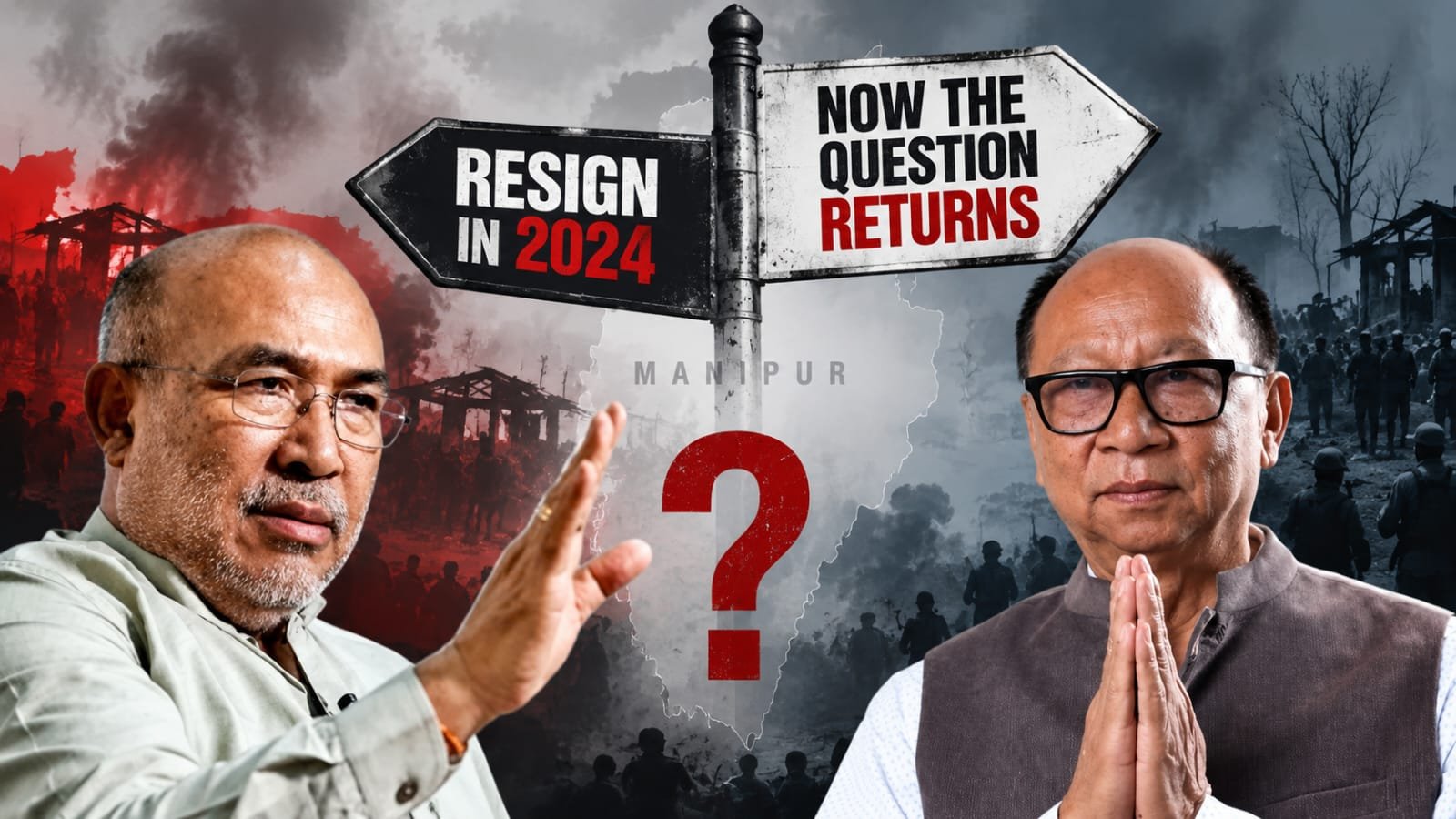
The issue is not whether CM Khemchand Singh should resign, or whether N. Biren Singh was right or wrong. It is about political accountability, the burden of the Chief Minister’s chair, and how differently that burden can look depending on which side of the chair one is standing.
Politics has a long memory. Sometimes, words spoken from one side of power return when the speaker himself occupies the chair he once questioned. Manipur is witnessing such a moment today.
In November 2024, Yumnam Khemchand Singh was a minister in the government headed by N. Biren Singh. Manipur had already endured around 18 months of violence, displacement and deep social division. Khemchand had emerged as one of the most outspoken critics of Biren within the ruling establishment. He did not merely express dissatisfaction with the situation. He questioned why Biren continued as Chief Minister when peace had not returned.
“I asked him to resign a couple of times, but he is not putting down his papers,” Khemchand said at the time. Then came the sentence that has acquired an entirely different significance today: “He could not bring peace till now, so why isn’t he resigning?” Contemporary reporting recorded those remarks, and The Indian Express later described Khemchand as a key internal critic whose opposition contributed to mounting pressure on Biren’s leadership.
Khemchand’s disagreement was not confined to a passing remark. He had skipped a meeting of MLAs called by Biren to discuss the law-and-order situation and questioned why legislators were being summoned instead of the Director General of Police and Chief Secretary if law and order was really the issue. By February 2025, according to various National Media reports, Khemchand had gone to Delhi and warned the BJP leadership that the government could collapse unless the Chief Minister was replaced. Biren resigned on February 9, 2025.
Much has changed since then.
President’s Rule followed Biren’s resignation and continued for nearly a year. On February 4, 2026, Yumnam Khemchand Singh was appointed Chief Minister. The official Manipur Gazette records that he entered office at 6 pm that day. An elected government had returned to Manipur, and the minister who once asked why the Chief Minister had not resigned was now sitting in the same chair.
That reversal would have remained merely an interesting chapter in Manipur’s political history if peace had returned. It has not.
On September 26, Save Indigenous People of Manipur (SIPOM) demanded Khemchand’s resignation, alleging that the present government had failed to protect indigenous communities and had not adequately addressed continuing violence and illegal immigration. Its memorandum refers to killings involving members of several communities, attacks on villages and the burning of houses before concluding that the present government should not continue if it cannot protect indigenous people. These are SIPOM’s allegations and conclusions and must be understood as such, rather than treated automatically as independently established findings. But the political demand itself could hardly be clearer: the organisation wants the Chief Minister to step down.
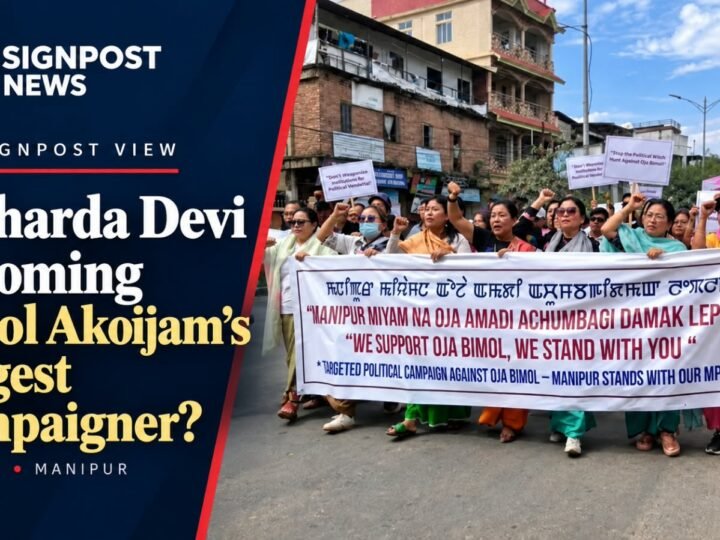
SIPOM is also not speaking in a vacuum. Earlier this month, women from Meitei and Naga communities joined a protest demanding justice and accountability over killings and disappearances. The protest included civil organisations such as SIPOM and the Joint Tribe Council, and participants publicly questioned the government’s response to continuing violence. Their specific allegations against security forces and armed groups remain disputed and require investigation, but the protest itself reflected something the government cannot ignore: frustration over security and justice remains alive on the ground.
And this is where Khemchand’s words from 2024 become difficult to escape.
When Khemchand questioned Biren Singh, he effectively placed a standard of political accountability before the public. His argument was simple enough for anyone to understand: if violence continues, peace does not return and the law-and-order situation remains deeply disturbed, the Chief Minister can be asked why he continues in office. That argument sounded powerful when Khemchand was standing outside the Chief Minister’s chair. The question today is what happens to that principle when he is sitting in it.
The comparison must nevertheless be fair. When Khemchand made those remarks in November 2024, Biren Singh had been Chief Minister throughout roughly 18 months of the conflict that began in May 2023. Khemchand has been Chief Minister only since February 4 this year. Their periods of responsibility are not identical. Nor did Khemchand create every problem his government inherited. He assumed office in a state already fractured by years of violence, displacement, mistrust, armed activity and severely damaged relations between communities. Any assessment of his government that ignores that inheritance would be incomplete.
There have also been efforts by the present government to address some of Manipur’s concerns. Khemchand has publicly called for communities to set aside political differences and work together to restore peace, while his government has engaged the Centre over issues raised within the state. Those actions deserve to be acknowledged alongside criticism of his administration.
But governments are ultimately judged not merely by appeals, resolutions, meetings or condemnations. They are judged by what citizens experience outside government offices: whether people can travel safely, whether families displaced by violence can return home, whether villages feel protected, whether armed groups and weapons are effectively controlled, whether perpetrators are brought to justice and, most fundamentally, whether people have stopped dying.
That brings us back to the question Khemchand himself once asked.
If continuing violence and failure to restore peace were grounds for questioning Biren’s continuation as Chief Minister, what standard should be used to judge Khemchand’s government today? How much time should any Chief Minister reasonably be given? What measurable improvement constitutes the restoration of peace? How many displaced families must return home before rehabilitation can be called successful? When will citizens be able to travel from one part of Manipur to another without wondering whether their identity places them in danger? How effectively are cadres, armed groups and weapons being monitored?
These questions are more important than political slogans because they give the people something against which governments can actually be measured.
There is also a larger lesson for Manipur’s political class. Political accountability cannot depend entirely upon who occupies the chair. A politician cannot establish one standard while questioning another leader and then expect that standard to disappear when he acquires power himself. Equally, opponents cannot ignore differences in tenure, circumstances and actions simply because an old quotation provides a convenient political weapon. Accountability has meaning only when the principle survives changes of personality.
I also want to make my own position clear. I am neither blaming Yumnam Khemchand Singh for everything that has happened under his government nor using this argument to defend or support N. Biren Singh. Manipur’s conflict is far too complicated to place every killing at the door of one Chief Minister, whether that Chief Minister is Biren or Khemchand. Those who commit violence must answer for their actions. Governments, meanwhile, must be judged on what they do to prevent violence, protect citizens, investigate crimes and restore normalcy.
What interests me is the extraordinary reversal of circumstances.
I sometimes wonder how N. Biren Singh must view the situation today. When he was Chief Minister struggling to restore peace, one of his own ministers publicly asked why he had not resigned. That minister was Yumnam Khemchand Singh. Today, Khemchand occupies the same chair and is discovering how difficult that chair becomes when violence continues and public patience begins to run out. Civil society organisations and sections of the public are now directing towards him the same fundamental question of political responsibility that he once directed towards Biren.
There is an irony here, but it should not be reduced to political point-scoring. Perhaps it tells us something much deeper about the burden of governing Manipur during a conflict. It is easier to stand outside the Chief Minister’s office and ask why peace has not returned. It is altogether different to sit in that office and discover that every fresh killing, every displaced family, every village attack and every security failure eventually reaches the Chief Minister’s door, whether or not he personally caused it.
That is why I do not see this merely as a Biren-versus-Khemchand story. Nor should it become an argument about which of the two leaders deserves sympathy. This is about the office, the responsibility that comes with it and how differently political accountability can look depending on which side of the Chief Minister’s chair one is standing.
In November 2024, looking at a Manipur where peace had still not returned, Yumnam Khemchand Singh asked of N. Biren Singh: “He could not bring peace till now, so why isn’t he resigning?”
Today, that question has travelled back to its author under very different circumstances.
According to Signpost News’ documented count, 65 lives have been lost since Khemchand became Chief Minister. SIPOM has now explicitly demanded his resignation. Other civil society voices have demanded accountability over continuing killings. The circumstances are not identical to those Biren faced, and none of this automatically means that Khemchand should resign. But it does mean that the standard he once invoked deserves to be remembered.
So the question I am asking is not whether Khemchand must resign.
And I am certainly not arguing that Biren was right and Khemchand was wrong.
My question is simpler.
When Khemchand asked Biren to resign because peace had not returned, did he imagine that one day he might occupy the same chair and face the same question himself?
Perhaps N. Biren Singh understands better than most what that feels like.
And perhaps Yumnam Khemchand Singh understands it now.
So whom will he blame now?
Manipur has heard enough blame.
It deserves an answer.