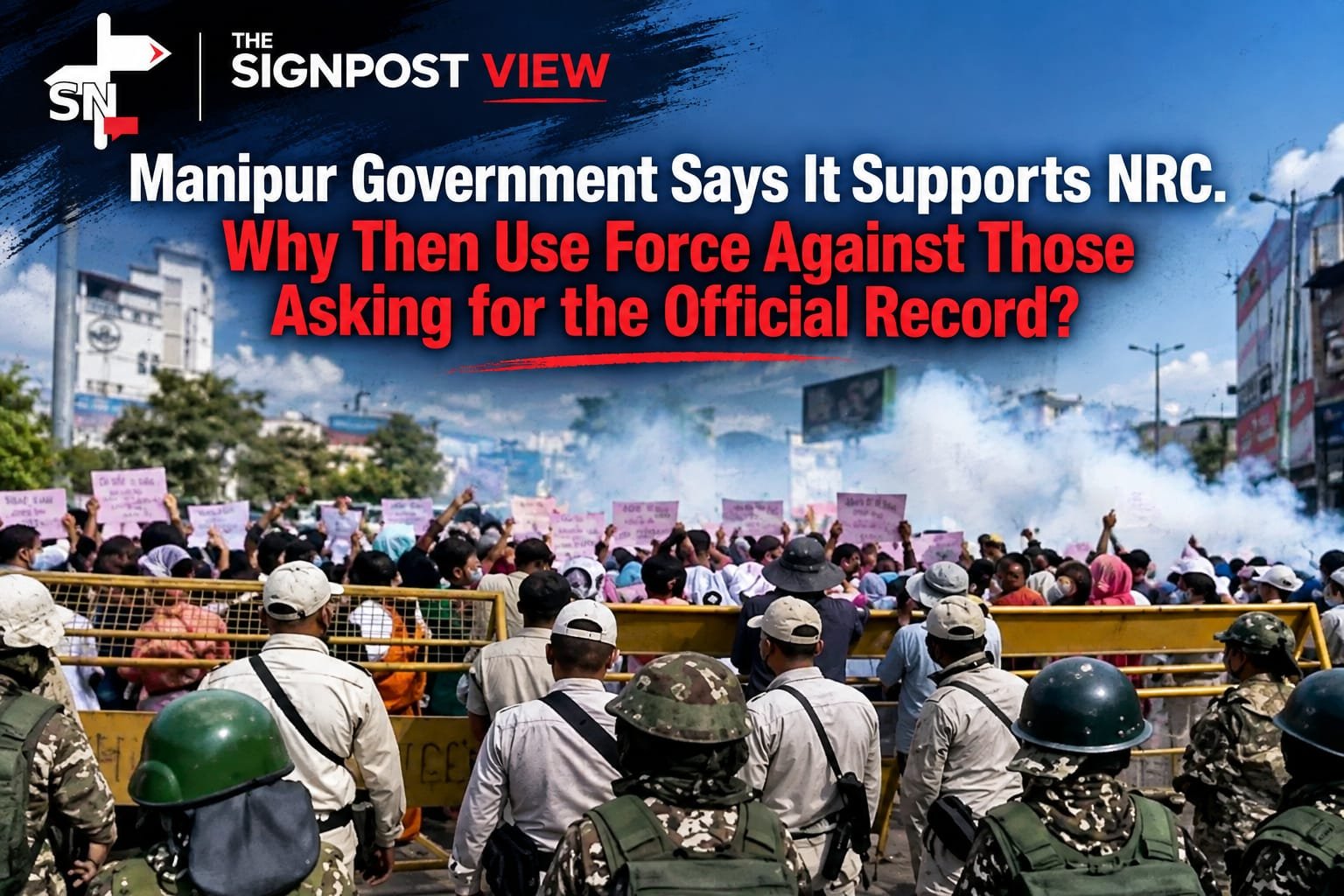
The women who marched through Imphal on September 27 were asking for more than another assurance on the National Register of Citizens. They wanted to know what the Manipur Government has actually done. That question now lies at the heart of the NRC debate.
The Women’s Wing of the Campaign for Just and Fair Delimitation marched from Citizens’ Club at Soibam Leikai towards the Chief Minister’s bungalow, pressing the Government for a concrete response to its demands. The protesters called for the Census to be deferred until the NRC is updated, for 1951 to be adopted as the base year for the NRC, and for internally displaced persons to be resettled before the Census is conducted.
They marched under the slogans “No NRC, No Census,” “NRC with 1951 as the Base Year” and “No IDP Settlement, No Census.” JFD has also sought a clear government position by September 30 and, as part of its wider campaign, has called for a comprehensive White Paper on NRC updation.
Security forces stopped the march near Palace Compound. When the protesters continued seeking an audience with Chief Minister Yumnam Khemchand Singh, security personnel dispersed the gathering using tear gas. Ukhrul Times also reported the use of mock bombs and said two protesters sustained injuries. Other local reports confirmed the use of tear gas, though accounts differ on the number of people injured.
The circumstances of Sunday’s confrontation deserve a proper official account. But the incident also raises an uncomfortable question. When the State Government and leaders of the ruling party have publicly spoken in support of an NRC in Manipur, why should protesters seeking concrete documents and assurances from that same Government have to face force on the streets?
The contradiction deserves an answer. Supporting the NRC in public statements is one thing; showing what has formally been communicated to the Government of India is another. The protesters were asking the Government to make that position clear through the official record. And that brings the issue back to the question that should now be answered without ambiguity:
What exactly has the Manipur Government formally asked the Government of India to do?
The question has acquired greater urgency with JFD setting September 30 as the deadline for a clear response from the State Government. The organisation has been pressing for the NRC demand to move beyond political assurances and be pursued institutionally.
One official document is already available. On September 5, the Ministry of Home Affairs, through the Office of the Registrar General of India, issued Gazette Notification S.O. 4917(E), deferring the houselisting operations for Census 2027 in Manipur “till further declaration.”
The notification is important, but its scope needs to be understood precisely. It does not announce an NRC for Manipur, prescribe 1951 as the base year or set out a framework for conducting an NRC. Its operative provision concerns the houselisting operations for Census 2027. That distinction should not be lost in political speeches, protest slogans or headlines.
Three Assembly resolutions, but the question has moved forward
Manipur already has a legislative position on the NRC. The Legislative Assembly adopted a resolution on the issue on August 5, 2022, and reaffirmed it on March 1, 2024. On September 2 this year, the House again passed a resolution urging the Government of India to update the NRC in Manipur before conducting the Census.
The latest resolution establishes the position of the elected House. But it also leaves an important question unresolved.
The September 2 resolution did not specify 1951 as the base year. Opposition members had sought the insertion of 1951, but the resolution ultimately adopted by the House reaffirmed the earlier resolutions and urged the Centre to update the NRC before the Census.
JFD’s present demand is therefore more specific than the wording adopted by the Assembly: it wants an NRC with 1951 as the base year.
The difference is not incidental. It should be clearly understood in any public discussion of what the Assembly has resolved and what JFD is now demanding.
The missing document
The debate has reached a point where another resolution or verbal assurance may no longer answer the questions being raised.
The Government has previously said that it pursued the NRC issue with the Union Government through correspondence. Government representatives have also publicly stated that the matter requires consideration at different levels.
What is missing from the public discussion is the documentary trail.
Has the State Government formally asked the Ministry of Home Affairs to conduct an NRC in Manipur? Did that request specifically propose 1951 as the base year? If such a proposal was sent, when was it made? Was it sent before or after the September 2 Assembly resolution? And has the Centre replied?
There is another question that cannot be separated from the present circumstances: what has the State communicated to the Centre about displaced people whose ordinary places of residence have been disrupted by more than three years of conflict?
These are questions of record, not political interpretation. If such correspondence exists, placing its essential contents in the public domain would provide greater clarity than another round of competing political claims.
Houselisting deferment is not NRC approval
The September 5 Gazette notification should be read for what it actually says. The Central Government has deferred the houselisting operations for Census 2027 in Manipur until a further declaration. That is the decision contained in the notification.
It should not, by itself, be treated as evidence that New Delhi has approved an NRC for Manipur. Nor should the deferment be presented as Central acceptance of 1951 as an NRC base year unless such a decision is formally issued.
The distinction is more than technical. A deferment of Census houselisting operations is one administrative decision. An NRC would be a separate citizenship-related exercise requiring its own legal and administrative basis. Conflating the two risks creating expectations that the available official documents do not support.
September 30 should become a transparency deadline
JFD has set September 30 as its deadline for a government response. The Government is not obliged to accept every demand made by a civil society organisation. But the NRC issue has already led to three Assembly resolutions, repeated public mobilisation and now confrontation on the streets of Imphal.
That makes the Government’s response all the more important. If the State and its political leadership support the NRC, the strongest response to people asking what has been done is not another slogan or assurance. It is the record of what has actually been sent to Delhi and what, if anything, Delhi has said in return.
The State Government can state what it has formally requested from Delhi, whether 1951 has been proposed as the base year, whether the Centre has responded and what position has been communicated regarding the enumeration of displaced people. It can also make clear that the NRC demand and the Census houselisting deferment are two separate matters unless an official decision establishes otherwise.
Such disclosure would not settle every disagreement over the NRC. Nor would it resolve the larger political and legal questions surrounding citizenship, migration and population in Manipur.
But it would establish something that is presently more important than another assurance: what has actually been decided, what has been requested, and what remains under consideration.
September 30 should therefore become more than another date for statements.
It should become a date for documents.
For a question as consequential as who will be counted, how they will be counted and what citizenship exercise may precede that count, Manipur needs something more durable than statements from podiums.
It needs the official record.