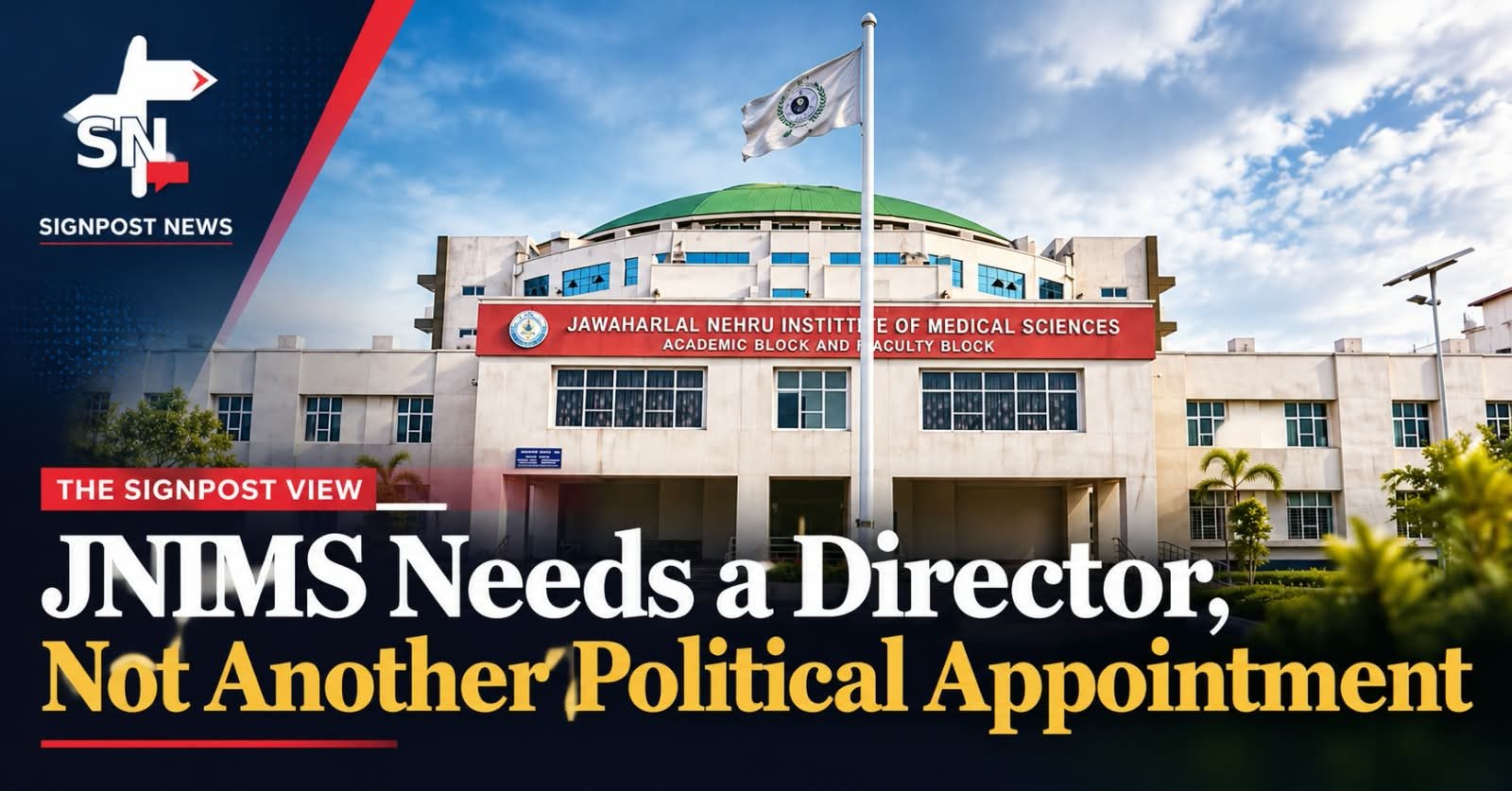
There are appointments that can be treated as routine administrative decisions, and there are appointments that determine whether an institution recovers or slips further into uncertainty. The selection of the next Director of the Jawaharlal Nehru Institute of Medical Sciences (JNIMS) belongs firmly to the second category.
JNIMS is not merely another government office where a change at the top affects a few files and administrative procedures. It is one of Manipur’s major public healthcare institutions, where decisions taken in the Director’s office ultimately affect doctors, nurses, students and, most importantly, thousands of ordinary people who depend upon the hospital for treatment. At such a time, the question before the Government should therefore be simple: who is best qualified to rebuild and lead JNIMS? It should not be who is politically convenient, who enjoys bureaucratic preference, or who has access to the right corridors of power.
The Teachers’ Association of JNIMS has now put this question squarely before the Government. Following the interview held on October 5 for the Director’s post, TA-JNIMS reiterated its longstanding demand that a regular, full-time Director should be selected from among eligible and meritorious faculty members serving in the institute. The Association says that JNIMS has already spent five months under an interim administrative arrangement and needs leadership that understands its problems from within. It also says that on July 22 it submitted to the Health Commissioner a panel of eligible internal faculty members for consideration, while specifically calling for a transparent, objective and merit-based selection.
There is considerable merit in that argument. An institution going through a difficult period cannot endlessly begin from zero whenever its leadership changes. A senior faculty member who has spent years inside JNIMS does not need a briefing to understand which department lacks resources, where administrative bottlenecks lie, what problems affect patient care or why frustration has accumulated among employees. TA-JNIMS argues precisely this: institutional knowledge, readiness to assume responsibility immediately and a demonstrated record of service are advantages that internal candidates bring to the selection process.
But being an insider alone cannot become the qualification for the post. The demand becomes legitimate only when it remains tied to merit, competence, integrity and transparent selection. If the best candidate happens to be from JNIMS, that candidate should not be overlooked merely because someone outside the institution is administratively or politically preferred. Equally, no internal candidate should expect the chair simply because he or she belongs to the institution.
This distinction is important because the controversy is larger than one appointment. According to the Teachers’ Association, JNIMS continues to face unresolved questions relating to employee absorption, Time-Scale Promotion and the National Pension System, along with deteriorating hospital and campus infrastructure, faculty dissatisfaction and attrition. The Association says these matters were also raised in its First White Paper released on August 12. If these problems have indeed remained unresolved despite repeated representations, the Government should respond to them institutionally rather than allowing the Director appointment itself to become another source of confrontation.
The language of the Teachers’ Association’s latest statement shows how serious that confrontation could become. It has warned that, subject to a collective resolution of its members, it is prepared to consider lawful democratic measures including non-cooperation, mass resignation and an agitation it describes as unprecedented in the institute’s history. The final paragraphs goes further, warning that an institutionally unjustified decision could lead to serious escalation while asking the Government to put the future of JNIMS and the welfare of ordinary people above extraneous considerations.
This is precisely where both sides carry a responsibility. Doctors and teachers have every democratic right to question a decision that they believe could damage their institution, but patient care cannot become collateral damage in an administrative confrontation. The Government, on the other hand, carries the much greater responsibility of ensuring that the situation never reaches that stage. Transparency now can prevent distrust later. If a selection process has been conducted, the Government should be able to demonstrate that the person eventually appointed has emerged through clearly defined criteria of merit, experience, administrative capability and institutional suitability.
There is also a broader lesson here for Manipur. Public institutions lose credibility not only when corruption is proved. They also lose credibility when important appointments appear opaque, when unexplained choices create suspicion, and when professionals working inside institutions begin to believe that competence counts for less than connections. Once that perception takes root, even a technically valid appointment becomes difficult to defend. The answer is not another political argument over who should occupy the Director’s chair. The answer is a selection process whose fairness is strong enough to withstand political scrutiny.
JNIMS belongs neither to a political party nor to a particular group of doctors. It belongs to the people of Manipur. The Director’s chair should therefore neither become a reward nor an instrument of administrative accommodation. If JNIMS has eligible internal candidates with the competence, experience and integrity required to lead the institution, their institutional experience deserves serious weight. If the Government chooses otherwise, it owes the institution a convincing and transparent justification.