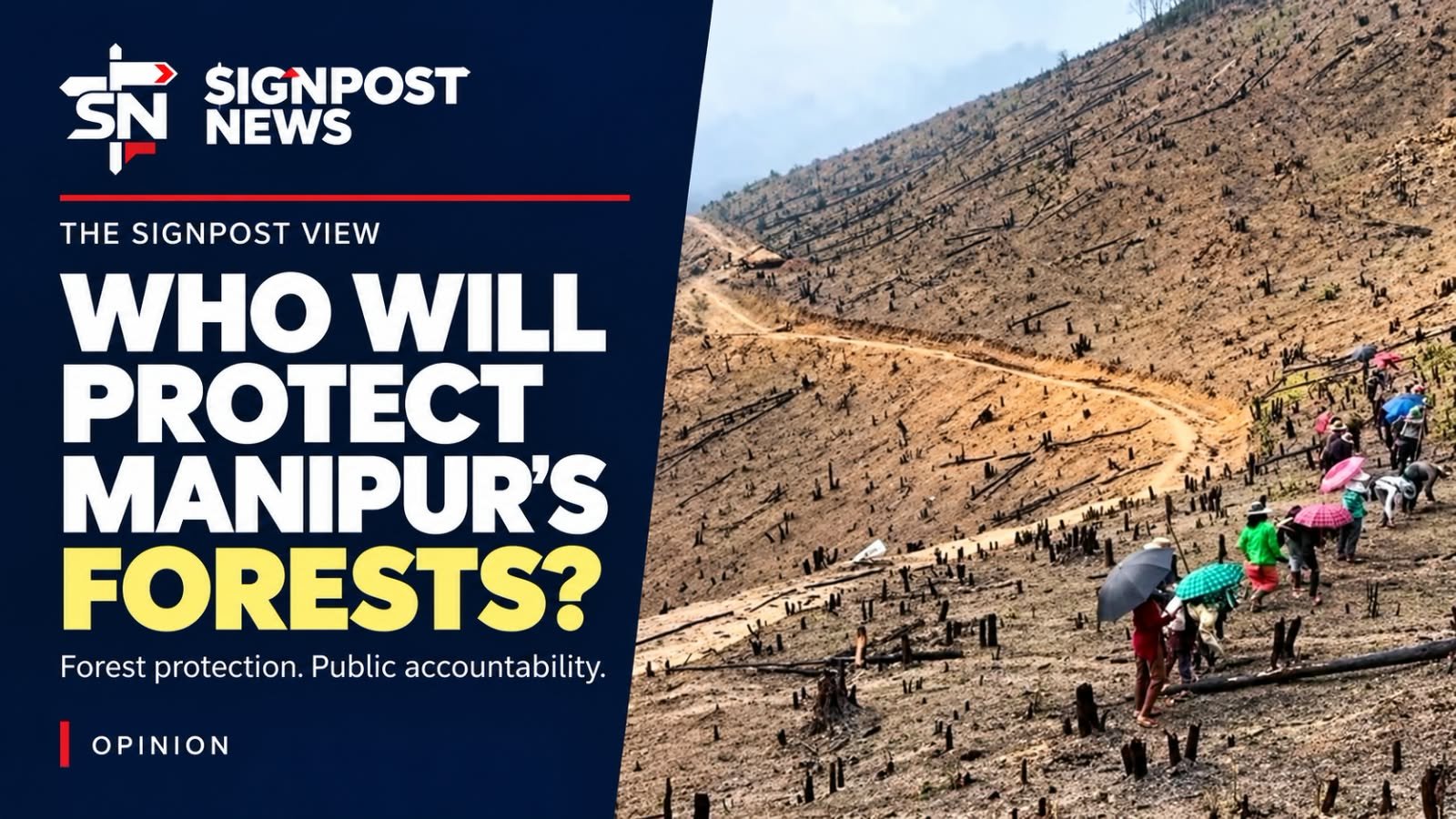
If the authorities can identify land under illegal poppy cultivation, who is responsible for ensuring that cultivation stops? If forests are being cleared and occupied unlawfully, who must prevent the next clearing? These are straightforward questions, yet Manipur continues to receive announcements that leave the public waiting for a complete answer. The Forest Department’s October 9 disclosure that it had identified 307 hectares under poppy cultivation in Senapati, Churachandpur and Chandel districts brings those questions back into focus. Further surveys were underway, and destruction operations were being prepared. Detection is necessary work. What matters now is what follows it.
A forest cannot protect itself after a press conference. Nor does identifying an illegal plantation establish that those responsible have been investigated or that the land will remain free of cultivation next season. The public deserves to know how the administration moves from a survey to enforcement, from enforcement to prosecution, and from a cleared plantation to lasting protection. When that sequence remains unclear, every fresh discovery raises the same concern: are the authorities steadily bringing the problem under control, or repeatedly returning to places where earlier action failed to last?
The responsibility belongs to the government. Forest personnel, police, narcotics agencies and the civil administration have different functions, but citizens should not have to work out which office must act before a hillside receives protection. Coordination must produce a result on the ground. Where access is difficult or security support is required, the government must explain how it intends to overcome those obstacles. An administrative difficulty may explain a delay. It cannot become a permanent answer to continuing destruction.
Detection must lead to accountability
It would be unfair to suggest that nothing is being done. There is documented evidence of anti-drug enforcement, including a March 10 operation in which security forces, the Narcotics Control Bureau and the Forest Department destroyed approximately 10 acres of poppy cultivation between Tingpibung and Leplen villages in Kangpokpi district. These actions deserve recognition. They also show why the public discussion must go beyond asking whether an operation has taken place.
The harder question is what those operations achieve over time. After poppy plants are destroyed, is the land revisited? Does cultivation resume at the same location or move elsewhere? Do investigations identify the people financing the activity and purchasing its produce? How many cases reach prosecution, and what are their outcomes? A campaign cannot be assessed properly if the record ends with the number of acres cleared or people arrested. Those figures describe action taken; they do not, on their own, demonstrate that the underlying business has been weakened.
The newly identified 307 hectares provide a specific starting point for public accountability. The government should publish a follow-up showing the area inspected, the cultivation destroyed, the cases registered and the arrangements for monitoring the sites. Sensitive operational information can be withheld until action is completed. There is still ample room to explain the results afterwards. People should not have to wait for another discovery to learn whether the previous one was addressed.
Forest encroachment also requires precise investigation. The legal status and boundaries of the land must be established, along with the nature of the alleged violation and the people responsible. A disputed boundary, a customary land claim and a verified instance of unlawful occupation should not be treated as interchangeable. Careful identification strengthens enforcement by ensuring that action can withstand scrutiny. Once a violation is established, however, uncertainty elsewhere must not become an excuse to leave it untouched.
Protect the forest beyond the operation
The wider environmental warning is serious. SUHORA’s satellite-based assessment, reported in 2025, estimated that Manipur lost about 21,100 hectares of forest between 2021 and 2025, while approximately 13,000 hectares showed vegetation regrowth. The account identified several pressures, including illegal logging, shifting cultivation, infrastructure development and poppy cultivation. These figures cannot be used to attribute the entire forest loss to poppy. They do establish the need for closer examination of what is happening to the landscape and stronger protection where unlawful clearing is verified.
An effective response must address the different causes rather than allow one to obscure the others. Illegal timber extraction cannot receive less attention because poppy cultivation attracts more publicity. Equally, concern over development-related forest loss cannot diminish the need to act against illicit cultivation. The government should identify the cause of damage at each location and explain the remedy. Otherwise, large figures will continue to circulate while responsibility for particular losses remains difficult to establish.
The reported suspension of 12 frontline staff at the Yairipok Beat Office following allegations of tree felling raises a separate question about the effectiveness of forest protection. An inquiry is underway, and suspension must not be treated as proof of guilt. Its findings should nevertheless be made public, together with the action taken. Accountability must extend to anyone found responsible, while officers performing their duties honestly need the personnel, equipment and institutional support to do their work.
Restoration deserves equally close scrutiny. According to reporting on the October 9 briefing, bamboo plantations were established on approximately 255 hectares of previously cleared poppy land during 2024–25 and 2025–26. That effort should be followed by information on plant survival, protection of the sites and the income available to participating households. Planting is a beginning. Whether the land remains protected and provides a workable livelihood will determine the programme’s lasting value.
Communities have an essential role, but community cooperation cannot substitute for government responsibility. Families being encouraged to move into lawful cultivation need practical support: suitable crops, access to markets and assistance through the period before dependable earnings begin. At the same time, investigations must reach those who organise and profit from the trade. Enforcement that repeatedly reaches the field but fails to follow the financial network will leave a central part of the problem unresolved.
No community should carry collective blame for forest offences or drug trafficking. Responsibility must be established against individuals through evidence. The same standard must apply across districts and irrespective of political influence. This is also how the government earns the cooperation of residents who want their land protected and their children kept away from drugs.
Manipur does not need another declaration whose meaning must be guessed from the next round of headlines. It needs a clear account of who is responsible, what action has been completed and whether that action has lasted. The authorities have identified the latest areas of cultivation. They must now show what happens to them.
Who will stop forest encroachment and illegal poppy cultivation in Manipur? The government must answer through enforcement that lasts—and a public record that proves it.