Words matter, particularly when they appear in a Gazette notification. On September 5, the Government of India did not announce that Census 2027 had been cancelled in Manipur. Nor did it formally say that the population census would not be conducted in the State.
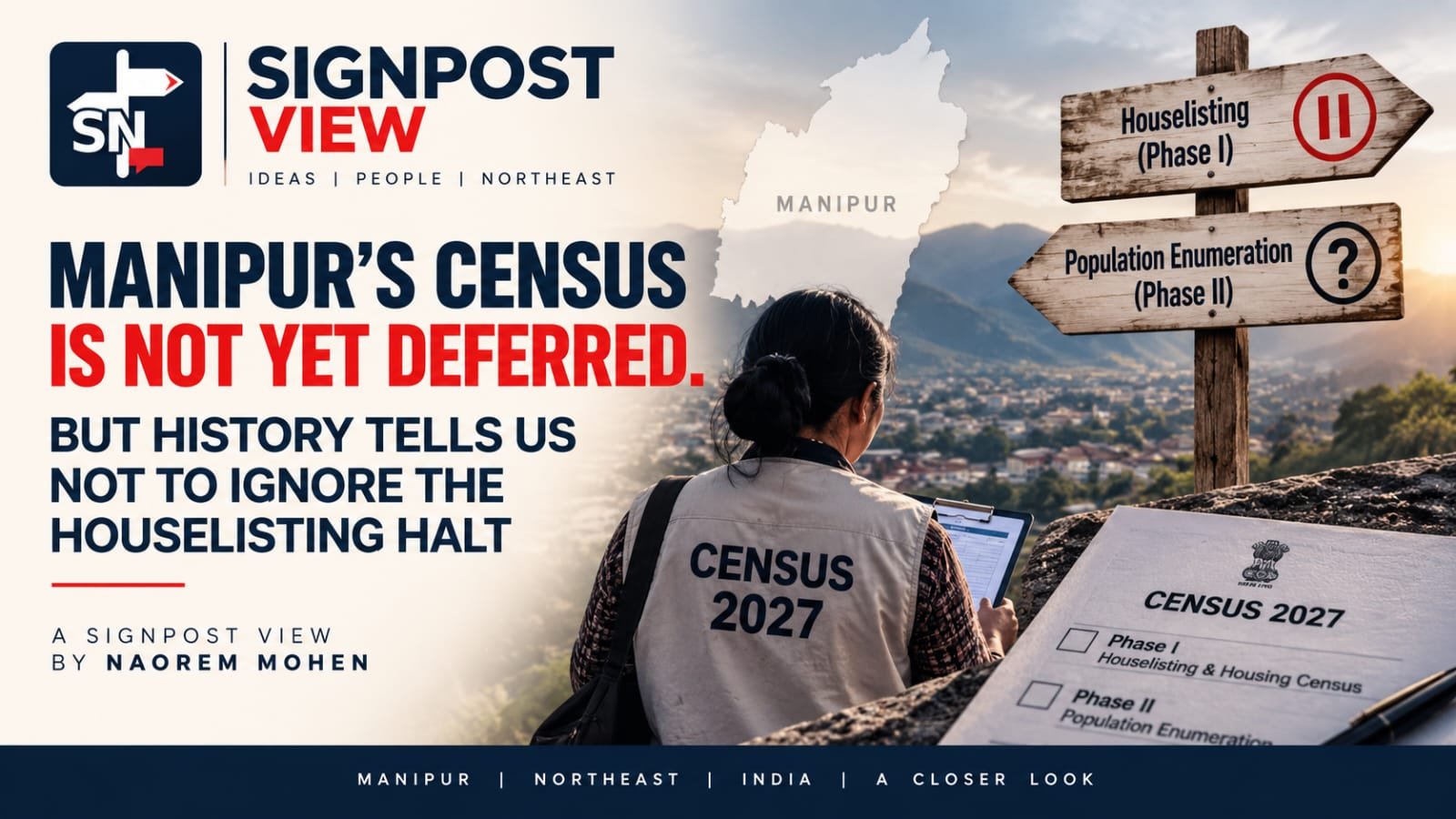
What it did was more precise. The Centre deferred the Houselisting Operations for Census 2027 in Manipur “till further declaration.”
To understand why that distinction matters, one first needs to understand how a Census is actually conducted.
- Before people are counted, their houses are listed
- Census 2027 is being conducted in two major phases.
- Phase I is the Houselisting and Housing Census, or HLO.
Enumerators go from house to house identifying buildings, census houses and households. They collect information through 33 questions covering matters such as the condition and use of the house, drinking-water source, toilet facilities, electricity, cooking arrangements and selected household assets.
But the importance of houselisting goes beyond these questions. It creates the ground-level framework for the next and more familiar part of the Census: counting the population. Think of it simply this way: before the government counts the people, it first maps where the households are.
Then comes Phase II — Population Enumeration.
This is what most people ordinarily understand by the word “Census”. Enumerators count individuals and record demographic, social and economic particulars about the population.
The distinction is therefore straightforward:
- Phase I asks, broadly, where and how households live.
- Phase II asks who and how many people live there, along with their individual particulars.
One prepares the field for the other. This distinction is crucial to understanding what has happened in Manipur.
Houselisting Operations in the State were scheduled for September 1 to September 30, 2026. But through its September 5 notification, the Centre amended the earlier notification governing the exercise and inserted a specific exception:
“except the State of Manipur till further declaration.”
In practical terms, therefore, Manipur has been stopped at Phase I.
The Government has not, at least so far, issued a notification saying that Phase II — the actual population enumeration — will not take place in Manipur.
That is why saying simply that “Census 2027 has been cancelled in Manipur” would go beyond what the Gazette presently says. But the opposite interpretation — that only some minor preliminary exercise has been postponed — would also be misleading.
Houselisting is not paperwork sitting outside the Census. It is the first phase of the Census itself. And without completing that foundation, the question naturally arises: how and when will Manipur proceed to Phase II?
There is no need to speculate about the answer yet. Indian census history already gives us two useful examples of why these two phases need to be understood separately.
Assam, 1981: Phase I happened, Phase II did not
Assam provides perhaps the clearest illustration of the distinction. Before the 1981 Census, Houselisting Operations had already been conducted in Assam in 1980. But because of the disturbed conditions prevailing during the Assam agitation, the subsequent population Census could not be conducted.
The sequence was therefore remarkable:
The houses were listed. The people were not counted.
Assam shows that completion of Phase I does not automatically guarantee Phase II.
Jammu and Kashmir, 1991: Neither stage could proceed
Jammu and Kashmir presents the other side of the story. The Ministry of Home Affairs’ Annual Report for 1990-91 records that houselisting and house-numbering were conducted across the country as preparation for the 1991 Census, except in Jammu and Kashmir.
The population Census was subsequently not undertaken there either.
So the sequence was different:
No houselisting. No subsequent population enumeration.
This does not mean that Manipur in 2026 will follow Jammu and Kashmir in 1991. It means only that postponing houselisting is consequential enough to deserve attention.
Manipur today stands at a point somewhere before either historical outcome. Phase I has been deferred. Phase II has not yet been formally called off. What happens between those two statements is now important.
Manipur is neither Assam nor Kashmir
Historical parallels should never be stretched beyond their evidence. Manipur today is not Assam of 1981. It is certainly not Jammu and Kashmir of 1991.
The political circumstances are different, the security environment is different and Manipur’s demographic debate has its own history.
But these precedents help us read the September 5 Gazette correctly. Two exaggerated interpretations should be avoided.
To say that the entire Census has already been cancelled goes beyond what the notification says. But to say that nothing consequential has happened because “only houselisting” has been postponed understates what houselisting means.
The first foundational operation of Census 2027 has been stopped in Manipur without a new date. And in this State, there is another dimension that cannot be ignored.
The confusion is not merely semantic
The ambiguity surrounding the September 5 notification is already visible on the ground. On September 6, the Just and Fair Delimitation (JFD), one of the groups that has been pressing the Centre over the Census and related demographic concerns in Manipur, welcomed the deferment of Houselisting Operations.
But its convenor, Jeetendra Ningomba, also drew attention to precisely the distinction that now needs official clarification.
Speaking at a press conference in Imphal, Ningomba pointed out that the Census has two major stages — Houselisting and Population Enumeration. The Gazette clearly deals with the first. What it means for the second, scheduled for February 2027, is less clear.
His argument raises an important question.
If only Houselisting has been deferred, when will Manipur complete Phase I before proceeding to Population Enumeration?
If, on the other hand, the Centre intends the notification to eventually result in deferment of the entire Census exercise in Manipur, that has not yet been explicitly stated.
JFD has therefore sought clarification from the authorities and submitted another memorandum on September 6 pressing its outstanding demands.
This is important because it shows that even those who welcomed the Centre’s decision are not treating the September 5 Gazette as the final word.
The debate has moved from whether the government should listen to Manipur’s concerns to a more immediate question:
What exactly has Delhi agreed to?
That question will become increasingly important as February 2027 approaches.
There is also an election on the horizon
And February 2027 carries another significance.
Manipur is moving towards an Assembly election.
The proximity of these two timelines — the scheduled Population Enumeration and the political return to the electorate — makes the Centre’s decision difficult to view only as a bureaucratic adjustment.
That does not establish an electoral motive. There is no evidence in the Gazette to support such a conclusion.
But Delhi’s political leadership cannot be unaware of the intensity of public sentiment surrounding the NRC, illegal immigration, demographic change and the Census.
The BJP, after all, will have to face voters after governing Manipur through one of the most difficult periods in its recent history.
If a substantial section of the electorate believes that its demographic concerns have been ignored and a new population count is being pushed through regardless, the political consequences are not difficult to imagine.
This is where the September 5 decision acquires a political meaning beyond the language of the Gazette.
Perhaps Delhi has been persuaded by the arguments coming from Manipur.
Perhaps it has recognised that proceeding without wider public confidence could carry an electoral cost.
The two explanations are not necessarily mutually exclusive.
What can be said with certainty is simpler: the Centre has paused the first phase at a moment when public pressure is high and an election is approaching.
Whether that is coincidence, administrative caution or political calculation cannot yet be established.
The next decision may tell us more.
Census is not NRC
There is one more distinction that deserves equal clarity.
- A Census counts the population.
- An NRC addresses citizenship.
A person being counted in the Census does not, by that fact alone, acquire Indian citizenship. Likewise, Census enumeration is not a citizenship-verification exercise.
This distinction is especially important in Manipur, where debates over population, migration and citizenship have increasingly become mixed together.
Yet the fact that Census and NRC are legally different exercises does not make public concern over the demographic baseline irrelevant. Census figures eventually influence planning, representation, allocation of resources and our understanding of demographic change.
The State therefore needs both things: a credible Census and a credible legal mechanism for addressing citizenship concerns. One should not be made to perform the function of the other.
What should Delhi do with this pause?
The deferment should not become an indefinite administrative vacuum.
The Centre now has an opportunity to explain what “till further declaration” means.
When will Phase I resume?
If Houselisting Operations are substantially delayed, can Manipur still participate in Phase II according to the national timetable?
How will thousands of internally displaced people living away from their normal places of residence be enumerated?
And how does the Centre intend to address demands concerning illegal immigration and the NRC without confusing citizenship determination with Census enumeration?
These are not questions against the Census.
They are questions necessary for a Census whose numbers people can trust.
Assam in 1981 tells us that Phase I can happen while Phase II does not.
Jammu and Kashmir in 1991 tells us what happened when houselisting itself could not proceed and the population Census subsequently did not take place.
Neither tells us what will happen in Manipur.
For now, the position is narrower and more precise:
Census 2027 has not been formally deferred in its entirety in Manipur. Phase I — the Houselisting and Housing Census — has been deferred “till further declaration.”
What Delhi does next will tell us whether this is merely a change in the Census calendar or something politically and administratively more consequential.
And with an election approaching, Delhi will also know that the answer will not be read only by enumerators.
It will be read by voters.