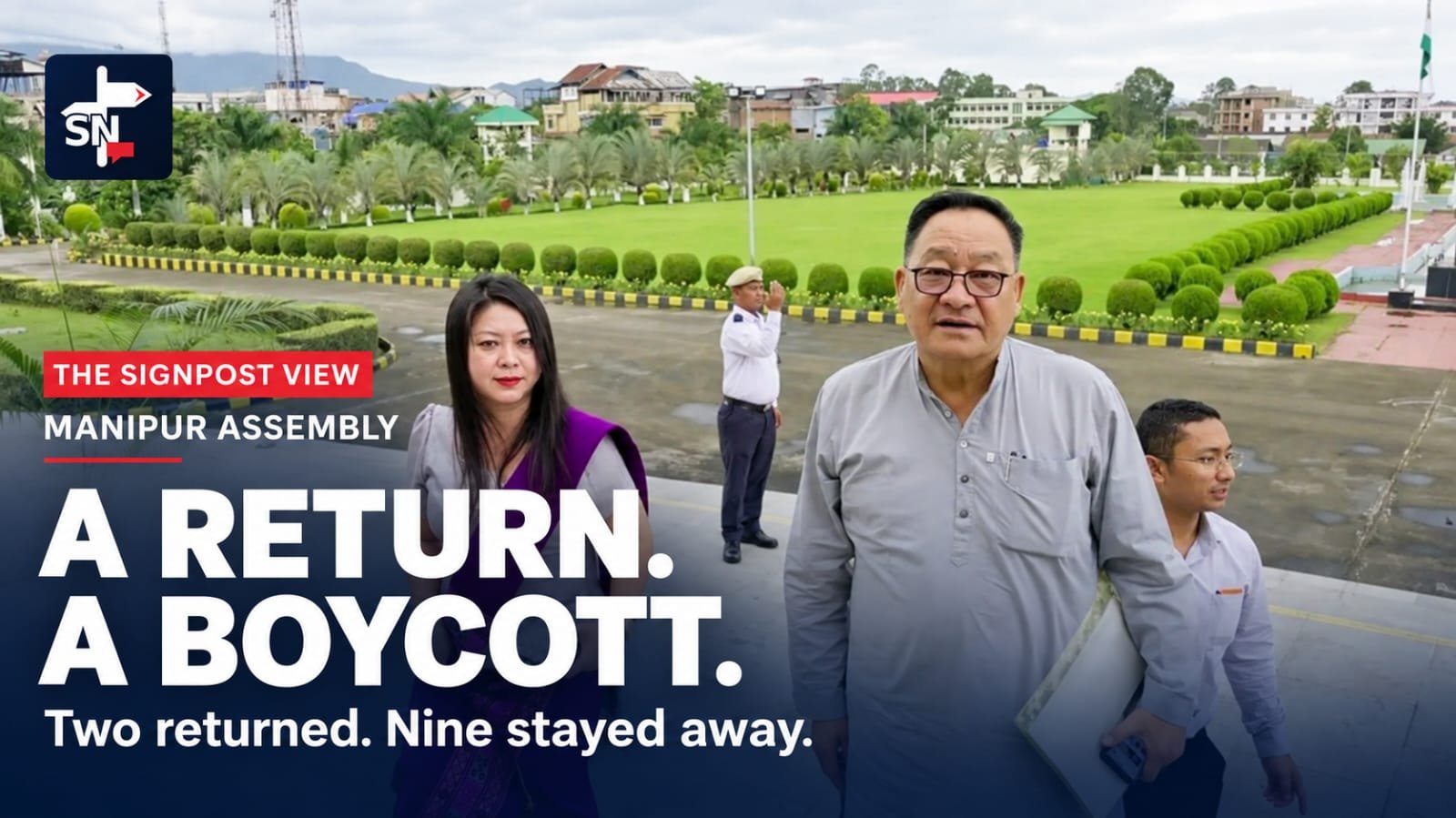
Two Kuki legislators returned to the House after more than three years. Five days later, nine Naga MLAs stayed away from the final sitting. That contrast tells us how fragile Manipur’s representative politics remains.
The opening day of the recent Manipur Assembly session produced an image that many people wanted to believe in. Haokholet Kipgen and Kimneo Haokip Hangshing entered Imphal and attended the House physically for the first time since the violence began in May 2023. After more than three years of separation, fear and political distance, two Kuki legislators were once again sitting with representatives from other communities inside the same Assembly.
Chief Minister Yumnam Khemchand Singh welcomed their return as a positive step towards unity and peace. He was right to acknowledge its significance. In present-day Manipur, even the ordinary act of an elected representative taking a seat in the House can require courage. Their presence showed that the barriers created by the conflict are difficult to cross, but not impossible.
Five days later, the final sitting presented a very different picture. All nine active Naga legislators stayed away from the House. Their empty seats spoke as clearly as the welcoming words heard on the opening day.
The Naga legislators said they were protesting against the failure to deliver justice in the abduction and killing of six Naga civilians in May. They demanded action against those they believe were responsible and sought the removal of Deputy Chief Minister Nemcha Kipgen. They have also made serious allegations concerning her husband, Thangboi Kipgen, and the KNF(P).
These allegations have not been established by a court and should not be repeated as proven facts. Nemcha Kipgen and every person named by the legislators are entitled to due process. But due process cannot become a reason for official silence. When nine elected representatives, including Deputy Chief Minister Losii Dikho, decide that staying away from the Assembly is the only way to make the government listen, Manipur has a political problem that cannot be left entirely to police files and press conferences.
The session therefore began with the return of two legislators from one estranged community and ended with the representatives of another community refusing to enter the House. Two returned. Nine stayed away. Between those two events lies the political condition of Manipur today.
A Return Is Not Yet Reconciliation
The presence of the two Kuki MLAs was important, but it should not be burdened with a meaning it cannot yet carry. It did not prove that relations between communities had returned to normal. It did not mean that all Kuki legislators felt safe or politically free to attend. Nor did it show that the competing demands created by the conflict had been resolved. What it showed was simpler and still valuable: constitutional politics remains possible.
The Assembly is perhaps the only institution in Manipur where representatives from every community are expected to sit under one roof, listen to one another and speak as members of the same State. They may disagree strongly, but the House exists precisely because disagreements cannot be settled forever through blockades, armed pressure, community directives and separate political platforms.
That is why the absence of the Naga legislators on the final day should concern everyone, irrespective of community. This was not an Opposition party walking out over a routine dispute. The MLAs who stayed away belong to different political parties, and most are part of the ruling arrangement. One of them holds the office of Deputy Chief Minister.
If members supporting the same government cannot share the Assembly because a serious criminal allegation remains unanswered, the crisis has entered the government itself.
It would be unfair to blame only the legislators who stayed away. They believe that repeated appeals for justice have not produced an adequate response. At the same time, absence cannot become the permanent language of representation. People elect their MLAs to carry their pain into the House, question the government and demand answers on the floor. When legislators withdraw, the voices of their constituencies also disappear from the proceedings.
The government must therefore give them a reason to return—not through persuasion or political management alone, but through visible and credible action.
The House Gave Us Figures, but Not the Full Picture
The three sittings did place several important statements and figures on record. According to a September 8 report in The Sangai Express, Home Minister Govindas Konthoujam told the House that the State would pursue 1951 as the base year for updating the NRC. The newspaper also reported his statement that the government had detected 24,475 illegal immigrants in Kamjong, Tengnoupal and Chandel districts and had pushed back 14,992 of them.
These are significant figures, but the records behind them should be placed in the public domain. The government should explain the period covered by the exercise, how identity and nationality were verified, the legal process followed while sending people back and the status of those who remain in temporary shelters. A number announced in the Assembly should begin public scrutiny, not bring the discussion to an end.
In a separate report on the Assembly proceedings, The Sangai Express quoted Chief Minister Khemchand as saying that around 36,000 of Manipur’s nearly 60,000 internally displaced persons had been resettled. The same report, however, said that only around 24,000 had returned to their homes and that financial assistance was still being provided to approximately 59,000 people, including those described as resettled.
These figures may be correct, but the government must explain what it means by “resettled.” How many families have returned to their original villages? How many are living in prefabricated houses or alternative locations? Can they cultivate their land, send their children to school, receive healthcare and travel without fear? A family may have left a relief camp and still remain far from the life it had before the conflict.
The government’s decision to continue assisting returnees recognises this reality. Many have gone back physically but cannot resume farming, trade or regular employment. Their continued dependence on relief shows that leaving a camp and rebuilding a life are not the same achievement.
Questions were also raised in the House about the reopening of the Moreh road and compensation for farmers affected by the conflict. The Chief Minister acknowledged that the Centre had not yet released the Rs 80 crore sought for 2024–25 because of discrepancies and that a fresh survey was being conducted.
For a farmer who has missed successive seasons, this is not a minor administrative delay. It can determine whether a family rebuilds its livelihood or falls further into debt. The House should have asked not only why the money had been delayed, but when the new survey would be completed and when affected farmers could expect payment.
The Naga Protest Needs an Institutional Answer
The boycott by the nine Naga legislators cannot be resolved through competing statements issued outside the Assembly. The killing of six Naga civilians is a criminal matter, and criminal responsibility must be established through evidence.
If the investigation has found material supporting the allegations raised by the legislators, the law should move without considering political office, party affiliation or coalition convenience. If the evidence does not support those allegations, the investigating authority should say so clearly. Keeping the matter surrounded by uncertainty will only deepen distrust between communities.
The State Government should make the basic status of the investigation public: the cases registered, the agency handling them, the arrests made and the stage the investigation has reached. Details that could compromise the inquiry need not be disclosed. But families waiting for justice and legislators raising the issue cannot be expected to accept indefinite silence.
The allegations involving the family of a serving Deputy Chief Minister make transparency even more necessary. Nemcha Kipgen is entitled to protection from unproven accusations. The families of the six men killed are equally entitled to know that the investigation is independent and moving with urgency. Manipur cannot protect one right by neglecting the other.
Chief Minister Khemchand should bring the Naga and Kuki legislators into a serious political dialogue before the next Assembly session. Such a meeting cannot decide guilt, which belongs to investigators and courts. Its purpose should be to prevent an unresolved criminal case from destroying the last common constitutional space available to Manipur’s communities.
Three Sittings Could Never Carry This Burden
Before the session began, I had argued that three sittings were too few for a State carrying more than three years of unresolved conflict. The final day made that concern more difficult to dismiss.
The House was expected to address the NRC and Census, the rehabilitation of displaced families, highway movement, border security, farmer compensation, armed groups and repeated civilian killings. At the same time, it was expected to rebuild a common political space for legislators who had remained separated since 2023. Government Bills and supplementary grants can be passed within three sittings. Trust cannot be restored according to such a short timetable.
Manipur needs another, longer session in which the conflict and its consequences receive more than passing attention during Question Hour or Zero Hour. The government should table written progress reports on IDP rehabilitation, farmer compensation, highway security and investigations into civilian killings. Legislators must be given enough time to question the meaning of the figures placed before them and receive answers that can later be checked against official records.
The Assembly remains the one constitutional forum where representatives of Manipur’s communities are expected to meet as members of the same House. If that space also becomes divided by absence, boycott and unanswered allegations, the political vacuum will be occupied by armed groups, pressure organisations and mobilisation on the streets.
The recent session began by showing that a closed door could still be opened. It ended by showing that elected representatives may stay away when they believe that nobody inside is listening.
Both messages deserve attention. The return of the two Kuki legislators tells us that dialogue has not become impossible. The empty seats of the nine Naga legislators warn us that dialogue cannot survive without justice, transparency and trust.
The next Assembly session should not be judged merely by how many legislators sign the attendance register. It should be judged by whether those who enter believe that their people will be heard, and whether they leave carrying answers rather than another reason to stay away.