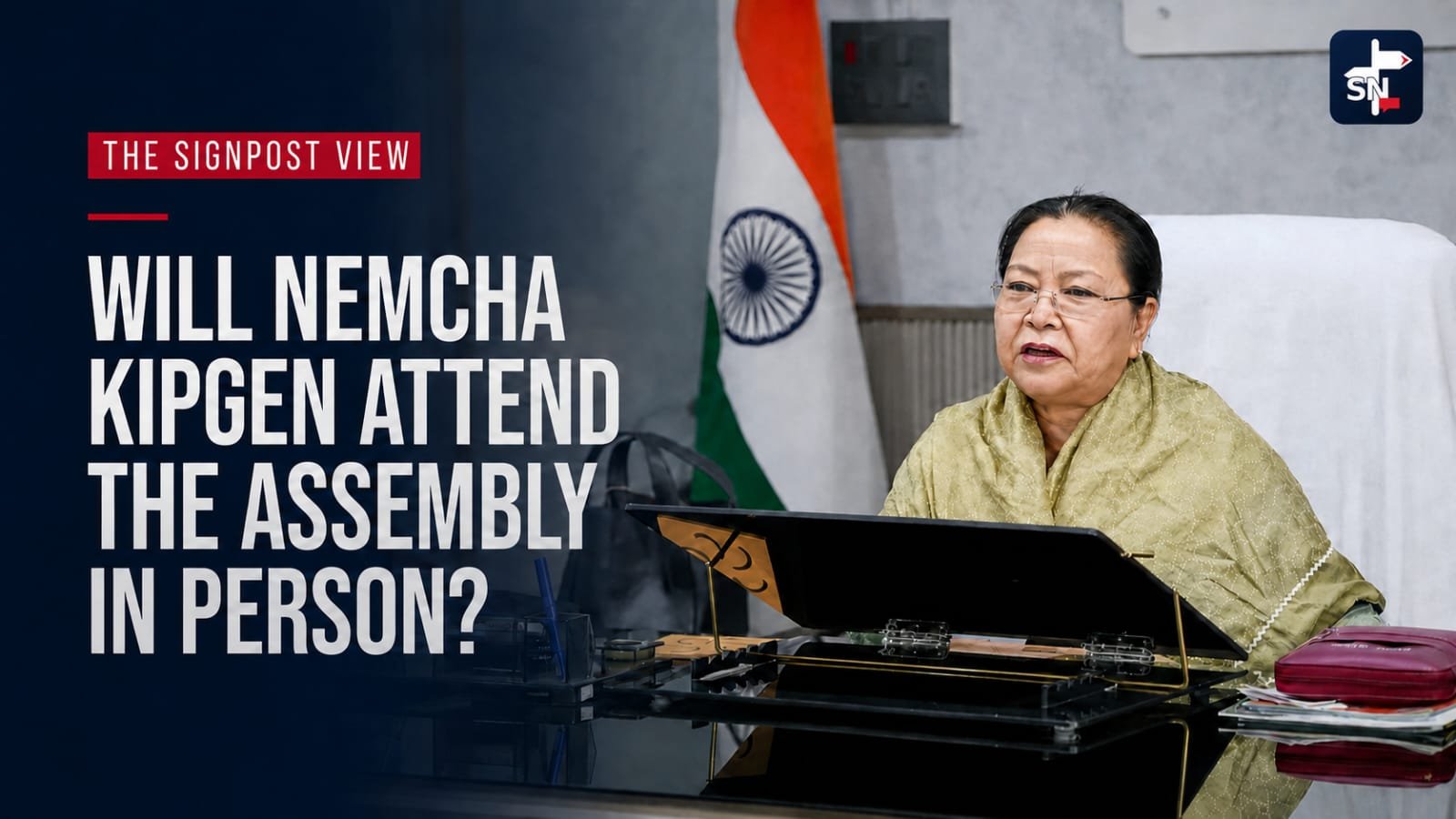
As the Manipur Legislative Assembly prepares to meet on September 2, one question deserves a clear answer before the sitting begins: Will Deputy Chief Minister Nemcha Kipgen attend the House physically, or will she once again participate through a video link?
This is not merely a question about attendance. Nor is it intended to single out one legislator for criticism. Nemcha Kipgen is not only the elected representative of Kangpokpi Assembly constituency; she is the Deputy Chief Minister of Manipur. Her presence—or absence—will therefore carry meaning far beyond one seat in the Assembly.
When the new Government was formed in February 2026, Kipgen took oath virtually from Manipur Bhavan in New Delhi. She and two other Kuki-Zo legislators also participated virtually in an Assembly sitting from Delhi. The arrangement may have been justified as an exceptional response to the continuing ethnic conflict and security concerns.
But an emergency accommodation cannot quietly become a permanent substitute for constitutional normalcy.
A Deputy Chief Minister Represents the Whole State
A Deputy Chief Minister cannot function only as the representative of one constituency, one district or one community. The office carries responsibility towards every citizen of Manipur—including those living in relief camps, those unable to travel freely across districts and those waiting for the Government to demonstrate that the State is moving towards genuine normalcy.
The Assembly is where ministers must answer questions, defend government policy and listen directly to the concerns raised by elected representatives. Participation through video conference may satisfy a procedural requirement, but it cannot fully replace physical engagement inside the House.
Political reconciliation is not built only through formal speeches delivered on a screen. It also develops through face-to-face discussion, informal communication across party and community lines, and the willingness of leaders to occupy a shared constitutional space despite disagreement.
For that reason, Nemcha Kipgen’s physical attendance would be more than symbolic. It would demonstrate that the Government believes its own institutions can again function as common institutions for all communities.
Security Concerns Cannot Be Dismissed
The security concerns of Kuki legislators must not be trivialised. Manipur has endured violence, displacement, mutual fear and deep communal separation since May 3, 2023. No public representative should be pressured to travel without an adequate and credible security assessment.
However, if the Deputy Chief Minister of the State cannot safely attend the Assembly in Imphal, that itself raises a serious question about the Government’s claim of improving normalcy.
The responsibility cannot be placed entirely on Nemcha Kipgen as an individual. The Chief Minister, the Speaker, the Home Department and the State’s security establishment must create the conditions required for every elected member to attend the House safely.
If physical attendance is considered unsafe, the Government should explain the nature of the difficulty, the arrangements it attempted to make and whether virtual participation is being treated as a temporary exception or an indefinite political arrangement. Silence will only deepen speculation.
Why Delhi and Kangpokpi—but Not Imphal?
Nemcha Kipgen has reportedly held political and official meetings outside Imphal, including engagements in Delhi and Kangpokpi. Reports have also referred to her meetings with officials, contractors and political stakeholders from different communities.
Such engagements are welcome. Dialogue should take place wherever it is possible. But they create an unavoidable public question: If meetings involving people from different communities can be conducted in Delhi or Kangpokpi under appropriate arrangements, why can a similar protected space not be created inside the Manipur Legislative Assembly?
The Assembly complex is not an ordinary public venue. It is among the most protected constitutional spaces in the State. If even that space cannot accommodate the physical presence of the Deputy Chief Minister, the public deserves to know what prevents it.
Virtual Participation Must Not Normalise Political Separation
Technology can keep constitutional business moving during an emergency. It should not, however, become a convenient mechanism for institutionalising the geographical and political separation created by the conflict.
If ministers representing different communities govern from separate locations and meet only through screens, Manipur may retain the appearance of a single Government while functioning through divided political spaces.
That would be a dangerous precedent. Virtual attendance may preserve a vote or allow a speech to be delivered, but it cannot recreate the complete democratic experience of being present in the House—facing questions, listening to criticism and participating directly in negotiations over public policy.
The September 2 sitting is expected to address a State still confronting displacement, restricted movement, insecurity and unresolved demands over Census and NRC. These questions require the full and visible engagement of the entire Council of Ministers.
Physical Presence Would Send a Wider Message
Nemcha Kipgen’s attendance in person could send several important messages at once. To Kuki citizens, it could show that their elected representatives can participate in the State’s constitutional institutions without fear or threats. To Meitei citizens, it could demonstrate that the Deputy Chief Minister is prepared to engage directly with the entire State and not administer her responsibilities from a distant location.
To the thousands of internally displaced people from all affected communities, it could offer at least one visible indication that political leaders are attempting to rebuild a shared public space.
Physical presence alone will not resolve Manipur’s conflict. But sustained absence also communicates something—especially when the person concerned holds the second-highest political office in the State Government.
The Government Must Clarify Before the Sitting
Before the September 2 Assembly sitting, the Government should answer three straightforward questions: Will Deputy Chief Minister Nemcha Kipgen attend the Assembly physically? If she will not attend, what specific security assessment prevents her presence, and what steps were taken to overcome the difficulty? Is participation through video conference a temporary emergency measure, or has it effectively become the Government’s accepted model for Kuki ministers and legislators?
These questions are neither communal nor personal. They concern the functioning of constitutional government. Manipur cannot repeatedly announce the restoration of normalcy, the reopening of highways and the return of free movement while its own Deputy Chief Minister remains unable—or unwilling—to enter the Assembly physically.
If the Government wants citizens to believe that Manipur is gradually returning to a shared constitutional order, the first evidence must come from its political leadership.
On September 2, the public will not only be listening to what the Assembly says.
It will also be watching who is physically present.