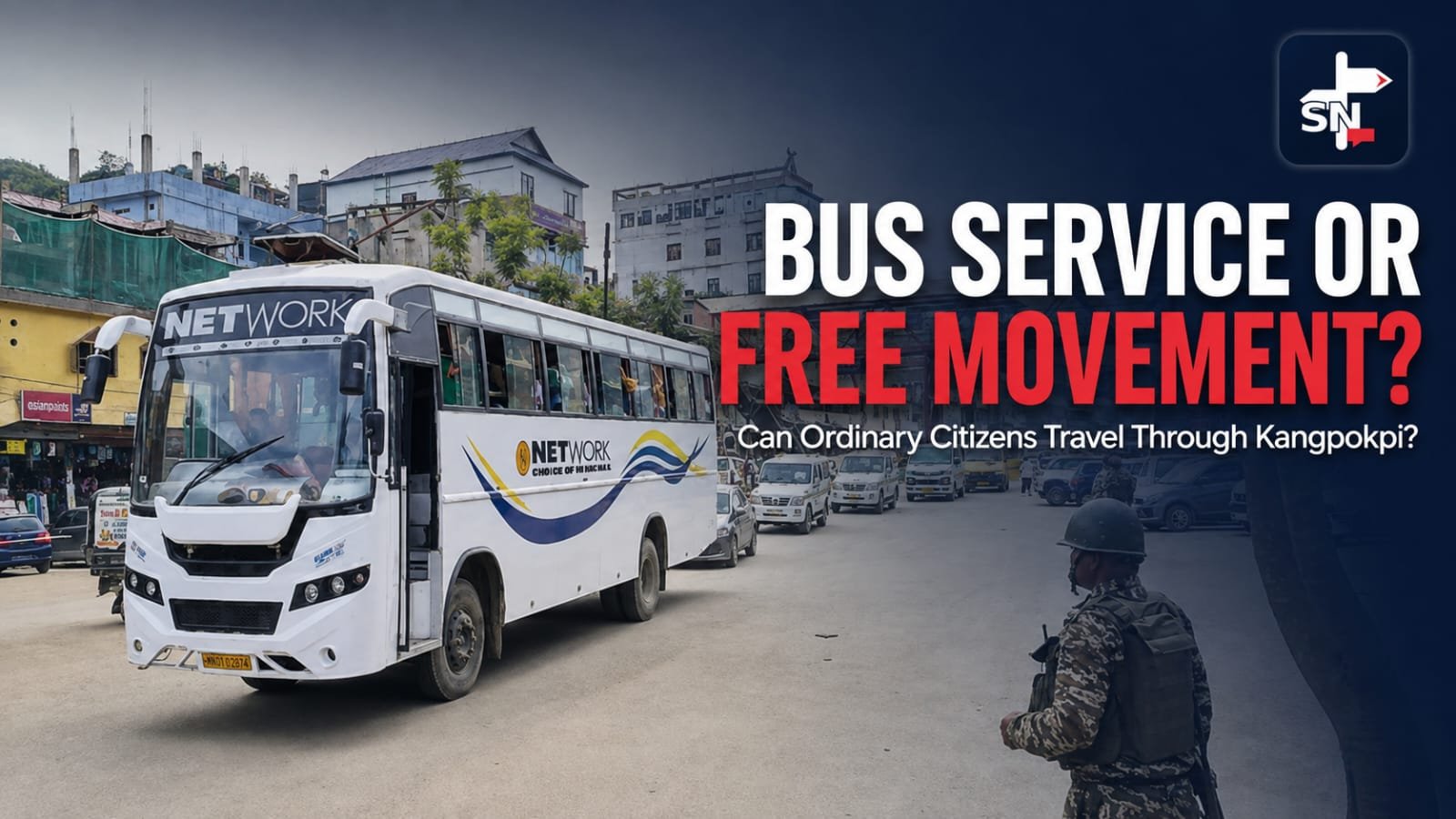
The return of the Imphal–Dimapur–Guwahati service deserves credit, but the August 23 incident raises a harder question: can ordinary citizens travel independently along National Highway through Kangpokpi?
The resumption of public transport on the Imphal–Dimapur–Guwahati route is a welcome and necessary development.
On August 21, two buses and five Wingers carrying 125 passengers left Imphal and travelled through Kangpokpi and Senapati before proceeding towards Dimapur and Guwahati. The service had remained suspended for more than three years following the outbreak of the Manipur conflict on May 3, 2023.
For students, patients, families and others burdened by expensive airfares, the restored road connection offers genuine relief. Passenger numbers increased on subsequent days, indicating that the service is meeting a real public need.
The Government deserves credit for restarting it. But restoring a scheduled bus service and restoring unrestricted freedom of movement are not the same achievement.
A protected convoy can demonstrate that the State is capable of securing an organised route. Free movement requires something more: every citizen must be able to use a public highway independently, without fear, ethnic restrictions or special political and security arrangements.
A Welcome Beginning
The resumed service represents more than the return of a transport facility. It is the first organised movement of Meitei passengers through Kangpokpi on this route since the conflict divided Manipur into areas where members of one community could no longer safely travel through those dominated by another.
The psychological barrier was therefore as serious as the physical one.
Passengers boarding the inaugural buses had no recent experience to reassure them that the journey would be completed safely. The Government had announced the reopening of the National Highways for the free movement of all communities, but announcements alone could not erase more than three years of fear.
The successful arrival of the first passengers in Guwahati proved that a journey under coordinated security arrangements was possible. It encouraged more people to use the service on the following days.
That progress should neither be ignored nor belittled. But it should also be described accurately. The buses travelled under security protection, with security personnel and Road Opening Parties deployed to facilitate safe passage. This was a carefully managed transport operation—not yet the ordinary, unrestricted movement citizens enjoyed before the conflict.
Publicity Exercise—or a Necessary First Journey?
The visible presence of several BJP office-bearers and Imphal-based party leaders among the passengers on the inaugural journey led some people to dismiss the exercise as a publicity stunt. Their interactions with the media and the political messaging surrounding the journey inevitably strengthened that perception.
The criticism is understandable. When members of the ruling party travel on a Government-backed service and subsequently appear before television cameras praising the initiative, the event cannot be regarded as entirely spontaneous or politically neutral.
But that is not the whole story. The route had remained inaccessible to ordinary Meitei passengers for more than three years. Fear could not disappear merely because the Government announced that buses would begin operating. The inaugural journey required passengers willing to enter those vehicles without knowing with complete certainty how their passage through Kangpokpi would unfold.
If any one of us had been asked to volunteer for that first journey, how many would have stepped forward?
The BJP leaders who travelled on the inaugural service may have received political publicity, but they also placed themselves inside the buses and helped demonstrate that an organised journey could be completed safely. That contribution deserves acknowledgement.
Political symbolism is not always meaningless. After a prolonged conflict, visible acts of confidence can help ordinary people overcome fear.
The more important development is what followed. On subsequent days, the buses began carrying larger numbers of passengers who genuinely needed affordable transport—students, patients, families and others travelling to Dimapur and Guwahati. What may have begun partly as a symbolic exercise has developed into a useful public service.
The Government and the participating BJP leaders deserve credit for helping the first convoy move. But the success of a protected convoy must not be exaggerated into proof that unrestricted free movement has returned.
The real test is no longer whether political leaders can travel inside a Government-backed bus. It is whether an ordinary citizen—without political connections, media attention or a security escort—can travel through the same area independently and safely.
The August 23 Test
The Government’s claim that free movement had been restored faced a serious test almost immediately after the bus service resumed.
According to a local newspaper report published on August 23, two Meitei men who entered Kangpokpi district while travelling along the Imphal–Dimapur highway were intercepted and subsequently handed over by Kangpokpi district police to Sekmai Police Station.
The timing is significant. The bus service resumed on August 21, with the Government presenting it as an important step towards peace, normalcy and the free movement of all communities. Yet only two days later, two individual Meitei travellers who entered Kangpokpi were returned to a police station on the valley side.
The newspaper report does not establish that the two men were formally arrested or that they had committed an offence. Nor has the Government issued a clear public notification explaining whether citizens are permitted to travel independently through Kangpokpi district in private vehicles.
That absence of clarity has produced an unavoidable question: has the highway genuinely been reopened to every citizen, or has safe passage effectively been extended only to scheduled buses and Wingers operating under Government supervision and security protection?
The Government Must Explain
If there was a specific reason for returning the two men, the authorities should disclose it.
Were they suspected of committing an offence? Were the police protecting them from a credible threat? Were they asked to return because independent travel through the area remains unsafe? Or does an administrative restriction continue despite the public announcement reopening the National Highways?
The Government cannot declare that the highways are open to all communities and then remain silent when individual citizens are prevented from completing their journeys.
If a security protocol remains in force, the public should be told what it is. If private vehicles require prior permission or police coordination, the Government should issue an official advisory. If no restriction exists, it must explain why the two travellers could not continue their journey.
Ambiguity is dangerous. Citizens should not have to discover the limits of their freedom only after entering a sensitive area.
The State must also clarify whether the same rules apply reciprocally. Can a Meitei citizen travel through Kangpokpi in a private vehicle? Can a Kuki citizen travel freely through the Imphal Valley? Can members of either community stop at markets, restaurants, hospitals and Government offices located in areas dominated by the other?
A highway cannot be described as open when citizens are transported through it only inside selected vehicles without the freedom to enter, stop or travel independently.
Bus Service Is Not Yet Free Movement
A scheduled bus moving under escort proves that the State can operate a protected transport service. It does not establish unrestricted movement if ordinary citizens still cannot travel independently beyond their respective community-dominated areas.
The distinction matters. A bus service carries passengers between secured points according to a coordinated schedule. Free movement means that citizens do not require political affiliation, advance coordination, media visibility or a security convoy to use a public highway.
The bus service is therefore a beginning—a valuable and commendable beginning—but it cannot become the sole measurement of normalcy.
The Government should publish clear information on the security arrangements, permissible forms of travel, emergency contact points and restrictions, if any, along the route. It should also state how and when private passenger vehicles, taxis and other commercial transport will be allowed to operate without extraordinary security arrangements.
Once NH-2 is genuinely accessible to everyone, the Government must also turn its attention to the Imphal–Moreh route. Restoring passenger and commercial transport on that road is essential for reviving Moreh’s economy and reconnecting communities in southern Manipur.
Give Credit, but Do Not Declare Victory
Those who travelled on the inaugural buses helped cross an important psychological barrier. The Government succeeded in operating a service that many believed could not resume. The growing number of passengers demonstrates that the initiative has practical value.
They deserve credit. But premature declarations of normalcy could weaken rather than strengthen public confidence. People know the difference between travelling inside a protected convoy and travelling freely as citizens of the same State.
The August 23 incident now requires an official explanation. The Government must clarify whether the two men were returned for their protection, because of a lawful restriction or for some other reason.
If every citizen is free to use the highway, that freedom must exist beyond selected buses. If independent travel remains unsafe or prohibited, the Government must acknowledge the reality and explain what it is doing to change it.
The buses are running, and that is a welcome beginning.
The Government has demonstrated that escorted public vehicles can cross Kangpokpi. It must now prove that Manipur’s citizens can do the same.