There are moments when a political statement matters not because every word in it must be accepted, but because it forces us to confront a question we have learnt to avoid. Campaign for Just and Fair Delimitation (JFD) finance secretary Sunil Karam has described the prevailing situation in Manipur as a “de-facto separate administration”, pointing to community-based administrative realities that have emerged during the conflict. He has also called for leadership acceptable to all communities.
His description is politically contentious. But behind it lies a question larger than the terminology: Who speaks for Manipur when politics itself increasingly speaks in the language of communities?
On paper, there is one Government of Manipur, one Legislative Assembly, one constitutional structure and one territorial State. But a State is not united by cartography alone. Unity must also be visible in the way people live, travel and experience the authority of government.
Since the violence of 2023, the physical and psychological distance between communities has become difficult to ignore. Movement through certain areas has itself become a security question. Community organisations have acquired greater importance in negotiations and public affairs, while political demands are increasingly articulated through ethnic interests.
Some of these conditions grew out of extraordinary violence and genuine fears for safety. They cannot simply be wished away. But temporary realities created by conflict become dangerous when society begins to accept them as permanent arrangements.
Territorial integrity, therefore, cannot be protected merely by repeatedly saying that Manipur is one. It has to be demonstrated through administration. A citizen should not have to wonder whether his community identity permits him to travel on a public road. Government officers should be able to perform their duties wherever the State sends them. National Highways should remain public highways. The authority of law should not change when geography changes.
If these basic conditions disappear, unity gradually becomes a constitutional statement rather than a lived reality.
Unity must begin with elected representatives
A united Manipur cannot be sustained by expecting civil society organisations alone to defend the idea of unity. The first political voice for a common Manipur should come from those whom the people elected to represent it.
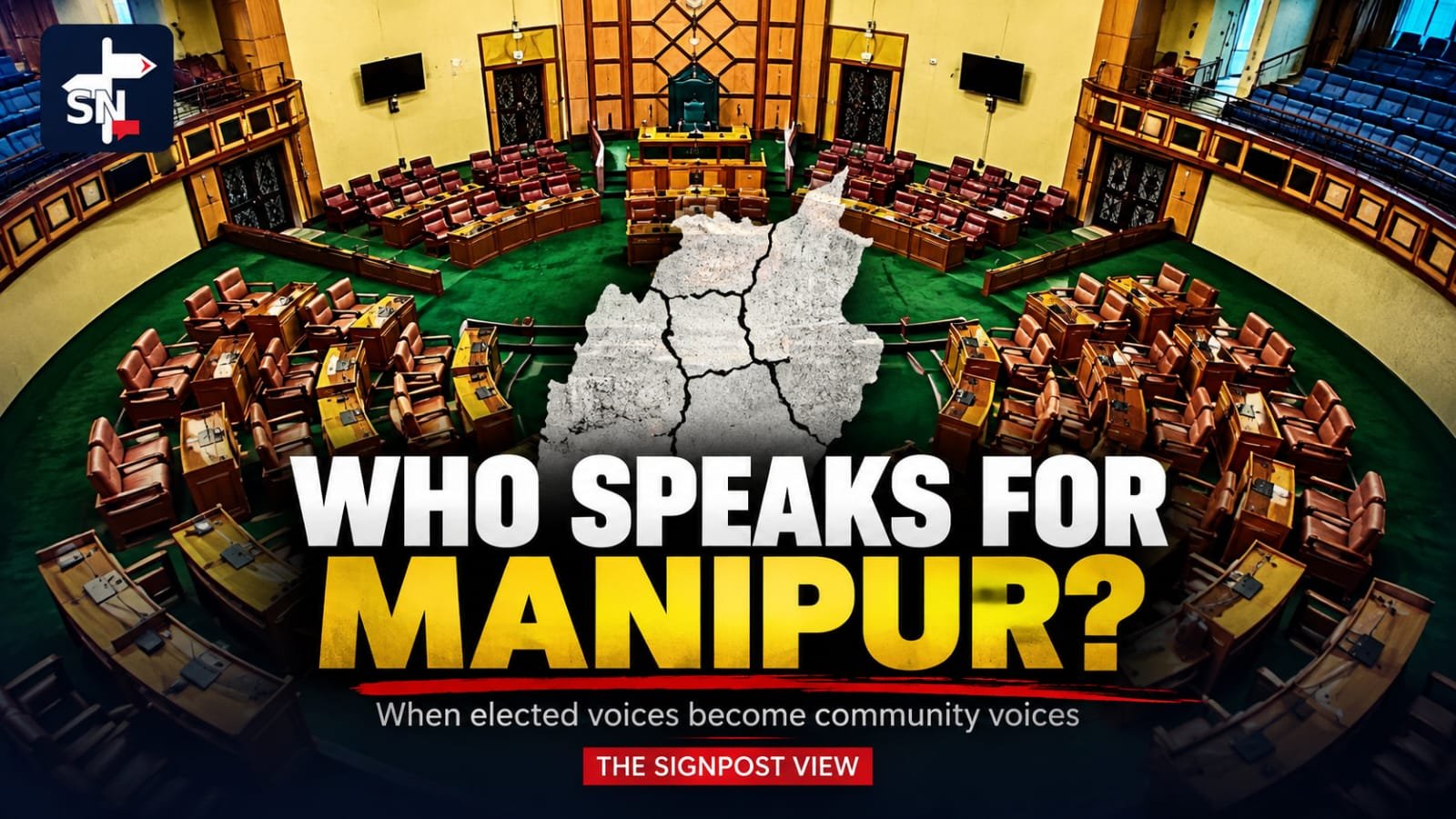
Manipur has a 60-member Legislative Assembly. Its members come from different constituencies, communities and political parties. They will disagree, sometimes sharply, and they have every right—and a responsibility—to raise the concerns of the people who elected them.
But collectively they belong to one institution: the Manipur Legislative Assembly. That name carries a meaning. An MLA is elected from a constituency, but does not become a member of a constituency legislature. Nor is anyone elected to a Meitei Legislative Assembly, a Kuki Legislative Assembly, a Naga Legislative Assembly or any other ethnic assembly. Each becomes a Member of the Manipur Legislative Assembly.
That distinction is more than semantics. It becomes especially important when the State itself is going through a conflict.
Community leaders will naturally speak about the grievances, security concerns and aspirations of their communities. Elected legislators carry an additional responsibility. They are members of a constitutional institution representing the State.
If every political leader eventually speaks only about what his or her own community wants, who speaks for Manipur?
The contradiction inside the Assembly
The question becomes more difficult when sitting members of the Manipur Legislative Assembly themselves advocate separate political or administrative arrangements along community lines.
Saikot MLA Paolienlal Haokip is one example. Haokip has publicly supported the demand for a separate administrative arrangement for the Kuki community. During the political discussions surrounding government formation earlier this year, he reiterated that position and linked participation in government to addressing the community’s political demand. Kuki legislators have at other points also combined participation in government formation with continued pursuit of separate administration.
Haokip and other legislators supporting such demands have stated their reasons, including security concerns, displacement and the breakdown of trust following the violence. Those arguments should be heard and debated rather than caricatured. But the political contradiction remains.
A legislator can and should represent the grievances of his constituency and community. Yet when someone who sits in the Manipur Legislative Assembly advocates a separate political or administrative future for his community, an unavoidable question arises about the larger meaning of representation during a fractured time. And this is not a question for Paolienlal Haokip alone.
The danger is much larger than one MLA or one community. If Meitei legislators speak only for Meiteis, Kuki legislators only for Kuki people and Naga legislators only for Nagas, Manipur may still have 60 MLAs but increasingly fewer political voices speaking for Manipur as a whole. A divided State does not find unity that way.
Leadership cannot stop at community boundaries
Manipur needs political leaders capable of speaking to people beyond their own communities. That does not mean surrendering community interests, nor does unity require anyone to forget killings, displacement, destruction of homes or grievances arising from the conflict.
A Meitei MLA can defend the legitimate interests of Meiteis while recognising the rights and fears of Nagas and Kuki people. A Kuki MLA can articulate the suffering and concerns of his community while still participating in a political conversation about a shared future. A Naga representative can pursue the interests of Naga constituencies while remaining part of the larger conversation about Manipur. That is what representative politics should make possible.
The danger begins when community representation becomes the end point of politics rather than its starting point. If political leadership itself becomes completely ethnicised, the space for rebuilding a common political future becomes smaller. We may then continue talking about a united Manipur while practising separate politics every day.
NRC needs an answer, but it cannot answer everything
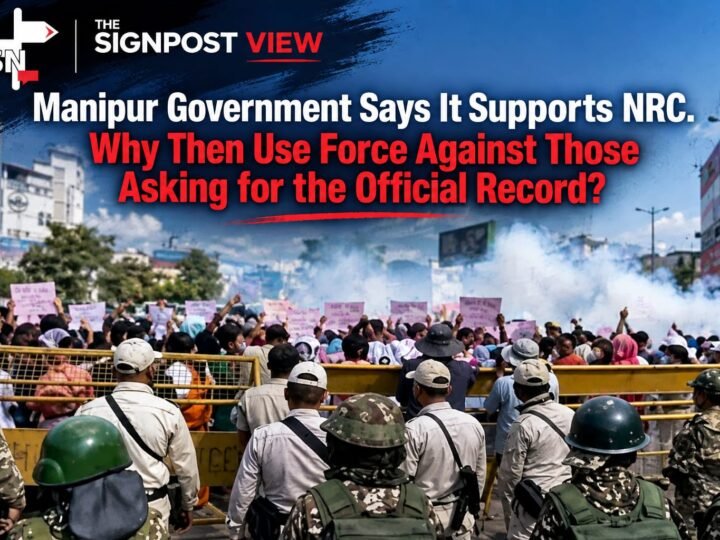
Sunil Karam’s remarks came during the continuing “No NRC, No Census” movement. The issue has already moved beyond street protests and entered the Legislative Assembly.
On September 7, Home Minister Govindas Konthoujam told the House that the State Government would pursue an NRC with 1951 as the base year and take the matter up with the Centre in accordance with Assembly resolutions. He said the original physical records of the 1951 NRC were being traced and acknowledged that the State Government cannot implement the exercise without approval from the Government of India.
The Home Minister also informed the Assembly that 24,475 undocumented immigrants had been detected and 14,992 had been pushed back.
These are significant statements, but an Assembly resolution and a statement on the floor of the House are not the same as commencement of an NRC exercise. If the Government wants an NRC based on 1951, people deserve clarity about the process, the records available, what has formally been sought from the Centre and what response has been received.
At the same time, NRC cannot become the answer to every problem confronting Manipur. An NRC concerns citizenship and documentation. It cannot reopen a road in the human sense of the word, make a displaced family feel safe enough to return home or rebuild trust between communities that have lived through years of violence.
Protecting Manipur’s demographic interests through lawful institutions and rebuilding a shared civic space are not competing objectives. Both require political leadership.
Delhi must provide clarity
There is also a limit to how long politically difficult questions concerning Manipur can travel between Imphal and New Delhi without definitive answers.
The State Government itself has acknowledged that it cannot proceed with the NRC without Central approval. Questions arising from the conflict—including security and political negotiations—also necessarily involve the Union Government.
New Delhi does not have to accept every demand made by every organisation or community. But issues falling within its jurisdiction require clear responses. Where a proposal is legally possible, the process should be explained. Where there are legal or constitutional difficulties, those too should be stated. Prolonged uncertainty creates political space in which competing narratives can harden into perceived realities.
The greater danger is normalising separation
The greatest danger facing Manipur may not begin with a formal declaration of separation. It may begin much more quietly—with people becoming accustomed to not travelling through certain places, political leaders speaking increasingly only to their own communities, and public roads becoming ethnic boundaries in people’s minds.
It grows when arrangements created as responses to violence slowly become accepted as the normal way Manipur functions. And perhaps most dangerously, it grows when elected representatives stop imagining a political responsibility larger than their own community.
That is why Sunil Karam’s use of the phrase “de-facto separate administration” deserves discussion even if one disputes his characterisation. The important question is not whether everyone accepts that phrase. It is whether conditions are being allowed to develop in which such a description becomes increasingly believable.
A united Manipur cannot exist only in resolutions, speeches and maps. It must be visible in governance, on the highways, in equal application of law and in the ability of citizens to move without fear. Above all, it must be visible in the politics of the people elected to represent the State.
Community organisations will speak for communities. That is their role. But if Members of the Manipur Legislative Assembly do not speak for a common Manipur, we must eventually ask a very simple question: who will?