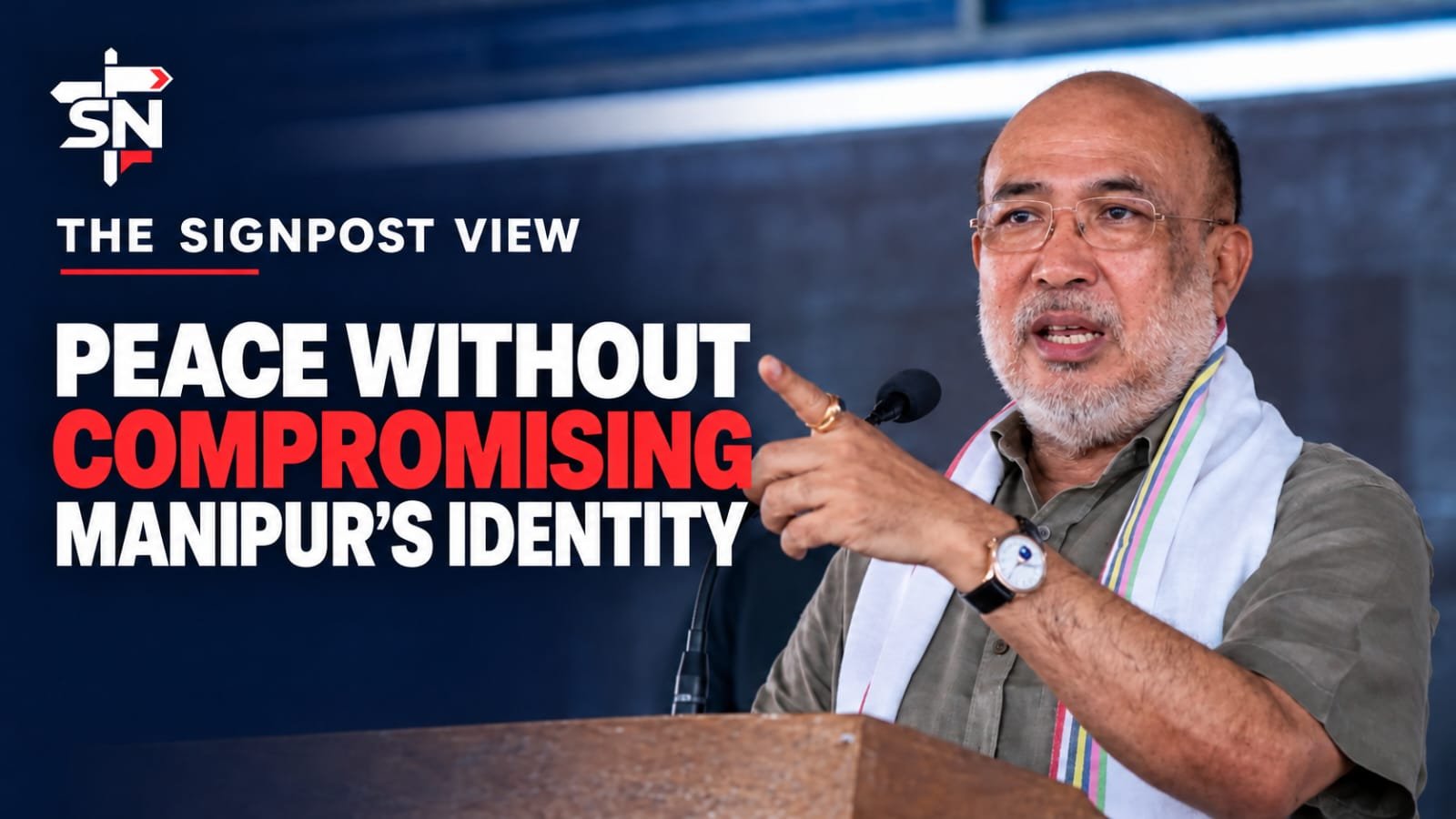
Former Chief Minister N Biren Singh has said that Manipur’s identity must not be compromised in the effort to restore peace and normalcy. At a time when the State continues to search for a way out of a prolonged crisis, the message deserves serious attention.
Peace is necessary. Normal life must return. Internally Displaced families must go home, students must resume their education and people must be able to travel and earn their livelihoods without fear. But peace cannot be built by asking Manipur to surrender the identity, history or collective interests of its indigenous people.
Speaking at the fourth general body meeting of the Thoungambi Women Multipurpose Cooperative Society Limited at Achanbigei in Imphal East, Biren Singh said Manipur could not be allowed to drift under the prevailing circumstances. He appealed to the people to save the State and secure the collective future of its indigenous communities.
This is not a rejection of peace. It is a reminder that peace must have principles.
Peace and Identity Are Not Opposites
Public debate sometimes presents a false choice: either Manipur accepts whatever is proposed in the name of peace, or it is accused of standing in the way of reconciliation. That is neither fair nor reasonable.
Every durable peace settlement must recognise the legitimate fears, rights and aspirations of the communities affected by conflict. At the same time, no arrangement should weaken Manipur’s integrity, erase its shared history or create permanent divisions that future generations will inherit.
A temporary silence of guns cannot be the only measure of peace. If an agreement leaves communities more separated, weakens public institutions or creates new sources of territorial and political uncertainty, the conflict may simply return in another form.
Manipur needs peace, but it needs a peace that keeps Manipur together.
That is why Biren Singh’s statement matters. The State cannot be treated merely as a geographical space that may be rearranged for administrative convenience. Manipur carries a historical identity and a collective political existence shaped by generations of indigenous communities.
Protecting that identity should not be interpreted as hostility towards any community. Properly understood, it means protecting the common home in which every recognised indigenous community must have security, dignity and a future.
The Future Must Be Collective
N Biren Singh’s emphasis on the collective future of indigenous communities is equally important.
Manipur’s identity does not belong to one community alone. Its history has been formed by the relationships—sometimes peaceful and sometimes difficult—among the many communities inhabiting its hills and valley.
The present conflict has damaged those relationships. Roads have become boundaries. Neighbouring settlements have become inaccessible to one another. Fear and suspicion increasingly determine where people may travel, work or live.
Such divisions cannot become the permanent structure of Manipur.
A political solution must therefore protect the State as a shared homeland while addressing the genuine concerns of every indigenous community. It must reject both domination and disintegration. It should restore trust without asking any section of the population to surrender its lawful rights or its place within Manipur.
Saving Manipur cannot mean saving only one part of it. The State will be secure only when its communities can see their future within a common political framework.
Manipur Cannot Afford to Drift
Biren Singh’s warning that Manipur must not be allowed to drift is timely.
A prolonged crisis gradually creates its own dangerous normal. Temporary security arrangements begin to look permanent. Restrictions on movement become accepted. Communities grow up without meeting one another. Livelihoods shift according to ethnic boundaries. Political leaders speak about peace, but the separation on the ground deepens. The longer such conditions continue, the more difficult reunification becomes.
Manipur therefore requires a defined and transparent path towards normalcy. Roads must be open to every citizen. People must be able to return home safely. The rule of law must apply equally in the hills and the valley. Armed attacks, intimidation and obstruction cannot be accepted merely because they occur in areas controlled or influenced by one group or another. The State cannot remain suspended between conflict and peace.
Leadership at this stage requires the courage to defend Manipur’s legitimate interests while keeping the door to dialogue open. These two responsibilities are not contradictory. Dialogue without principles produces uncertainty; principles without dialogue may leave the conflict unresolved. The task is to pursue both.
Livelihood Is Also Part of Saving Manipur
The setting in which N Biren Singh delivered the message was also significant. He was addressing a women’s cooperative society engaged in building livelihoods through collective effort.
In his social-media post, the former Chief Minister described women’s collective strength as a force for economic empowerment and grassroots development. He appreciated the society’s efforts to create sustainable livelihoods through cooperation and mutual support. This economic message complements, rather than weakens, his larger political appeal.
Manipur cannot wait for the conflict to end before thinking about employment, education and household survival. Students have already lost valuable years. Businesses and farmers have faced disrupted markets. Families affected by displacement and insecurity must find ways to rebuild their lives.
Women’s cooperatives and Self Help Groups can play an important role in that recovery. When public systems struggle, women often sustain households, maintain community networks and create small but dependable sources of income.
Biren Singh was therefore right to say that the people cannot abandon their responsibilities towards livelihoods and the future of the younger generation merely because Manipur is passing through a crisis. Saving Manipur means protecting its land and identity. It also means ensuring that its people can study, work and live with dignity.
A Peace Worth Defending
Manipur must participate in every sincere effort to end violence and restore normalcy. But it should do so with clarity about what peace must achieve.
Peace must reunite rather than institutionalise separation. It must protect the State’s integrity while providing security and justice to every community. It must restore constitutional governance and equal movement across Manipur. Above all, it must leave the next generation with a State that is more secure, not more fragmented.
N Biren Singh’s message should therefore be understood as a necessary principle: Manipur must work for peace, but it must not lose itself in the process. The State’s identity is not an obstacle to peace. It is the foundation on which a durable and inclusive peace must be built.