A killing takes place in Manipur. Within hours, political leaders issue statements. They are “deeply shocked.” They “strongly condemn” the crime. They demand an investigation, promise that the guilty will not be spared and offer condolences to the bereaved family.
An FIR is registered. Security forces conduct search operations. Civil society organisations protest. Political parties blame one another.
Then the noise fades—until someone else is killed. The same words return. The same assurances are posted. Another FIR is registered. This has become Manipur’s tragic routine. After every killing, people ask whether this will be the last.
It never is.
Condemnation has become a performance
Condemnation is necessary. Silence from elected representatives after the killing of a citizen would itself be unacceptable. But a statement cannot become the final act of leadership.
In Manipur today, condemnation increasingly appears to be treated as an achievement in itself. Political Leaders rush to put out statements, sometimes as though being first to post is evidence of greater concern.
The vocabulary is familiar: “heinous,” “barbaric,” “cowardly,” “unacceptable” and “an attack on peace.” What matters, however, is what follows.
How many leaders return a week later to ask what happened to the FIR? How many demand to know whether suspects have been identified, arrested and chargesheeted? How many return to the bereaved family after the cameras have gone? How many raise the case in the Assembly and insist on a time-bound report?
A leader’s responsibility cannot end with pressing the “post” button.
The casualties return whenever Manipur begins to breathe
The latest violence shows how fragile every period of calm has become. Four Liangmai Naga civilians were killed in an ambush on the Imphal-Tamei road on August 27. Three Kuki villagers, including two women, were killed at N Teikhang on August 31. Four more Kuki civilians died in attacks at Tollen and Longpi on September 13. On September 15, Phalneichong Chonga Sitlhou, 76, and Kimjalhing Kimboi Singson, 30, were shot dead at Leijangphai near Muktokhal in Tamenglong district. They were reportedly engaged in ordinary farm activities when unidentified armed assailants attacked them. Kimjalhing had recently completed her nursing course and returned home to help her parents with farming.
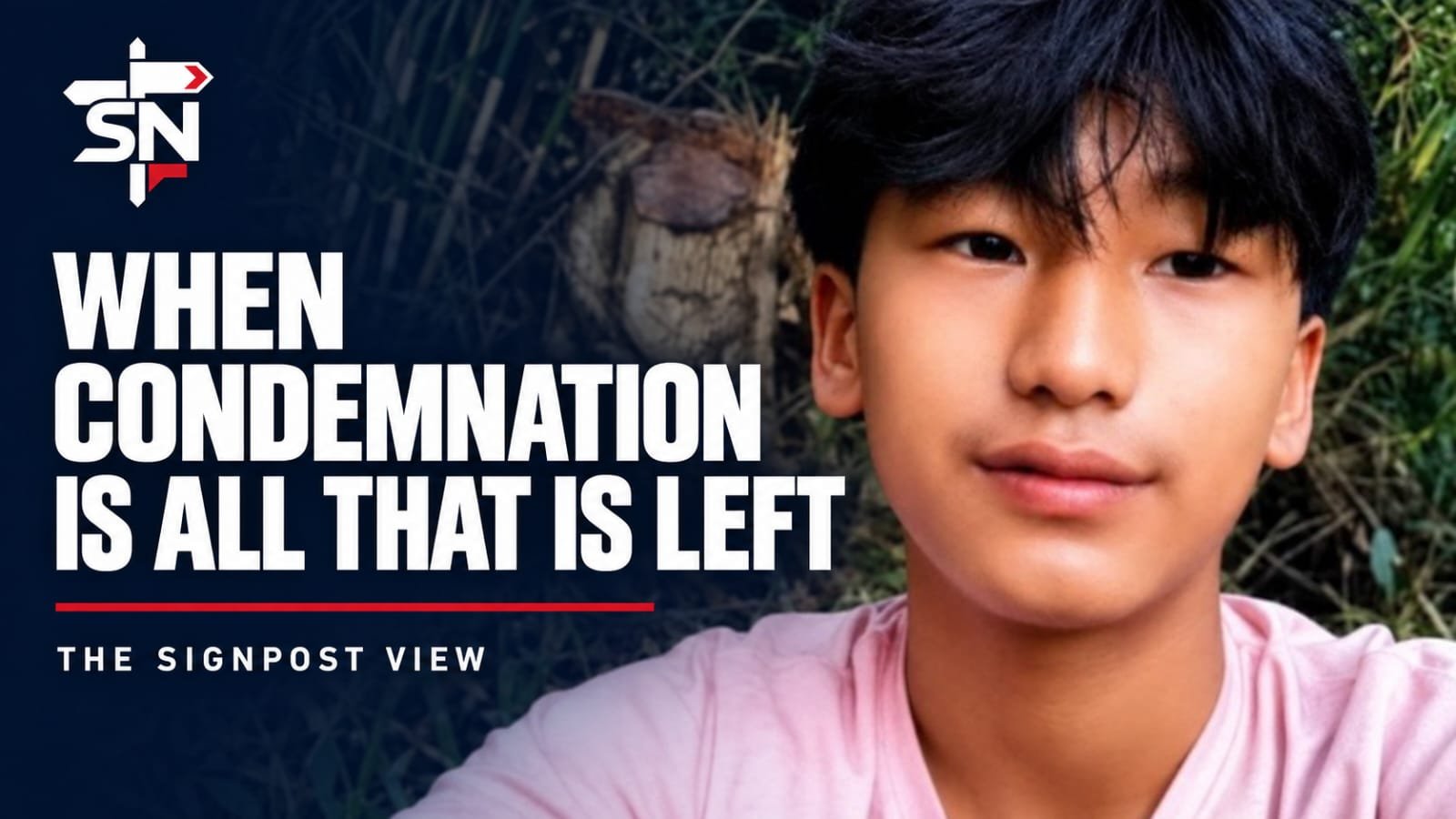
On September 21, a 17-year-old NK Wiphenbou was reportedly ambushed and killed while travelling from Takou village towards Tamei. The attack occurred at around 10.30 am on the road between Takou and Tamei in Tamei subdivision. The identities and affiliations of the perpetrators in these incidents remain matters for investigation.
These were different incidents affecting different families and communities. Every victim deserves the same recognition, an impartial investigation and justice.
Taken together, however, the killings point to a larger failure. Violence returns just when people begin to believe that the worst may have passed. Manipur grows tired, lowers its guard and tries to return to ordinary life. Then another gunshot reminds everyone that the machinery capable of producing violence has not been dismantled.
That cannot be called peace. It is an interval between crimes.
An FIR is only the beginning
Registering an FIR is not justice. It is the first procedural step towards justice. What follows is often far less visible to the public. Were suspects identified? Were arrests made? Was forensic evidence collected? Was the case transferred to another agency? Was a chargesheet filed? Did prosecution begin? Were witnesses protected? Was the family kept informed?
There may be legitimate operational reasons why every detail cannot immediately be made public. Investigations take time. Evidence must be protected, and confidentiality can be necessary. But prolonged silence cannot simply be defended in the name of investigation.
When one case after another disappears from public discussion, that absence of information causes its own damage. Families begin to fear that their dead have been forgotten. Communities suspect selective enforcement. Armed groups see how quickly public outrage passes. Citizens lose confidence in the police, the government and the justice system.
FIR numbers may continue to rise. Visible accountability does not necessarily rise with them.
Justice cannot depend on community pressure
There is another dangerous pattern. When an arrest is made, organised pressure may be brought upon the authorities. Roads are blocked, security personnel are surrounded and public disorder is threatened. The message this can send to suspected perpetrators is damaging: mobilise enough people, and the law may retreat.
No community should be collectively blamed for the acts of individuals. That principle must be protected. But it is equally important that no accused person is shielded merely because an influential organisation, an armed group or a crowd stands behind them.
The law must operate by the same standard in the valley and the hills. It must protect Meitei, Kuki, Naga and every other citizen without discrimination. An arrest must rest on evidence, and a release must rest on law—not intimidation, political negotiation or the capacity to gather a larger crowd.
If the authority of the state changes from one district to another, Manipur does not have the rule of law. It has negotiated law.
Political leaders must answer beyond social media
Manipur’s elected representatives have powers that ordinary citizens do not. They can summon officials, seek reports, question ministers, raise matters in the Assembly, demand special investigations, inspect relief and security arrangements, press for witness protection and ask why an accused person was released. Those in government can act through policy and administration. Those in the Opposition can force matters into public scrutiny.
If these powers remain unused while condemnation statements continue to appear after every killing, the statements begin to reveal political helplessness—or unwillingness to act. People do not elect representatives merely to express the grief that every ordinary citizen already feels. Leadership is measured by what follows that grief.
A serious political response should include a publicly accessible status report on major conflict-related cases: the date and place of the crime, FIR number, investigating agency, arrests made, chargesheet status and stage of trial. Information that could compromise an investigation may be withheld temporarily, but the case itself should not be allowed to disappear from public memory.
The government should also provide regular reports to the Assembly on civilian killings, attacks on villages, highway ambushes, abductions and the prosecution of armed offenders. Opposition parties, too, must follow cases beyond the first press conference.
Condemnation without consequence encourages the next crime
When perpetrators see no visible consequences, condemnation loses force. Worse, repeated outrage without visible accountability can give them reason to believe that the pattern will continue.
They know what usually follows. There will be outrage for a few days. Leaders will issue statements. Organisations will call a bandh or hold a rally. An FIR will be filed. Public attention will move elsewhere. Then an accused person may disappear behind difficult terrain, community protection, political patronage or institutional delay.
The moral message this creates is dangerous: a human life can be taken, and the state’s most visible response may ultimately be a paragraph on social media. Manipur cannot accept that as governance. The next time a leader prepares to write, “I strongly condemn this barbaric killing,” the public should ask five questions:
Who has been identified? Who has been arrested? When will the chargesheet be filed? What security failure allowed the crime? What has changed to prevent the next killing?
If there are no answers, the condemnation remains incomplete. Manipur does not need the fastest condemnation. It needs the last killing.
Until leaders can show that a crime has been followed by investigation, prosecution and measurable steps to prevent another, each new statement will sound less like leadership and more like an admission that condemnation is all they have left.