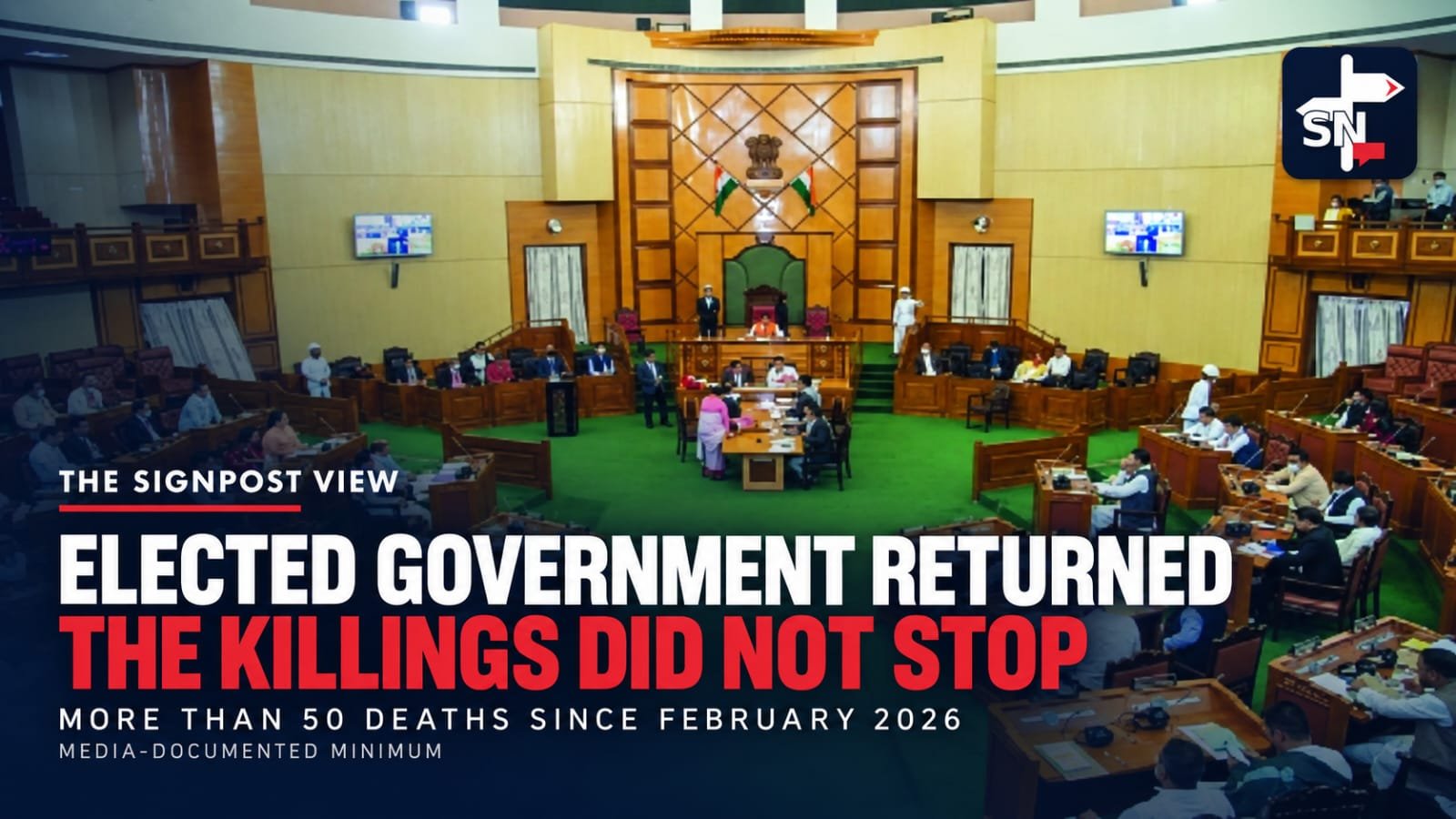
An open-source register now identifies at least 54 deaths in Manipur violence during Yumnam Khemchand’s government’s tenure since February 2026. The number is provisional. The need to protect people is not.
On September 13, two attacks on Kuki settlements left four people dead. In Tollen, a couple was killed and their young son injured. In Longpi, two villagers returning with essential supplies were killed; a third person was reported missing. The attacks took place on Sahnit Ni, a day on which Kuki communities remember those killed in the Naga–Kuki violence of the 1990s.
There will be demands for arrests, security posts and an inquiry. Those demands are justified. But Manipur must also ask a question that has become harder to avoid with every new killing: what has changed for a civilian living in a vulnerable village since an elected government returned in February 2026?
Yumnam Khemchand Singh took office on February 4, 2026. The ministry brought Meitei, Kuki and Naga legislators into its leadership. After nearly a year of President’s Rule, that arrangement offered the possibility of political responsibility shared across communities. People had reason to hope that decisions about security would again be made by leaders answerable to the Assembly.
Seven months later, families are still burying people killed on roads, in fields and near their homes.
A count that should disturb the government
A media-based incident register prepared through August 17 identified 43 deaths during the new government’s tenure. It is an open-source working record, not an official casualty list.
Since its cut-off, four Liangmai Naga civilians were killed in an August 27 ambush. On August 31, three Kuki villagers—two women and a man—were killed at N Teikhang. The four deaths at Tollen and Longpi on September 13 take the register’s identifiable minimum to 54.
That calculation does not mean 54 people were killed in the ethnic conflict under this government. The original register includes ordinary violent crime, deaths in security-force action and one person who died during this period from injuries sustained in an attack in 2023. Nor does it claim to capture every death between August 18 and September 13. It counts identified cases without counting a person twice when they were first reported missing and later found dead.
The distinction matters. So does the number. Even a provisional count of more than 50 deaths during one government’s first seven months ought to demand a public accounting.
In the Assembly on September 3, Home Minister Govindas Konthoujam gave a different, official figure: 306 people killed and 49 still missing in the violence since May 2023, as recorded up to August 31. That figure covers a much longer period and a different category. It cannot be added to, or directly compared with, the February–September open-source register.
What the government has not put before the public is an incident-by-incident account for the period since it took office: who was killed, what happened in each investigation, how many accused were arrested and which places remain exposed to another attack.
These deaths did not happen to one community
In May, six Naga men taken hostage were later found dead. In August, gunmen killed two Liangmai villagers at Langka. Four more Liangmai civilians were killed on the Imphal–Tamenglong road later that month. Three Kuki villagers died at N Teikhang days afterwards. Now four more Kuki civilians have been killed at Tollen and Longpi.
These incidents cannot responsibly be stitched into a single story of retaliation without evidence. Nor should a community organisation’s identification of an armed group be published as a police finding. Investigators must establish who carried out the attacks, not inherit an accusation from whichever statement appeared first.
The victims belong to different communities. Their families are entitled to the same standard of investigation and protection. A government that includes leaders from those communities should be especially capable of saying so—and of showing what it has done.
What does protection look like before the next attack?
After the four Liangmai killings on August 27, the Chief Minister Yumnam Khemchand directed security officials to identify and arrest those responsible. That was necessary. It is also what any government would be expected to say after an ambush.
The public now needs to know what followed. Were suspects identified? Were arrests made? Did the security review change patrol routes or response times? Which villages were assessed as vulnerable, and did they receive protection?
The same questions must be asked after Tollen and Longpi. Obtain the FIRs. Establish when the first distress calls were made and when help arrived. Confirm the missing person’s whereabouts and the injured child’s condition. Give the authorities, village representatives and organisations accused by Kuki bodies a fair opportunity to respond.
None of this requires the government to disclose operational information that would endanger a patrol. It requires enough information for citizens to know whether lessons from one killing are being applied before another.
An elected government cannot guarantee that no crime will occur. It can be judged by whether it investigates crimes without favour, protects people who have been threatened and tells the public when its earlier promises have failed.
For the families in Tollen and Longpi, an assurance of peace issued from Imphal will mean little tonight. They need to know who will keep watch, how to reach help and whether they can remain safely in their homes.
The return of an elected government was supposed to make responsibility visible again. It must not become another date after which Manipur kept counting the dead.
Editor’s verification note: The figure of 54 is a provisional minimum calculated from the attached register’s 43 deaths through August 17, plus four reported deaths on August 27, three on August 31 and four on September 13. It is not an official conflict-death total.