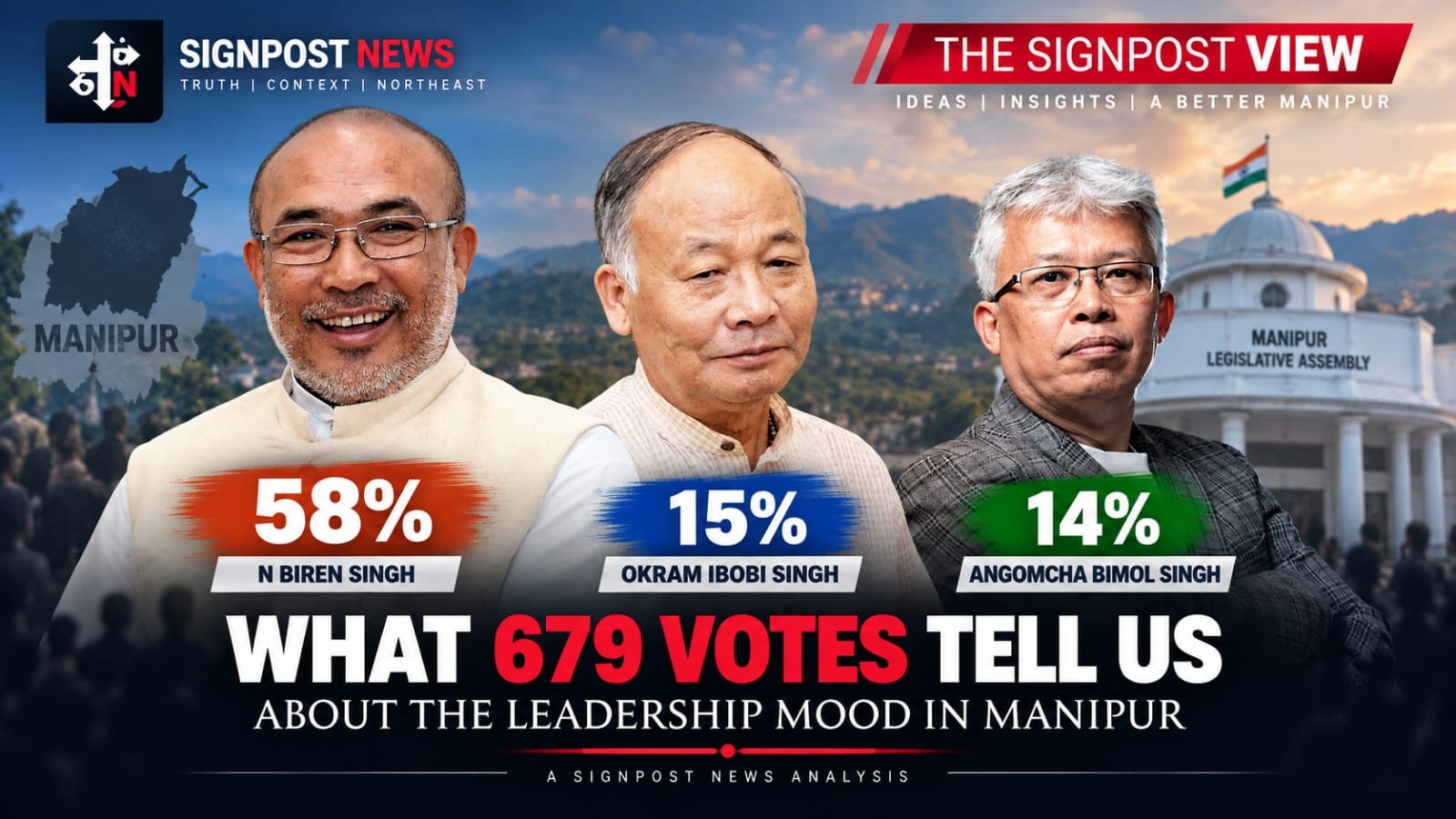
For one month, from August 15 to September 15, Signpost News asked its readers a simple but difficult question: “Which leadership will heal Manipur now?”
The poll drew 679 votes. Former Chief Minister N. Biren Singh received 397 votes, or 58 per cent. Former Chief Minister Okram Ibobi Singh received 102 votes, or 15 per cent. Inner Manipur MP Angomcha Bimol Akoijam received 96 votes, or 14 per cent. “Others” accounted for 74 votes, or 11 per cent, while Chief Minister Yumnam Khemchand Singh received 10 votes, or 2 per cent.
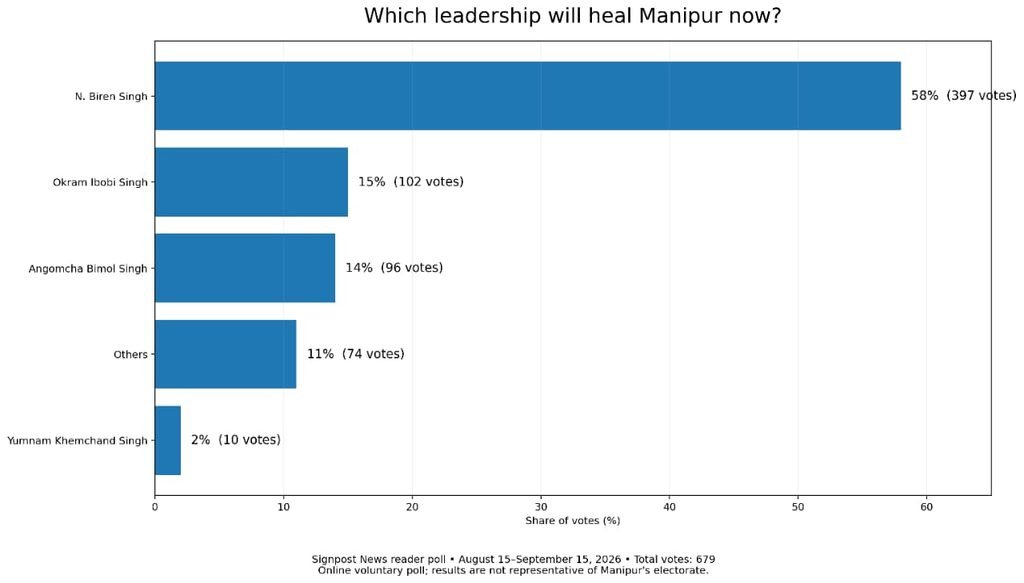
These numbers should not be mistaken for an election forecast. This was an online reader poll, not a scientific opinion survey based on a representative sample of Manipur’s electorate. Participation was voluntary, and the poll was also circulated through social media. It therefore tells us about the choices made by those who encountered and participated in this particular poll—not how Manipur as a whole would vote.
Still, 679 responses are enough to make the result worth examining, particularly because the poll ran during an eventful month in Manipur politics.
Why does Biren Singh remain prominent in this poll?
The clearest numerical feature is the 58 per cent recorded by N. Biren Singh.
There are several possible reasons, but the poll itself cannot tell us which one motivated individual voters. One relevant political context is the continuing debate over the National Register of Citizens and the Census.
Biren Singh met Union Home Minister Amit Shah in New Delhi on August 17 and raised the demand for an NRC before the Census, along with displacement and resettlement issues. Signpost News reported at the time that he submitted a detailed letter dated August 15 seeking reconsideration and deferment of Census operations amid continuing displacement.
The NRC question subsequently became one of the dominant issues of the September Assembly session. On September 2, the Manipur Legislative Assembly reaffirmed its earlier resolutions of August 2022 and March 2024 urging the Centre to update the NRC before conducting the Census.
Home Minister Govindas Konthoujam later told the Assembly that 1951 would be the base year for the proposed NRC update and that records of the 1951 NRC were being traced. He also said the State Government could not implement the exercise without the Centre’s approval.
That chronology matters because the first of the Assembly’s earlier NRC resolutions was adopted in 2022, when Biren Singh headed the government. It provides one plausible context for why his name continued to resonate with participants in a poll conducted while NRC and Census questions were again dominating public discussion. It does not, by itself, establish why the 397 participants selected him.
Ibobi’s 15 per cent comes with another political signal
Okram Ibobi Singh finished with 102 votes, or 15 per cent, narrowly ahead of Angomcha Bimol Akoijam in this poll.
His result is worth reading against his increasingly visible interventions on Manipur’s current problems.
During the September Assembly session, Ibobi pressed the government over the NRC issue and questioned the absence, at that stage, of a formal Central notification. The exchanges became heated before the House ultimately reaffirmed its previous NRC resolutions.
More recently, speaking at a tribute in New Delhi for Chongtham Vikram Singh, Ibobi delivered a line that travelled well beyond the gathering:
“We the Manipuri never, never bow down to any people.”
He ended by saying Manipur would not bow down until it received justice.
Whether one agrees with Congress leader Ibobi politically or not, the intervention put him prominently into the public conversation during the closing days of the Signpost poll.
Bimol’s 14 per cent is also significant to understanding the poll
Angomcha Bimol Akoijam was only six votes behind Ibobi: 96 against 102.
Bimol has repeatedly raised Manipur-related questions in Parliament. PRS Legislative Research records, among his 2026 interventions, a March 30 matter concerning verification of illegal immigrants before the Census and delimitation process, and an August 11 intervention seeking review of the Suspension of Operations arrangement and free movement of goods and people in Manipur.
His showing in this reader poll therefore comes against a background of continued parliamentary visibility on issues directly affecting Manipur.
Interestingly, the combined figures for Ibobi and Bimol amount to 29 per cent, but they should not be treated as a common political bloc. They represent different political positions and different kinds of leadership, and an online poll does not tell us whether their respective supporters share broader political preferences.
The figure that raises a question is Khemchand’s 2 per cent
Perhaps the result most deserving of examination is that of the incumbent Chief Minister.
Yumnam Khemchand Singh received 10 of the 679 votes—2 per cent—in this particular poll.
That figure needs careful interpretation. It cannot establish his popularity across Manipur, much less predict an election result. But the contrast between incumbency and the response from this group of participants is notable enough to raise a question: why did so few participants select the sitting Chief Minister when asked which leadership could heal Manipur?
Khemchand’s government has said that restoring peace and normalcy remains its priority. During the Assembly session, he spoke about strengthening the police and improving law and order, while stressing collective responsibility in restoring normalcy.
The Assembly under his government also reaffirmed the NRC-before-Census demand. And in recent days, government representatives have said the State will continue pursuing the Centre for an early NRC exercise while appealing to protesters to allow normal functioning of government offices.
The poll therefore presents a contrast rather than an answer: government action and assurances on one side, and a very small share for the incumbent among these 679 respondents on the other.
What the poll can—and cannot—tell us
Signpost News also took measures to reduce straightforward repeat voting. The poll configuration used both cookie-based and IP-based blocking, with a two-hour blocking period. Guest voting was permitted.
Those safeguards make casual rapid repeat voting more difficult, but they do not turn an online poll into a scientific survey. Cookie deletion, changing networks, shared IP addresses and the two-hour expiry can all affect participation. We therefore should not claim that every vote necessarily represents one unique individual.
Nor should these percentages be extrapolated to Manipur’s electorate.
What the poll does capture is something narrower but still useful: the leadership preferences expressed by 679 participants who responded to a Signpost News question during a politically intense month.
And the pattern is striking.
A former Chief Minister no longer holding the state’s top office received 58 per cent. Another former Chief Minister and the sitting Inner Manipur MP were separated by only six votes. The sitting Chief Minister received 2 per cent.
Manipur’s recent Assembly proceedings show how unresolved the larger questions remain—peace and law and order, the return and rehabilitation of internally displaced people, free movement, immigration and the NRC. Official Assembly records also show Ibobi urging the government to prioritise restoration of normalcy and improve law and order, while Khemchand has described peace-building as a collective responsibility.
That may ultimately be the more important message behind this poll.
The question asked was not “Who will win the next election?”
It was “Which leadership will heal Manipur now?”
For the 679 people who chose to answer it, the distribution of their responses offers a snapshot of the political mood within this particular Signpost audience. It is not Manipur’s verdict. But at a time when questions of security, displacement, free movement, NRC and reconciliation continue to dominate public life, it is a snapshot worth recording.