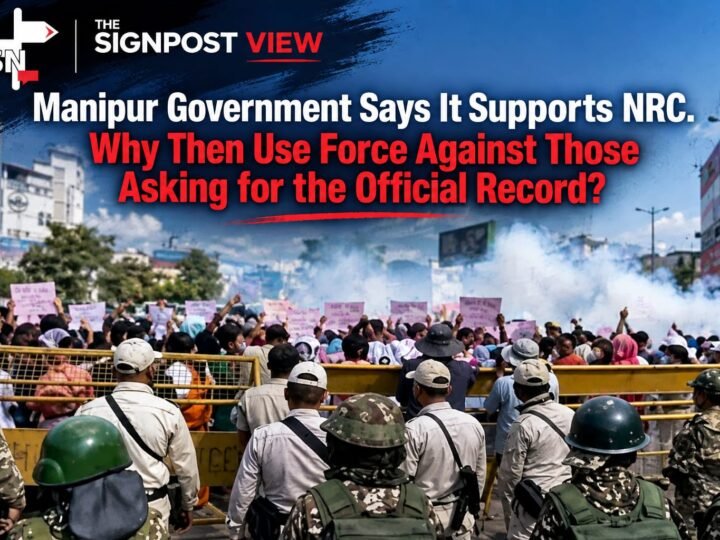
The debate over a National Register of Citizens (NRC) in Manipur is often framed as a political confrontation between communities. That framing misses the more fundamental issue. Manipur has a historical citizenship-documentation problem.
Government of India records show that people crossed into Manipur from Burma decades ago, that the nationality of some of those migrants was difficult to establish, and that relief and rehabilitation proceeded even while questions over their precise status remained.
That documentary history makes the case for an NRC stronger than any political slogan could. The 1967 Record Cannot Be Wished Away
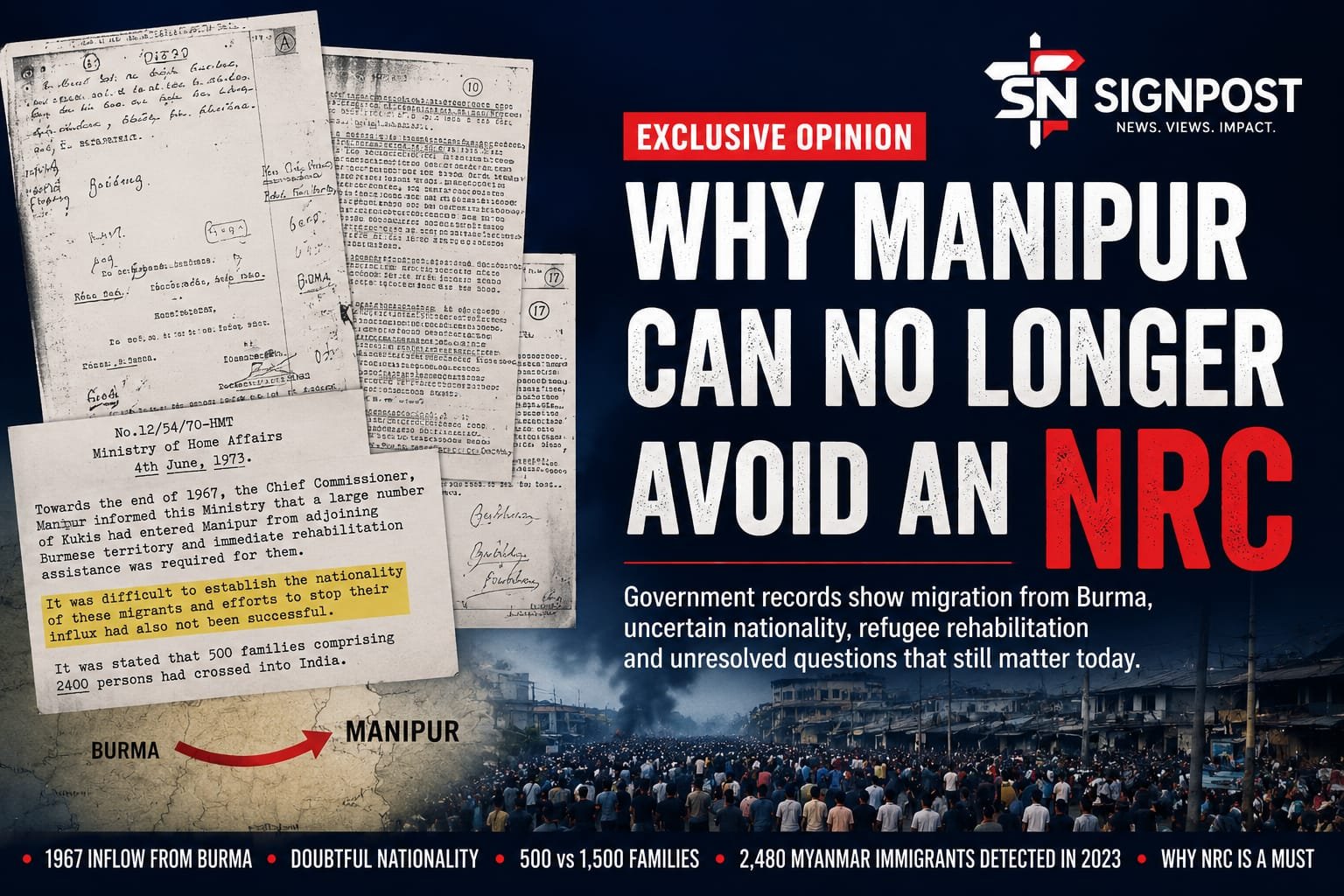
A Ministry of Home Affairs file noting dated June 4, 1973, prepared by Under Secretary R.C. Iyer, records that towards the end of 1967 the Chief Commissioner of Manipur informed the Centre that a large number of Kukis had entered Manipur from adjoining Burmese territory. The document records approximately 500 families comprising around 2,400 persons crossing into India.
More significantly, it states that it was “difficult to establish the nationality of these migrants” and that efforts to stop the influx had not been successful. That is not an allegation made in 2026. It is what the Government of India recorded about the situation.
Another government file makes the administrative uncertainty even clearer. The Department of Rehabilitation noted that the persons concerned were not regarded as repatriates but as “Kuki migrants of the doubtful nationality.”
Rehabilitation Was Not Citizenship
India had a humanitarian responsibility towards people requiring assistance, and the Government responded accordingly. The records show that ₹1 lakh was sanctioned for relief and that a rehabilitation scheme was proposed for the approximately 500 families, including settlement on land. The estimated requirement was ₹3,62,500.
But humanitarian rehabilitation and citizenship determination are two different things. A refugee may legitimately receive food, shelter, financial assistance and rehabilitation without those measures themselves constituting a determination of Indian citizenship. The archival files demonstrate that government departments themselves struggled with this distinction.
A January 28, 1972 noting concerning approximately 500 Kuki families described them as being of doubtful nationality and having been squeezed out of Burma. It recorded that 130 families had already been covered while others remained to receive assistance.
A February 1972 record similarly discusses whether the Rehabilitation Department should take over the matter and notes the position that the Kuki families concerned were not repatriates.
If their status had been straightforwardly settled from the beginning, why did this administrative debate arise? That question deserves an archival answer.
From 500 Families to 1,500: A Discrepancy That Needs Explanation
Then comes one of the most important questions in the historical record. The MHA account refers to approximately 500 families comprising 2,400 persons. Yet a June 20, 1973 letter from Lok Sabha MP P. Paokai Haokip concerning Burma refugees in Manipur referred to approximately 1,500 refugee families and sought further rehabilitation assistance.
That is a threefold difference in the number of families. There may be an administrative explanation. The two records could have covered different groups or periods. The original enumeration could have been incomplete. Additional refugees might have arrived subsequently.
But the discrepancy cannot simply be ignored. Where did the additional families come from? When did they arrive? Were they registered? What was their nationality? Were they refugees, migrants, repatriates or Indian citizens returning from Burma? How many eventually remained in Manipur?
An NRC accompanied by a historical citizenship audit provides an opportunity to answer precisely these kinds of questions.
The Later Repatriate Question
The documentary chain becomes more complicated when records from the 1980s are examined. Government files concerning 23 families in Senapati district record later efforts to establish their antecedents. They were reportedly said to have entered India through Tengnoupal on December 20, 1967. Yet the later record acknowledged that they did not possess refugee cards, although they were reportedly enlisted with the Burma Kuki Refugee Association.
The Union Government sought further particulars, including where each person had been repatriated from, the date of repatriation and particulars of repatriation documents, “if any.” By December 1983, the Government of Manipur reported that 23 of 24 cases had been found genuine for the purpose under examination.
But consider the chronology.
The reported entry occurred in 1967.
Important verification took place many years later.
The administrative determination followed roughly a decade and a half after the reported crossing. It demonstrates something different and extremely important: The longer citizenship and nationality questions remain unresolved, the harder their documentary reconstruction becomes.
What Happens After Several Generations?
This is where the historical question becomes relevant to Manipur in 2026. A person whose nationality was initially uncertain may subsequently acquire residence-related documents. Children may be born and attend school. Families may acquire other civil records. Names may eventually enter electoral rolls.
After several generations, descendants may possess extensive documentation. Those documents are important and cannot simply be dismissed. But where the original nationality itself was unresolved, later documents do not necessarily tell us what happened at the beginning of the chain.
A birth certificate establishes birth. An electoral entry establishes electoral registration. A residence document establishes recognised residence. But none automatically answers every historical citizenship question concerning the preceding generation.
This is why Manipur’s problem cannot necessarily be resolved merely by checking one contemporary document against another.
Where necessary and permitted by law, the documentary chain must be capable of being traced backwards.
What 2,400 People Illustrate After Five Decades
There is also a demographic reason why unresolved nationality questions become progressively harder to address.
Official statistical series for Kuki-unspecified mother-tongue categories show substantial population growth over the decades. Using those historical rates merely as a demographic illustration, the approximately 2,400 persons mentioned in the archival record would correspond to a population of roughly 15,000–16,000 by 2026 if they hypothetically experienced a similar long-term rate of natural population growth.
An unresolved nationality question involving a few thousand people can become a much larger documentary question after five decades and several generations.
And the historical record contains the still-unresolved reference to approximately 1,500 refugee families in 1973, making reconciliation of the archival figures all the more important.
The lesson is simple. Citizenship questions are easiest to settle when migration occurs. They become progressively more difficult when governments postpone them for generations.
Then Came Another Myanmar Crisis
The historical problem would be less urgent if cross-border movement had ended decades ago. It did not.
Following the February 2021 military takeover in Myanmar, displacement again increased along India’s eastern frontier. By February 2023, the Government of Manipur had constituted a Cabinet Sub-Committee to guide the State Population Commission and other authorities on the “identification of Myanmarese immigrants/refugees in the State.”
This time the State attempted systematic identification. A June 6, 2023 report of the Inspector General of Police concerning verification in five hill districts recorded 2,480 Myanmarese immigrants detected in the areas covered by the exercise.
The accompanying table recorded 1,147 in Tengnoupal, 1,175 in Chandel and 154 in Churachandpur, while also recording cases in Kamjong. The existence of Myanmar-origin immigration into contemporary Manipur therefore does not rest upon political allegation. The State Government itself documented it.
Census Cannot Answer the Citizenship Question
This distinction becomes particularly important as Manipur debates Census, delimitation and NRC.
A Census essentially asks: Who is living here?
An NRC asks another question: Who is an Indian citizen?
The two exercises should not be confused.
A State sharing an international border, possessing archival evidence of migration and unresolved nationality questions, and experiencing renewed cross-border movement has legitimate reasons to establish its citizen population.
That does not mean Census is unnecessary. It means Census cannot substitute for citizenship determination.
If population figures subsequently become the basis for delimitation, representation, resource allocation and policymaking, resolving the citizenship question beforehand becomes even more consequential.
NRC Must Cover the Whole of Manipur
There must, however, be one non-negotiable condition. An NRC cannot become an ethnic exercise. It must cover every district, every community and every part of Manipur — hills and valley alike.
The same documentary standards must apply to Meiteis, Kukis, Nagas, Pangals and every other community. No tribe should be collectively suspected. No community should be collectively certified. No geographical area should receive immunity from verification.
An Indian citizen is an Indian citizen irrespective of ethnicity. A refugee remains entitled to humane treatment. A foreign national’s status must be determined according to law. These distinctions are precisely what an impartial NRC should establish.
After more than five decades of unresolved questions, Manipur should no longer leave citizenship to political assertion, demographic speculation or ethnic suspicion.
When the Government’s own archives document cross-border migration and unresolved nationality, citizenship verification is no longer merely a political demand. It becomes a responsibility of the State.