The claim that remoteness may have left substantial indigenous hill populations outside the 1951 Census deserves examination. But Manipur’s documentary history stretches well before 1951, while the 1948 election provides another important pre-cut-off record. If mass exclusion is the argument against 1951, the historical evidence of that exclusion should be produced.
The opposition to 1951 as the proposed base year for an NRC in Manipur has now produced an argument that deserves serious examination.
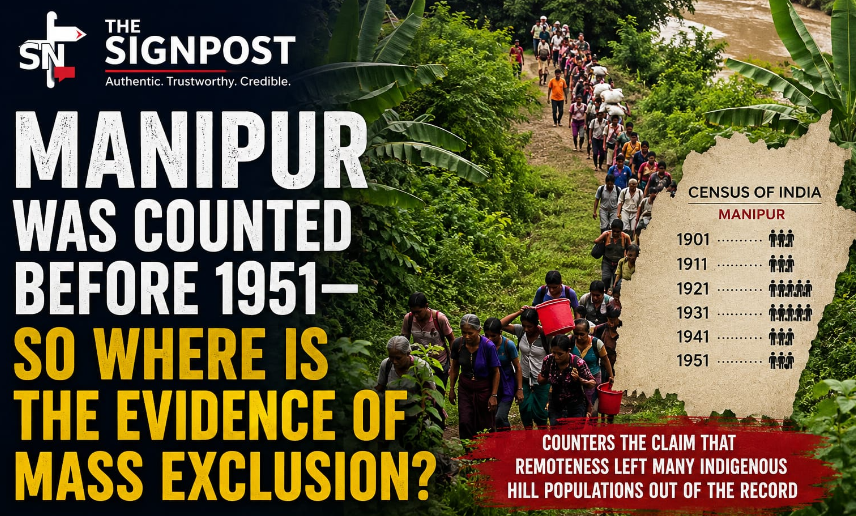
Kuki-Zo Council spokesperson Ginza Vualzong has said that Manipur’s hill areas were extremely remote in 1951, road connectivity was poor and many villages could not be reached by vehicles. As a result, he argues, many villages and their inhabitants may not have been recorded.
The concern deserves to be heard. If a genuine indigenous family was living in Manipur before 1951 but was omitted because an enumerator never reached its village, no fair NRC should casually turn that administrative failure into a citizenship crisis for its descendants.
But there is an equally important distinction. The possibility that individuals or even particular settlements were missed is not, by itself, evidence that substantial indigenous populations were excluded from Manipur’s historical record.
And if such mass exclusion is now being advanced as a reason to reject 1951, Manipur is entitled to ask: Where is the evidence?
Manipur’s Documentary History Did Not Begin in 1951
The first problem with treating 1951 as though it were Manipur’s first encounter with population documentation is historical. It was not.
Manipur had a much longer history of population enumeration before 1951. Historical Census material relating to Manipur goes back into the nineteenth century, while official Census records preserve a population series through successive decennial exercises in the decades before and after Independence.
There were Census exercises in 1901, 1911, 1921, 1931, 1941 and then 1951. This does not mean every one of those exercises was perfect. No serious argument should pretend that historical censuses were incapable of omission, especially in difficult terrain.
But successive enumeration changes the nature of the present claim. The question is no longer simply whether one enumerator could have failed to reach one remote household in 1951. The question becomes whether families and communities living continuously in Manipur for generations would have left no documentary trace across successive Census, electoral, village and administrative records.
That is a question historical evidence can help answer.
Then Came the 1948 Election
There is another important documentary layer immediately before 1951. Manipur held its historic State Assembly election in 1948.
The significance of that election for the present NRC debate should not be overstated, but neither should it be ignored. An election requires constituencies, electoral rolls, identification of eligible voters, polling arrangements and an administrative machinery capable of conducting the exercise. And the political structure of the time provided representation extending to the hill areas.
The 1948 electoral records therefore offer another potential source for examining who was documented in Manipur immediately before 1951.
Again, an electoral roll is not an NRC. Nor does absence from an electoral roll automatically establish that a person was not resident in Manipur. Children would obviously not appear, and other eligible residents may also have been omitted for various reasons.
But if the argument is that remoteness resulted in substantial numbers of bona fide adult residents being left outside the documentary system, another question follows: Was that exclusion complained of at the time?
Were claims for inclusion submitted? Were particular villages recorded as inaccessible? Were electoral rolls challenged because whole settlements were absent? Did administrative authorities acknowledge such omissions? Do surviving records contain petitions or corrections?
These questions matter because an assertion about what happened in 1951 should, wherever possible, be tested against evidence produced around that period.
Individual Omission Is Not Mass Exclusion
This distinction should become central to the debate.
Suppose a genuine indigenous family cannot find an ancestor in a particular 1951 record. That deserves investigation. It does not follow that the family has no history in Manipur. Other records may establish it.
But suppose the argument goes much further and says substantial indigenous populations were not recorded because the hills were inaccessible. That is a historical proposition capable of investigation.
Which villages? How many? In which subdivision? Were they absent only in 1951, or also in earlier Census records? Were their residents present in electoral or administrative records? Were omissions subsequently corrected?
The burden should not be placed entirely upon a citizen seventy-five years later. Government archives must also be examined. But neither should a possibility be transformed into historical fact merely through repetition.
If mass exclusion is the argument against 1951, mass exclusion needs evidence.
A Cut-Off Does Not Mean One Document
There is also a practical way to protect genuine indigenous citizens without abandoning 1951 merely because historical documentation may contain gaps.
A cut-off date and the documents accepted to establish presence before that cut-off are different things. An NRC based on 1951 need not mean that every citizen must produce one particular Census paper carrying an ancestor’s name.
A legally designed verification mechanism could examine multiple credible historical records. Earlier electoral rolls, Census records, recognised village or administrative records and other contemporaneous documents may all be relevant. Later generations could establish family linkage to a person whose pre-cut-off presence is independently verified.
Exactly which documents should be admissible is a matter for the competent authorities and the legal framework governing any NRC exercise. There should also be a transparent appeal mechanism for genuine cases where records are missing, damaged or demonstrably incomplete.
That is how an exceptional historical omission should be addressed. Difficulty in producing one document is an argument for allowing credible alternative evidence. It is not automatically an argument for abandoning 1951.
Records Before 1951 Matter — So Do Records After It
There is another reason why the historical line cannot simply be dismissed. Manipur’s archives and published accounts also contain references to refugee movement from Burma after Independence.
Records relating to specific Kuki refugees from Burma, refugee assistance and later representations associated with the Burma Kuki Refugee Association, Manipur have entered the public discussion.
These records require careful handling. They cannot legitimately be used to claim that every Kuki living in Manipur is a refugee. That would be a sweeping and unjust conclusion. Indigenous Kuki communities existed in Manipur independently of later refugee movements.
But acknowledging indigenous Kuki history does not require Manipur to pretend that documented later refugee movements never occurred. Both can be historically true. There can be indigenous Kuki families whose roots in Manipur predate 1951, and there can also have been later Kuki refugees arriving from Burma.
Ethnicity cannot distinguish between those histories. Records can. That is one reason citizenship verification matters.
What Happened to the Recorded Refugees?
Historical refugee records also produce questions that should be answered through government documentation rather than political speculation.
If particular people were officially recognised as refugees and received relief or rehabilitation assistance, what subsequently happened to them? Were they repatriated? Did they remain in Manipur? Were some eventually granted Indian citizenship? If citizenship was granted, under what provisions and to how many? What records document that transition? And what is the legal status of their descendants today?
These are legitimate questions. They are not predetermined conclusions.
A refugee can, depending on the applicable law and circumstances, subsequently acquire citizenship. If that happened lawfully, the resulting citizenship must be respected. But there should be a documentary trail.
The State and Union governments are better placed than competing political organisations to produce it. Where historical refugee records exist, open them. Where naturalisation or citizenship records exist, establish what they show. Where people were repatriated, document that. Where records are incomplete, acknowledge the gap.
Manipur should not have to settle its demographic history through rumours when government archives may contain answers.
NRC Must Verify Individuals, Not Condemn Communities
This is where the debate requires restraint from every side. The NRC cannot become a mechanism for declaring one ethnic community indigenous and another foreign.
The standard must apply equally. A genuine indigenous Kuki family should be able to establish its pre-cut-off history without fear. So should a Naga family, a Meitei family and a Pangal family. The same scrutiny should apply to anyone who entered after the accepted cut-off, irrespective of ethnicity.
There should be no collective accusation. But there cannot be collective exemption either.
One historical benchmark. Multiple legitimate forms of evidence. One legal standard for everyone.
That is a much stronger defence of indigenous rights than an ethnic contest over who belongs.
What Evidence Exists of the Alleged Exclusion?
We therefore return to Ginza Vualzong’s concern.
His argument has value because it identifies a genuine danger any historical NRC must guard against: wrongful exclusion. But the response to that danger should be safeguards, evidence and verification.
If particular indigenous villages were omitted from the 1951 Census, identify them. If earlier Census exercises also failed to record them, establish that. If contemporary officials acknowledged that certain areas could not be enumerated, produce those records. If electoral rolls omitted whole settlements, examine the rolls. If residents protested their exclusion, locate those petitions. If administrative correspondence documented the problem, place it before the public.
Such evidence would materially strengthen the argument that 1951 requires special safeguards. But until then, an apprehension that people may have been missed cannot carry the same evidentiary weight as proof that substantial indigenous populations actually were excluded.
Protect the Exceptional Case — Do Not Erase the Benchmark
Manipur should therefore avoid two equally damaging extremes.
The first would be an inflexible NRC that says: Your ancestor’s name is absent from one 1951 document, therefore you do not belong. That would be unjust.
The second would say: Historical records may contain omissions, therefore no historical cut-off can be used. That would make meaningful verification almost impossible.
There is a reasonable position between them. Retain the benchmark, broaden legitimate documentary evidence, examine Manipur’s pre-1951 records, digitise whatever historical rolls survive, allow family linkage under clearly defined rules, create safeguards for genuinely under-documented indigenous settlements, provide appeal and review, and apply precisely the same standard to everyone.
Manipur Was Counted Before 1951
Ultimately, that is the historical fact around which this debate must proceed.
Manipur did not suddenly appear on a Census map in 1951. Its people had been counted before. Its population had appeared through successive enumeration exercises. It had conducted an elected Assembly exercise before 1951. Administrative and village histories existed. And records also exist concerning migration and refugee movements afterwards.
The archive therefore runs in both directions. That is why Manipur should use it.
If substantial indigenous populations were genuinely excluded in 1951, identify the villages, produce the contemporary evidence and establish the omission. Where genuine individual gaps existed, protect those families through alternative evidence and a fair appeal mechanism.
But the possibility that somebody might have been missed cannot, by itself, become proof that Manipur’s indigenous population was broadly undocumented. Nor should it become sufficient reason to discard 1951 without first examining the records that came before it.
The NRC debate does not need another contest of competing fears. It needs evidence.
Manipur was counted before 1951. If mass exclusion is the argument for rejecting 1951, show Manipur the record.