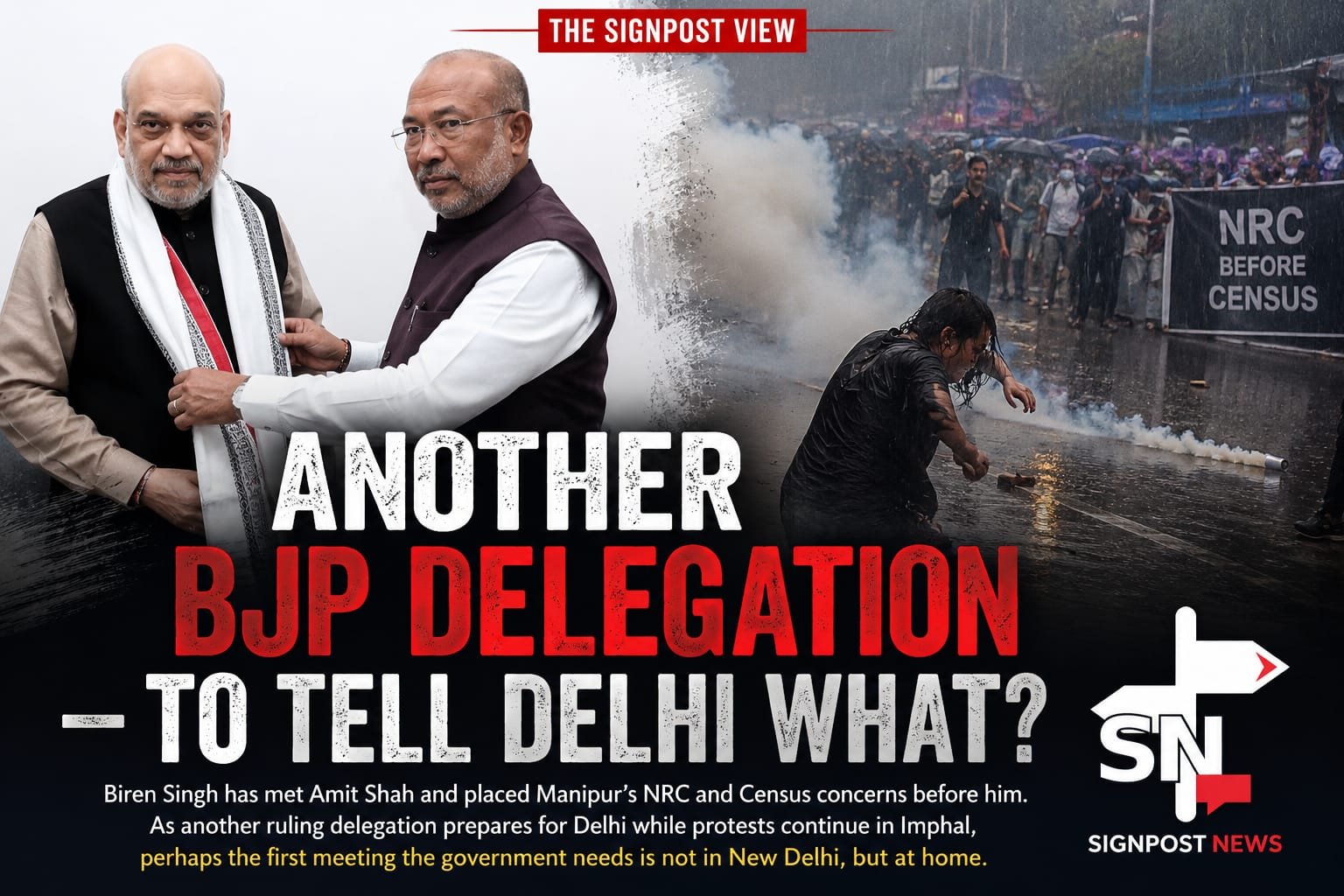
N. Biren Singh has already met Amit Shah and placed Manipur’s NRC and Census concerns before him. As another ruling BJP delegation prepares for Delhi while students and civil society organisations protest in Imphal, perhaps the first meeting the government needs is not in New Delhi, but at home.
KEY POINTS
- Former Chief Minister N. Biren Singh met Union Home Minister Amit Shah in New Delhi on August 17 and raised Manipur’s demand for NRC before Census, along with other issues facing the State.
- During the meeting, Biren placed before Shah a detailed letter dated August 15 seeking reconsideration and deferment of Census operations amid continuing displacement and incomplete resettlement.
- Another team of ruling legislators is now expected to travel to Delhi to raise the NRC and related concerns again.
- Meanwhile, students and civil society organisations demanding “NRC before Census” remain on the streets, with confrontations between protesters and security forces resulting in reports of injuries.
- Before sending another delegation to Delhi, the State government should sit with the protesting organisations, students and other stakeholders and attempt to formulate a clear position that Manipur can carry together.
- The question is no longer whether Delhi has heard Manipur. It is what another delegation is expected to tell Delhi that Delhi has not already been told.
Another BJP delegation is preparing to go to Delhi. But to tell Delhi what?
That question may sound provocative. It is not. It is necessary.
Former Chief Minister N. Biren Singh has just met Union Home Minister Amit Shah in New Delhi. He raised Manipur’s demand for an updated National Register of Citizens before the Census and discussed other issues confronting the State. He did not go empty-handed.
During the meeting, Biren also placed before the Home Minister a detailed letter dated August 15, seeking reconsideration and deferment of Census operations in Manipur. Delhi has therefore received the concern verbally. Delhi has received it in writing.
The Manipur Legislative Assembly has discussed demographic anxieties surrounding the Census. Civil society organisations have mobilised. Students are protesting. Women have joined the agitation. And now another group of legislators belonging to the ruling establishment is preparing to approach Delhi.
There is nothing wrong with going to Delhi. The question is what the next delegation intends to achieve, and what it expects to bring back.
Biren Has Already Put the Case Before Shah
The sequence matters.
On the evening of August 17, Biren met Amit Shah in New Delhi. During that meeting, he raised the NRC-before-Census demand and other issues concerning Manipur. He also submitted the detailed letter dated August 15.
That letter is important because its argument goes beyond the political slogan of “NRC before Census.” It raises a fundamental question: Can a Census conducted while thousands of citizens remain displaced accurately represent Manipur’s settled demographic and residential reality?
Meitei families displaced from Churachandpur, Moreh and other areas remain away from their original homes. Kuki families displaced from Imphal and surrounding areas are similarly living away from their previous residences. Homes have been destroyed. Rehabilitation remains incomplete. Return and permanent resettlement have not been achieved for many families.
Every citizen must be counted. That is not in dispute. The concern is whether a Census conducted under extraordinary displacement could record a temporary geography created by conflict as though it were Manipur’s settled demographic pattern.
In a State where population figures intersect with identity, political representation, land and future delimitation, this is not a minor procedural concern. It deserves an authoritative answer.
Delhi Cannot Say It Has Not Heard
The significance of Biren’s meeting is therefore larger than a political courtesy call.
The NRC and Census concerns reached the Union Home Minister directly. They were communicated face to face. They were also placed before him in writing.
This was hardly the first time Delhi had heard Manipur raise the NRC question. The State Assembly has dealt with the demand. Political leaders have raised concerns over illegal immigration and demographic change. Civil society organisations have organised rallies and campaigns. Students are now protesting.
The issue has travelled from public meetings to the Assembly, from Imphal to New Delhi, and finally to a direct meeting with the Union Home Minister.
The problem can no longer reasonably be described as Delhi not knowing what Manipur wants. The question is whether Delhi has decided what it intends to do.
Another BJP Delegation — To Tell Delhi What?
That brings us to the proposed visit by another team of legislators.
Representatives of a State have every right to approach the Union Government. In many circumstances, repeated political engagement becomes necessary. But this particular visit requires clarity.
The former Chief Minister who has just met Amit Shah belongs to the BJP. The present Manipur government is BJP-led. The legislators preparing to approach Delhi belong to the ruling establishment. And the Union Home Minister they hope to approach is the same Amit Shah before whom Biren has just placed the issue.
So what precisely is the next delegation going to tell Delhi?
If it is going to seek a decision, say so. If it is carrying a new proposal, place that proposal before the people. If it is seeking a specific administrative or legal mechanism for sequencing NRC and Census, explain what that mechanism is.
If it intends to carry a negotiated position representing the State government, protesting organisations and other stakeholders, such a delegation could carry considerable political weight.
But if the purpose is simply to repeat that Manipur wants NRC before Census, Delhi already knows. Another memorandum cannot substitute for an answer.
First Meet the People Protesting in Imphal
Before another delegation boards a flight to Delhi, there is one meeting the government can arrange without waiting for an appointment. A meeting in Imphal.
Sit with the JFD. Sit with the student representatives. Sit with civil society organisations. Sit with the people whose anxieties have brought them onto the streets.
Listen to precisely what they are demanding. Then explain what the State Government can legally and administratively do. Explain what requires the authority of the Union Government.
Discuss the Census timetable. Discuss NRC. Discuss illegal immigration. Discuss continuing displacement. Discuss how internally displaced citizens will be enumerated. Discuss the possible implications for future delimitation and political representation.
Where there is disagreement, identify it. Where there is consensus, record it. Then take that position to Delhi.
The next delegation could then tell the Union Government something considerably stronger than: “Some organisations in Manipur are demanding this.”
It could say: “We have spoken to the stakeholders. This is the position that has emerged from Manipur.”
That is no longer merely a representation. That is a negotiating position.
One State Cannot Speak in Two Opposite Scenes
The need for dialogue becomes even more urgent when one looks at what is happening on the streets.
Students and civil society organisations demanding NRC before Census have intensified their agitation. Census-related activities and training have become sites of confrontation. Security forces have used crowd-control measures. There have been reports of tear gas. There have been allegations of lathi charges on students.
And on August 18, another confrontation occured at the Imphal East DC complex at Porompat, where a woman was reportedly injured after police used a stun grenade as protesters attempted to enter the complex.
The precise circumstances surrounding each confrontation must be established fairly. Police have a responsibility to maintain public order. Protesters have a responsibility to remain within democratic and lawful means. But neither fact removes the political contradiction.
In Delhi, Manipur’s political leaders are asking the Union Government to listen to concerns over NRC and Census. In Imphal, citizens raising substantially the same unresolved concern are confronting police barricades.
Can these really remain two separate conversations?
A State cannot convincingly tell Delhi that a demand deserves serious consideration while allowing its relationship with those making that demand at home to deteriorate into repeated street confrontation.
The first instrument of democratic government should be dialogue. Force should never become a substitute for politics.
A Stun Grenade Cannot Answer a Political Question
The scenes from the protests contain a simple lesson.
A stun grenade can disperse a crowd. It cannot answer whether NRC will precede Census. Tear gas can clear a road. It cannot explain how displaced citizens will be enumerated. A barricade can stop students from entering an office. It cannot resolve fears about illegal immigration, demographic change or future delimitation.
Those are political questions. They require political answers. And when the government itself believes the NRC concern is serious enough to send legislators to Delhi, it becomes even more important for that government to engage those raising the concern in Imphal.
Otherwise, the message becomes difficult to understand. Is the demand legitimate when expressed by legislators in Delhi but unacceptable when expressed by students on the streets of Imphal? The government should ensure that such an impression is never allowed to take root.
Getting an Appointment Is Itself a Political Reality
There is another practical reason why dialogue in Imphal should come first.
Access to the Union Home Minister cannot simply be assumed. During Manipur’s prolonged crisis, political leaders have repeatedly travelled to New Delhi, and obtaining meetings with the highest levels of the Union Government has itself often become politically significant.
That makes Biren’s August 17 meeting important. He secured the meeting. He sat across the table from Amit Shah. He raised the NRC-before-Census concern. He placed the written case before the Home Minister.
Another delegation may travel to Delhi and again have to seek appointments before it can make its case.
Meanwhile, Manipur will not stop moving. Students will continue protesting. Civil society organisations will continue demanding answers. Census preparations will continue to generate controversy. Security forces and protesters may again find themselves facing each other across barricades.
Before waiting for another appointment in Delhi, the government can arrange one immediately in Imphal. With its own people.
NRC and Census Are Different. The Sequencing Question Remains
Responsible public debate must preserve an important distinction.
The Census and NRC are not the same exercise. The Census counts the population and gathers demographic information. An NRC exercise concerns citizenship determination under a different legal and administrative framework.
Demanding NRC does not remove the need for an accurate Census. Conducting a Census does not automatically answer concerns about illegal immigration.
The dispute in Manipur is increasingly about sequence, credibility and consequence.
Those demanding NRC first fear that demographic data collected before citizenship concerns are addressed could later have consequences for representation and delimitation. There is also a separate concern about whether prolonged displacement could distort the residential picture recorded during enumeration.
The Union Government may accept these arguments. It may reject them. It may propose safeguards. But it should respond clearly.
Ambiguity is increasingly being translated into confrontation on the streets.
Is This a Communication Deficit or a Decision Deficit?
Repeated delegations raise another uncomfortable question. Is there really a communication problem between Imphal and Delhi?
The evidence increasingly suggests otherwise. Delhi knows the demand. The Union Home Minister has now heard it personally from a former Chief Minister. A written representation has been placed before him. The issue has been debated publicly and politically for years.
If another delegation must now travel to explain the same concern again, the problem may no longer be communication. It may be decision.
There could also be questions of coordination within the ruling establishment. Or repeated visits may serve the political purpose of demonstrating to an impatient public that leaders are continuing to press Delhi.
Those possibilities should not be presented as established motives without evidence. But they are legitimate questions for a democracy to ask.
The easiest way for the government to answer them is transparency. Tell the public what the next delegation is seeking. And when it returns, tell the public what Delhi said.
The Khemchand Government Has an Opportunity
The present government has an opportunity to change the direction of this confrontation. It does not have to wait for Delhi.
Call an all-stakeholder meeting. Bring the protesting organisations and students to the table. Bring the officials responsible for Census administration. Explain the legal position surrounding NRC. Place before the participants what the State has already communicated to the Centre.
Listen to the concerns surrounding displacement, enumeration, immigration and delimitation. Then identify what can realistically be demanded from Delhi.
Complete agreement may not emerge. Democracy does not require complete agreement before dialogue begins. But even disagreement around a table is preferable to disagreement across a police barricade.
A delegation carrying the outcome of such a dialogue would arrive in Delhi with something previous representations may not have possessed: a clearly articulated position built through consultation at home.
Manipur Needs More Than Another Photograph From Delhi
There may soon be another photograph from New Delhi. Legislators may stand beside Union leaders. A memorandum may be handed over. There may be another statement saying Manipur’s concerns were heard.
But that alone will no longer be enough.
Biren has met Amit Shah. He has placed the NRC and Census concerns before him verbally and in writing. The Assembly has discussed the demographic question. Civil society organisations have mobilised. Students have protested. Women have joined the agitation. And the streets have witnessed tear gas, allegations of lathi charges and reports of a stun-grenade injury.
Another delegation can still be useful. But only if it seeks something beyond another acknowledgement.
Manipur needs clarity.
Will NRC be undertaken? Will the Census timetable in Manipur be reconsidered? How will internally displaced citizens be enumerated? How will concerns over illegal immigration be addressed? What safeguards will ensure that extraordinary displacement does not distort demographic representation? And what exactly will the proposed delegation ask Delhi to decide?
These are questions of public policy. They deserve public answers.
Before the delegation leaves, the Khemchand government should ask itself one more question: Has it first listened to the people whose demand it is going to carry to Delhi?
If some of Manipur’s leaders are waiting in New Delhi for an appointment while students and civil society organisations continue protesting on the streets back home, Manipur will not be speaking with one voice.
So before another BJP delegation goes to Delhi to tell Delhi what it already knows, the government should first open its doors in Imphal.
Listen, explain, negotiate, and find the common ground. Then go to Delhi with something stronger than another memorandum. Go with Manipur’s voice, Delhi has heard Manipur, Now Manipur must first hear itself, Then Delhi must answer.