The nation celebrates the strength of Manipur’s women when they bring home medals, but appears unwilling to hear the same women when they raise democratic concerns about identity, demography and the future of their indigenous homeland.
KEY POINTS
- Mirabai Chanu’s Commonwealth Games gold made her an “inspiration for every Indian,” according to Prime Minister Narendra Modi.
- Bindyarani Devi also brought home a bronze, reinforcing Manipur’s extraordinary contribution to Indian sport.
- On August 17, girl students supporting the demand for an NRC update before the Census were reportedly lathi-charged during a confrontation with police at DM College of Teacher Education.
- The State has a responsibility to maintain order, but every use of force against democratic protesters must be necessary, proportionate and accountable.
- Meitei women cannot be celebrated only when they win medals for India. Their dignity and democratic voice must matter equally at home.
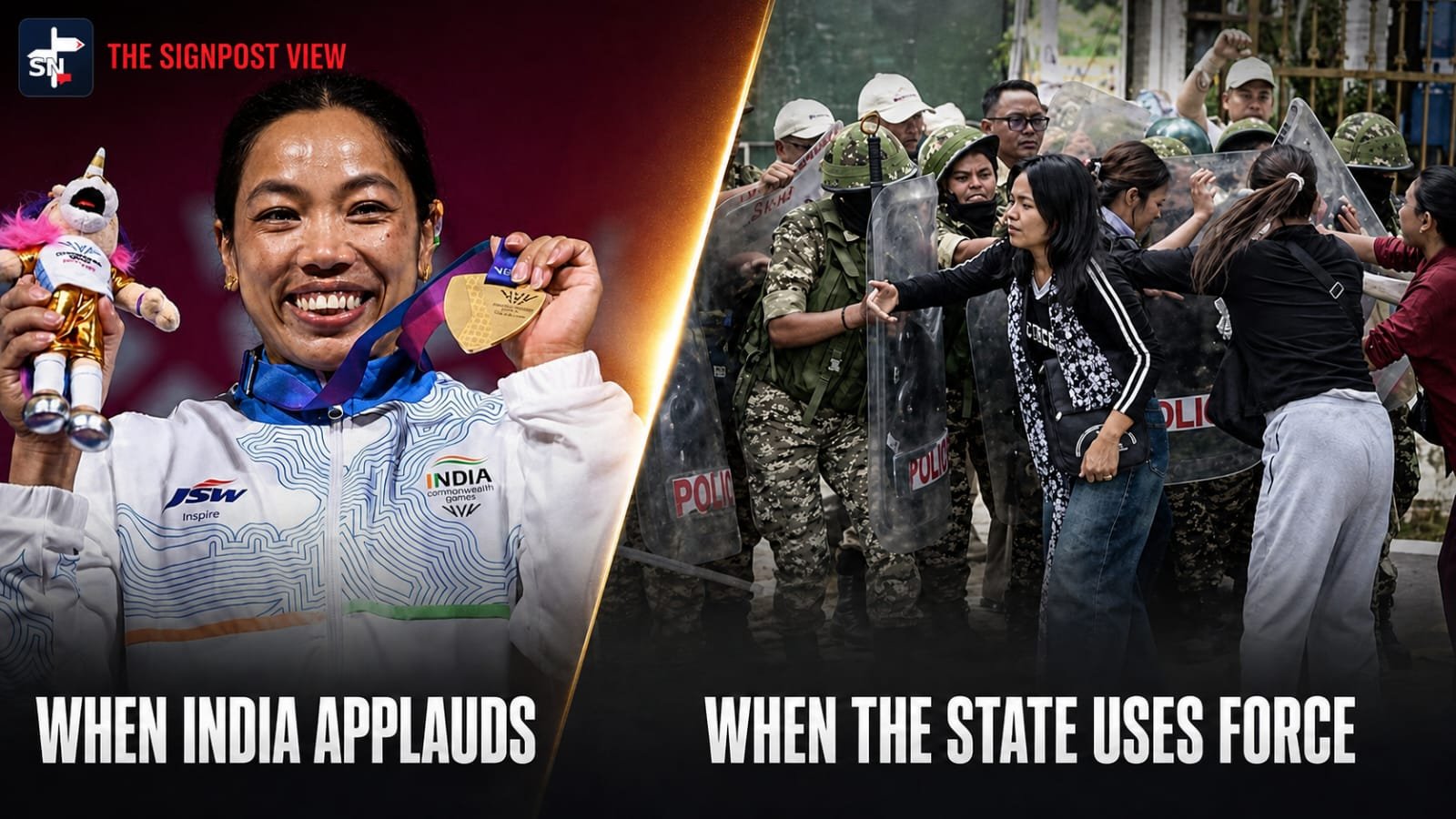
On July 26, Saikhom Mirabai Chanu stood on the Commonwealth Games podium in Glasgow after winning gold in the women’s 48 kg weightlifting event. She had lifted not merely 190 kilograms. She had lifted India’s expectations, Manipur’s pride and the dreams of countless young athletes watching from distant villages.
The country celebrated. Prime Minister Narendra Modi congratulated her, describing her victory as another glorious chapter in Indian weightlifting and calling her an inspiration for every Indian. Mirabai had secured her third successive Commonwealth Games gold and her fourth medal across four editions of the Games.
Sorokhaibam Bindyarani Devi also brought honour to the country by winning bronze in the women’s 58 kg category. Along with other athletes from the State, she helped Manipur contribute four medals to India’s Commonwealth Games tally. Once again, the women of Manipur had given India a reason to stand tall before the world.
Only weeks later, another image of Manipur’s women emerged. On August 17, members of the Students’ Wing of the Campaign for Just and Fair Delimitation marched to DM College of Teacher Education, where Census-related training was reportedly being conducted. Their demand was clear: the Census exercise should not proceed in Manipur unless the National Register of Citizens is first updated.
The confrontation intensified after the protesters entered the campus and raised objections to the training programme. Police intervened. In the scuffle that followed, girl students were reportedly lathi-charged. Some of them later broke down in front of the press, crying not out of defeat, but out of pain, humiliation and a deeper fear for the future of their indigenous homeland.
There may be different accounts of precisely what happened inside the campus. The police have a duty to protect public institutions. Protesters cannot claim an unrestricted right to obstruct an official programme or force their way into a training venue.
But that cannot be the end of the discussion.
The more important question is why a political and demographic concern that has mobilised students, women’s organisations and civil society across Manipur has been allowed to reach a point where the Government’s most visible response is the lathi, the barricade and the spectacle of young women weeping before cameras.
The Two Faces of India’s Recognition
The contrast is painful. When a Meitei woman lifts a barbell for India, the nation celebrates her strength. When Meitei girl students lift their voices over the future of their homeland, the State appears to treat that strength as a threat.
When Mirabai shed tears on the medal podium, national leaders recognised the pain, discipline and sacrifice behind those tears. When girl students cried in front of the press after police action at DM College of Teacher Education, their tears carried another meaning. They were not tears of sporting triumph. They were tears of shame, anger and wounded dignity. They were tears drawn from the same root that produced Mirabai’s courage: the root of an indigenous society that has taught its daughters to be brave, powerful and unafraid.
India cannot have two standards for recognising the courage of Manipur’s women: one for the international podium and another for the streets and campuses of Imphal. A medal-winning athlete and a girl student standing before the press with tears in her eyes may appear to occupy different worlds. In reality, they emerge from the same society.
Both have inherited resilience from generations of women who carried families, sustained local economies, defended neighbourhoods and stood at the forefront of Manipur’s public movements. Their strength is not created only inside a sports academy. It is cultivated in the fields, markets, kitchens, classrooms, relief camps and turbulent streets of Manipur. India cannot celebrate the product of that strength while disregarding the society that produces it.
A History of Women Refusing Silence
Meitei women have never been passive spectators to history. During the two Nupi Lan movements of 1904 and 1939, women confronted colonial authority and challenged policies that threatened their society and economic survival. In later decades, Meira Paibis stood against alcoholism, drug abuse, human rights violations and violence in their neighbourhoods.
Their interventions have not always been free from controversy. No social movement should be placed beyond scrutiny. But it is impossible to write the political history of Manipur without acknowledging the central role of its women.
Today, when women and girl students join the call for “No NRC, No Census,” they are acting within that historical tradition of defending the future of their community.
The Government may disagree with the demand. It may argue that the NRC and the Census are separate legal and administrative processes. It may question the proposed sequencing, the base year or the mechanism through which citizenship should be verified.
But it cannot answer a demographic anxiety merely through batons, barricades and crowd-control action. It must answer with facts, policy and dialogue.
The NRC Demand Must Be Heard Seriously
The demand for updating the NRC before conducting the Census arises from a widespread fear that undocumented immigration, prolonged displacement and demographic changes could affect the representation and political future of Manipur’s indigenous communities.
These concerns have become particularly sensitive because delimitation is ultimately based on population data. Thousands of indigenous residents remain displaced from their homes. Some have been living in relief camps for more than three years. At the same time, civil society organisations allege that undocumented migrants may be counted without any prior citizenship-verification mechanism.
Whether every allegation is accurate must be determined through evidence. Indigenous protection cannot become a licence to harass people solely because of ethnicity, language, religion or place of origin. But rejecting all demographic concerns as paranoia would be equally irresponsible.
The State and Central governments must publicly explain how displaced citizens will be enumerated, how duplication will be prevented, how alleged undocumented immigration will be addressed, and what safeguards will ensure that future delimitation does not punish communities already uprooted by violence. Silence on these questions only deepens suspicion.
Proportionality and Accountability Matter
Every use of force must satisfy three basic tests. Was it necessary? Was it proportionate? Was every reasonable attempt made to de-escalate the situation? Those questions become more urgent when the protesters are girl students and when public memory is left with images of young women crying before the press after a police confrontation.
The Government should therefore establish the exact sequence of events at Porompat where three protesters (identified as Khangembam Pilot, Longjam Roja and Angom Daisy) were reported injured and were taken to hospitals on 16 August and DM College of Teacher Education on 17 August, identify the nature of force used and disclose whether the police response followed established procedure. If personnel used unnecessary or excessive force, responsibility must be fixed.
Do Not Celebrate Her Strength Only When It Is Useful
India is proud to call Mirabai Chanu its daughter. It is proud when Bindyarani Devi stands on an international podium under the Tricolour. That pride must not disappear when young women from the same society stand outside classrooms and training halls, carrying placards instead of medals.
Patriotism cannot be transactional. A Meitei woman should not have to win gold before India recognises her dignity. Her voice should not become legitimate only when it brings glory to the nation.
The girl students and women demanding protection for their indigenous homeland are not necessarily rejecting India. Many believe they are asking the Indian state to protect them through Indian law and constitutional institutions. The Government is free to reject, modify or negotiate their demand. But it must first listen.
It must speak to the protesters, explain its position and address their fears through a transparent policy. A lathi can break a gathering for an afternoon. It cannot resolve a people’s anxiety about their future.
India cannot call a Meitei woman its daughter when she lifts a barbell for the country and treat her like an adversary when she raises her voice for Manipur.
Mirabai’s tears and the tears of the girl students at DM College of Teacher Education came from the same moral root. One was seen as national pride. The other must not be dismissed as public disorder. The strength that wins medals and the strength that defends a homeland come from the same woman.
Both deserve the nation’s respect.