A final electoral roll is not merely a number announced at a press conference. It determines who may enter the polling booth when Manipur votes. When that number falls by more than 1.32 lakh in a state preparing for an Assembly election, the public deserves more than an assurance that due process was followed. It deserves the complete deletion data.
Manipur’s final electoral roll, published after the Special Intensive Revision, contains 19,60,620 electors. Before the publication of the draft roll, the state had 20,93,076 registered voters as of May 18. The difference is 1,32,456 names—approximately 6.3 per cent of the earlier electorate.
Many of these deletions may be entirely justified. Electoral rolls must be cleaned of the names of deceased voters, duplicate entries and people who have permanently shifted. But a clean electoral roll and a transparent electoral roll are not automatically the same thing.
The Chief Electoral Officer must now show Manipur how this number was reached.
The numbers require reconciliation
The figures released after the revision tell only part of the story. The draft roll contained 19,34,399 electors. During the claims-and-objections period, 56,871 names were added and 30,650 were deleted, taking the final total to 19,60,620.
The CEO’s office also said that 26,362 electors included in the draft roll were subsequently found ineligible. The reasons reportedly included inadmissible or unsatisfactory documents and cases in which electors were found absent, dead, shifted or repeated during the hearings.
These may be overlapping figures arising from different stages and procedures. But the public should not have to guess how they relate to each other.
How many names were removed because the elector had died? How many had shifted permanently? How many were duplicate entries? How many were marked absent? How many appeared for hearings but failed to produce documents accepted by the authorities? What accounts for the difference between the reported 30,650 deletions after the draft and the 26,362 persons described as ineligible?
These questions do not accuse the Election Commission of wrongdoing. They ask it to provide the audit trail that should accompany an exercise of this scale.
Manipur is part of a larger transparency question
Manipur’s figures have emerged amid a national debate over the manner in which the Special Intensive Revision has been conducted.
Writing in The Indian Express on September 8, researchers Rahul Shastri and Yogendra Yadav examined changes recorded across different phases of the SIR. Using Election Commission figures and official population projections, they estimated that the decline between the pre-SIR and post-SIR electorates increased from around eight per cent in the first phase to 13 per cent in the second and 17 per cent in the third.
Their analysis does not establish that every deletion was wrongful. Electoral rolls inevitably accumulate errors and outdated entries. But the authors raise an important question: if deceased voters constitute only a relatively small portion of the deletions, what explains the much larger number placed under categories such as “absent” and “shifted”?
These terms cannot be left to informal or inconsistent interpretation at the local level. A voter temporarily staying away for employment, education, medical treatment or displacement cannot automatically be treated as someone who has permanently shifted.
The national analysis also questions whether additions and deletions made shortly before the formal beginning of an SIR are always reflected in the figures announced as part of the revision. Manipur’s Election authorities should therefore disclose not merely the changes made after publication of the draft roll, but the complete movement in the electoral roll from the benchmark date used for the exercise until publication of the final list.
The national estimates are based partly on population projections and cannot, by themselves, prove that Manipur’s final roll is inaccurate. But they make the case for a publicly verifiable audit stronger. Every substantial fall in the electorate should be explained through identifiable categories, documented procedures and a meaningful appeal mechanism.
An electoral roll is not an NRC
The timing makes clarity even more important. Manipur is simultaneously debating an update of the National Register of Citizens. The Assembly has reaffirmed its demand for an NRC before the Census, and the State Government has said it will pursue 1951 as the base year with the Centre. The government has also acknowledged that it cannot conduct an NRC on its own and that the original 1951 records are still being traced.
The SIR and the NRC are not the same exercise. Removal from an electoral roll cannot, by itself, be treated as a determination that a person is an illegal immigrant. A voter may be deleted because of death, duplication, change of residence or failure to complete a verification procedure. Citizenship requires a separate legal determination.
Political leaders and civil society organisations must therefore avoid presenting the fall in voter numbers as proof that more than 1.32 lakh illegal immigrants have been detected. The figures released by the CEO do not support such a conclusion.
At the same time, those questioning the revision should not describe every deletion as disenfranchisement without examining the reasons. The answer to both claims is category-wise evidence.
Displacement changes the burden
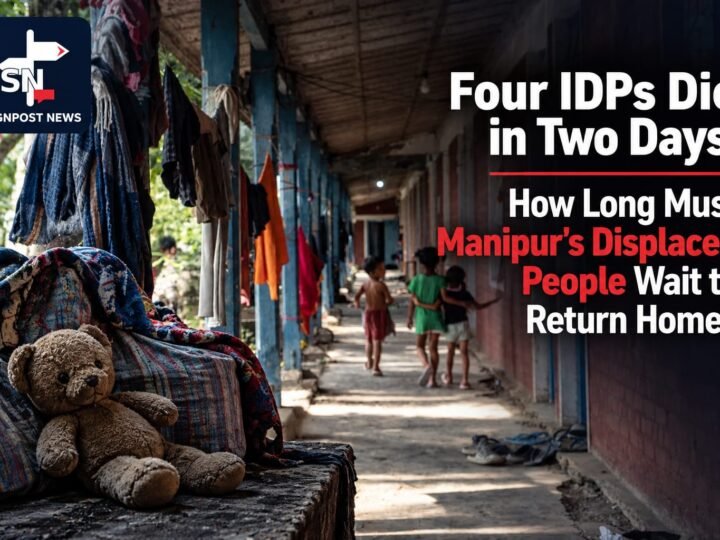
Manipur is not conducting an electoral revision under ordinary conditions. Thousands of citizens remain displaced by the conflict. Many have lived away from their original homes, villages and polling areas for years. Some have lost houses and documents. Others may be unable to return safely to the places where their family and electoral records originated.
The Election authorities reportedly made special arrangements through designated officials for displaced electors. The effectiveness of those arrangements must now be disclosed. How many displaced voters were contacted? How many submitted documents? How many were included, deleted or left unmapped? Were electors staying outside recognised relief camps equally able to participate?
A notice may fulfil a procedural requirement. It does not necessarily prove that a displaced citizen actually received a fair opportunity to respond.
The distinction matters. An absent voter may be a fictional entry, a person who has permanently relocated, a student or worker temporarily living elsewhere, or a citizen displaced by violence. They cannot be treated as one undifferentiated category.
Publish the constituency-wise record
The CEO’s office has said that 91,178 unmapped electors were served notices and that 96,985 claims and objections were received. Of these, 56,871 claims were accepted.
It has also informed excluded electors that they may first appeal to the District Election Officer and, if still aggrieved, approach the Chief Electoral Officer. Normal updating of the rolls is expected to resume in October.
That appeal process should be widely publicised in local languages and taken directly to relief camps, remote hill settlements and communities with limited internet access. People should not discover that their names have disappeared only when they search for them shortly before polling day.
The Election authorities should publish, constituency by constituency:
- The number of electors before the SIR, in the draft roll and in the final roll.
- Deletions classified as deceased, permanently shifted, duplicate, absent or rejected for documentary reasons.
- The number of additions and deletions made between the selected benchmark date and the formal commencement of the SIR.
- The official definitions and verification standards used for “absent,” “shifted,” “unmapped” and “logical discrepancy” cases.
- The number of notices served, hearings held and speaking orders issued.
- Claims accepted and rejected, with the broad grounds for rejection.
- The number of internally displaced electors contacted and the assistance provided to them.
- The appeal procedure, responsible officers and applicable timelines.
Personal information need not be exposed. Aggregate figures can be released without violating anyone’s privacy.
Manipur needs an accurate electoral roll. It also needs public confidence in how that roll was prepared. Neither political celebration of deletions nor an automatic assumption of mass disenfranchisement can substitute for evidence.
The final number—19,60,620—tells us how many electors remain. It does not tell us enough about who was removed, why they were removed, how “absent” and “shifted” were determined, or whether displacement was adequately considered.
The question is no longer confined to Manipur. Across India, the scale and pattern of SIR deletions have produced demands for an independent audit. Manipur should not wait for a citizen to reach the polling station in 2027 and discover that democracy has misplaced his or her name.
Before the next election, the complete audit trail must be placed in the public domain.