
Moirang has a habit of changing its political script. Congress once held the constituency. The BJP broke through in 2017. Five years later, the NPP captured the seat through Thongam Shanti Singh. Behind those changes, however, are three political figures who have repeatedly appeared before the same electorate under different party banners: Shanti, Mairembam Prithviraj Singh and Pukhrem Sharatchandra Singh.
That history makes Moirang difficult to read through party labels alone.
As the constituency moves towards 2027, another question is beginning to emerge: will the ghost of IDP RTI going to haunt Shanti?
There is not enough evidence yet to say where Moirang’s votes will move. But there are enough developments to make that question worth investigating.
Three elections, three different equations
In 2012, Moirang was essentially a two-way contest. Congress candidate Mairembam Prithviraj Singh defeated Pukhrem Sharatchandra Singh, then of the NCP.
The political landscape changed sharply in 2017.
Sharatchandra contested for the BJP and secured 37.04 per cent. Prithviraj, still with Congress, received 35.85 per cent. Shanti entered as an Independent and captured a significant 26.47 per cent.
Only 375 votes separated BJP and Congress.
That election took place amid the BJP’s rapid expansion in Manipur and the wider Narendra Modi-led political momentum of the period. The context matters, although it would be simplistic to attribute a constituency decided by just 375 votes to one factor alone.
More importantly for understanding Moirang today, Shanti’s 26.47 per cent as an Independent demonstrated that he possessed an electoral base before joining the NPP.
By 2022, the same three personalities had been rearranged under different banners.
Shanti contested for the NPP. Prithviraj moved from Congress to the BJP. Sharatchandra, who had won for the BJP in 2017, contested for Congress.
Shanti won with 39.75 per cent of the vote. Prithviraj finished second with 33.57 per cent and Sharatchandra received 25.93 per cent. The official result sheet records 14,349 votes for Shanti, 12,118 for Prithviraj and 9,358 for Sharatchandra, giving Shanti a margin of 2,231 votes.
The numbers reveal something important.
2012: Prithviraj (INC) — 52.08% | Sharatchandra (NCP) — 47.92%
2017: Sharatchandra (BJP) — 37.04% | Prithviraj (INC) — 35.85% | Shanti (Independent) — 26.47%
2022: Shanti (NPP) — 39.75% | Prithviraj (BJP) — 33.57% | Sharatchandra (INC) — 25.93%
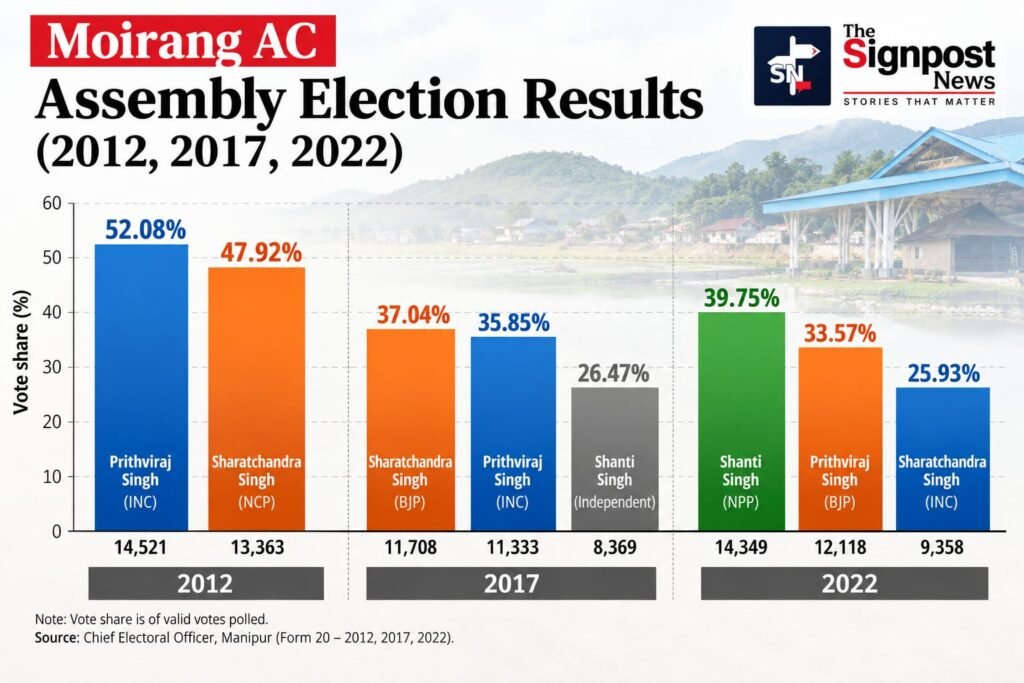
Moirang has not produced a permanently dominant party vote. Candidates, personal networks and changing party affiliations have repeatedly interacted.
That distinction will matter again in 2027.
Shanti now has a record to defend
The political circumstances surrounding Shanti are also different from 2022.
He is no longer simply the challenger who built an Independent base and subsequently captured the constituency for the NPP. He is the sitting MLA, carrying the advantages as well as the liabilities of incumbency.
One issue has already become part of Moirang’s political debate: expenditure on relief for internally displaced persons.
An RTI response reported in September 2025 showed expenditure of more than Rs 23.21 crore between May 3, 2023 and August 25, 2025 for essential items and services for 4,542 IDPs housed in 14 relief camps in Moirang. Among the entries that attracted attention was expenditure of more than Rs 35 lakh on salt.
The Manipur Pradesh Congress Committee subsequently alleged irregularities in relief distribution and expenditure and demanded an investigation. These remain allegations; an RTI disclosure or an opposition accusation is not by itself a finding of wrongdoing.
But elections are also shaped by public perceptions, and the IDP expenditure controversy has created an issue on which the sitting MLA and the administration can be questioned.
There are other local grievances that Manipur Pulse will examine separately, including the controversy being raised locally around the Eco Heritage Park. That issue requires a development audit based on project records, expenditure documents, official responses and interviews with residents before conclusions can be drawn.
The relevant electoral question is therefore not whether these controversies automatically cost Shanti votes. It is whether they have changed how some of the people who supported him in 2022 now view his performance as MLA.
Can Prithviraj expand his 2022 base?
This naturally brings Prithviraj back into the equation. He was not far behind Shanti in 2022.
A gap of 2,231 votes in a constituency where more than 36,000 valid votes were cast is significant but not insurmountable as an historical fact. Prithviraj’s 33.57 per cent also provides him with a substantial previous electoral base from which to organise.
But it would be premature to convert dissatisfaction with Shanti into votes for Prithviraj.
That assumes voters have only two choices.
Moirang’s own history says otherwise.
Prithviraj will have to retain his previous support, address perceptions surrounding his own political record and compete with Congress, NPP and any new candidate who enters the field. BJP’s standing in Moirang in 2027 may also be different from the political environment that helped the party establish itself in the constituency in 2017.
The correct question, therefore, is not whether Prithviraj will gain votes. It is whether he can become the principal beneficiary if Shanti’s 2022 vote shares fragments.
Those are two very different propositions.
Congress still has history on its side
Congress should not be removed from the equation simply because it finished third in 2022.
Historically, Congress has won Moirang five times since 1972, the highest number among parties in the constituency’s Assembly history.
Its recent Assembly trajectory, however, has moved in the opposite direction: from 52.08 per cent in 2012 to 35.85 per cent in 2017 and 25.93 per cent in 2022.
Candidate switching complicates that trend.
The Congress winner of 2012 later became the BJP candidate. The BJP winner of 2017 subsequently became the Congress candidate.
And there is a more recent number that cannot simply be ignored.
In the 2024 Lok Sabha election, Congress candidate Angomcha Bimol Akoijam received 18,343 votes, or 60.81 per cent, within the Moirang Assembly segment, compared with 7,955 votes, or 26.37 per cent, for BJP candidate Thounaojam Basanta Kumar Singh.
A parliamentary election cannot be mechanically converted into an Assembly forecast. Candidates, issues and voter calculations are different.
But the result does demonstrate that a substantial number of Moirang voters were prepared to vote Congress as recently as 2024.
That keeps Congress relevant to any serious examination of the constituency.
Then comes Kwakta
Perhaps the most important new variable is emerging from Kwakta.
Shanti’s 2022 support in the Kwakta belt forms an important part of the constituency story. This makes reports of an intending candidate emerging from Kwakta particularly significant for the next phase of ground reporting.
Again, the effect should not be assumed.
A candidate from Kwakta does not automatically take votes from Shanti. Kwakta’s voters are not a transferable bloc, and local identity is only one of several considerations that can influence voting.
But if a competitive candidate emerges there, Moirang’s arithmetic becomes more complicated.
The critical question will be whether such a candidate draws disproportionately from Shanti’s previous supporters, from the BJP and Congress bases, or from all three.
This is precisely where booth-level analysis becomes necessary.
Four questions may define Moirang
At this stage, Moirang presents four separate political questions.
First is Anti incumbency. Has Shanti retained the personal support that took him from 26.47 per cent as an Independent in 2017 to 39.75 per cent and victory as the NPP candidate in 2022?
Second is Prithviraj’s ability to consolidate his previous vote. His 33.57 per cent in 2022 gives him a substantial starting point, but it does not guarantee expansion.
Third is Congress’s residual strength. Its Assembly vote has declined, but its historical presence and the 2024 Lok Sabha performance in the Moirang segment mean that the party cannot be treated as electorally absent.
Fourth is Kwakta. A credible new candidacy there could alter existing calculations, particularly if it fragments one of the established candidate coalitions.
None of these factors tells us today who will win Moirang.
Together, however, they tell us why the constituency deserves close attention.
The strongest conclusion available at this stage is narrower but more useful: Shanti will find it difficult to control his vote shares in the coming elections, while his challengers have identifiable openings to test.
Whether those openings translate into actual movement of votes is the story Manipur Pulse 2027 must now follow — booth by booth, issue by issue and candidate by candidate.