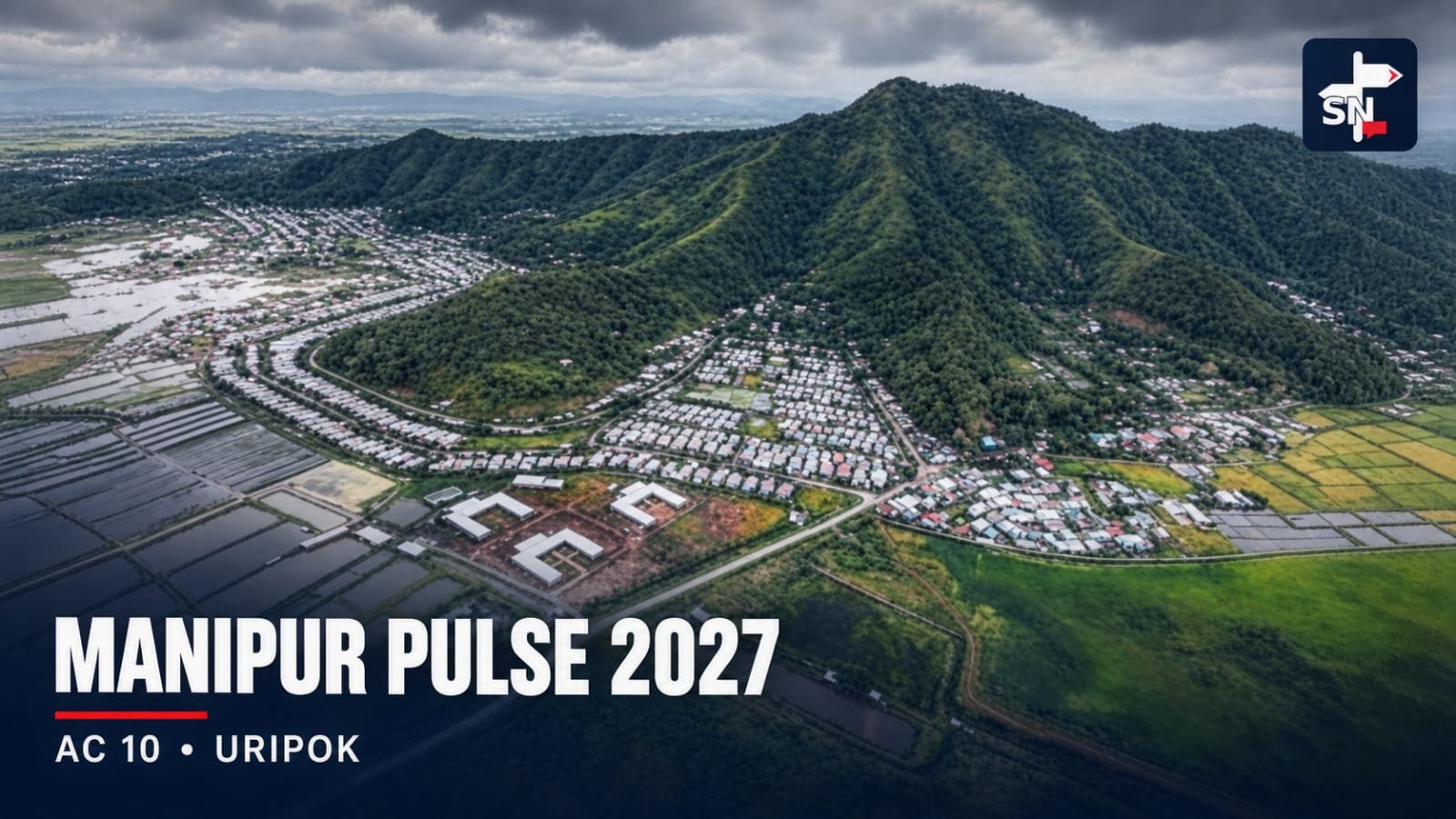
Signpost News begins its constituency-by-constituency journey across Manipur from AC 10–Uripok, examining electoral change, political representation, development and the issues residents want addressed before the next Assembly election.
Election reporting in Manipur usually becomes intense only after candidates are announced and campaigns begin. Public meetings are held, promises are made and political parties start calculating which constituency they can win. The discussion then moves quickly towards personalities, alliances and possible election results.
What often remains missing is a proper account of the period between two elections.
What happened after the votes were counted? Which promises became public works? Which announced projects were completed? Did roads, drainage, water supply and other essential services improve? Was the elected representative accessible to the people? What concerns did the representative raise before the government and in the Manipur Legislative Assembly?
These questions matter as much as the identity of the next candidate.
To help build such a public record, Signpost News is beginning Manipur Pulse 2027, a constituency-by-constituency reporting and research project covering all 60 Assembly constituencies of Manipur.
The journey begins with AC 10–Uripok in Imphal West district.
Why Begin with Uripok?
Uripok provides an important starting point because it is not simply one old residential neighbourhood carrying a familiar name.
The Assembly constituency stretches across different parts of western Imphal, including the older Uripok leikais as well as Naoremthong, Lamphel, Lamboikhongnangkhong, Iroishemba and parts of Langol. These localities do not necessarily experience development and public services in the same manner.
Some areas are densely populated and face pressure on narrow roads, drainage, parking, sanitation and water supply. Others are located closer to expanding residential zones where connectivity, land use, transport and the reach of municipal services may become more important.
The constituency also includes localities close to important government offices and public institutions. Yet physical proximity to an administrative centre does not automatically guarantee efficient civic services.
Uripok must therefore be examined as a constituency containing different neighbourhoods, different civic conditions and different expectations from its elected representative.
It also has a history of closely fought elections. The seat has changed hands, and the margins in the last two Assembly elections show that no political party can take its voters for granted.
A Constituency of Close Electoral Contests
In the 2017 Manipur Assembly election, National People’s Party candidate Yumnam Joykumar Singh won the Uripok seat after receiving 6,469 votes. Congress candidate Laishram Nandakumar Singh finished second with 6,124 votes.
The difference between the two candidates was only 345 votes.
Five years later, Uripok changed its representative again.
In the 2022 Assembly election, Bharatiya Janata Party candidate Khwairakpam Raghumani Singh secured 8,335 votes, representing 36.17 per cent of the votes polled. Yumnam Joykumar Singh of the NPP received 7,426 votes, or 32.23 per cent.
Raghumani won the seat by 909 votes.
The result marked more than a change of party. It also brought a former civil servant into electoral politics. Before becoming an MLA, Khwairakpam Raghumani Singh had served as an IAS officer and Commissioner to the Government of Manipur.
His administrative background became an important part of his political identity. It also raised public expectations that experience within the government system could help him understand administrative procedures, secure development projects and respond effectively to constituency-level problems.
Four years after the election, however, the relevant question is no longer what qualifications or promises a candidate presented before polling day.
The question now is: What did Uripok receive after giving its mandate?
From Election Victory to Public Record
The performance of an MLA cannot be assessed only through photographs of functions, distribution programmes, foundation-stone ceremonies or meetings with ministers.
Such activities may form part of public representation, but they do not by themselves establish that development has taken place.
A proper assessment must distinguish between a proposal, a government sanction, a work order, a project under construction and a completed work available for public use.
A road announced but not completed cannot be recorded as a finished road. A drainage project should not be judged only by the amount sanctioned for it; its condition and usefulness must be examined on the ground. Assistance distributed to a few beneficiaries cannot automatically be presented as evidence that an entire constituency has benefited.
The Uripok report will therefore examine available official records alongside conditions reported by residents.
The assessment will cover roads and internal lanes, drainage and flooding, sanitation and waste management, drinking water, street lighting, education, healthcare, public spaces, sports facilities, welfare delivery and access to government services.
It will also examine whether development works have reached different parts of the constituency or remained concentrated in selected localities.
Where official information is unavailable, Signpost News will say that sufficient information could not be obtained. Absence of evidence will not be converted into an assumption either in favour of or against the elected representative.
The Crisis Changed the Meaning of Representation
Any assessment of an MLA’s term beginning in 2022 must recognise that Manipur changed profoundly after violence erupted in May 2023.
The crisis disrupted ordinary administration, damaged the economy, displaced thousands of people and created prolonged political uncertainty. Constituencies could no longer be judged only through routine development indicators.
Residents also expected their representatives to speak on security, displacement, territorial integrity, free movement, economic hardship and the restoration of normal public life.
For Uripok, this creates another set of questions.
How did the elected representative respond during the crisis? Was he accessible to residents seeking help? What position did he take on the major issues confronting Manipur? Did he raise public concerns through official and political forums? How visible and effective was his representation when citizens were looking towards their elected leaders?
These questions must be examined through documented statements, official proceedings, correspondence, interviews and responses from the MLA—not through rumours or unsupported political allegations.
The crisis cannot be used to erase the need for development accountability. At the same time, the extraordinary conditions since May 2023 cannot honestly be excluded from an assessment of the MLA’s term.
Both realities must be recorded.
Listening Beyond Political Camps
A constituency cannot be understood only through the statements of political parties.
The Uripok ground report will seek the experiences of residents from different localities and social backgrounds. Local clubs, meira paibis, youth organisations, senior citizens, teachers, shopkeepers, professionals, daily-wage earners and beneficiaries of government schemes may experience the same constituency differently.
Their statements will be presented as resident views unless supported by official records or independently verified evidence.
Political claims will also be clearly identified as claims. Statements from the ruling party, opposition parties, aspiring candidates and their supporters will not automatically be treated as established facts.
The sitting MLA will be given an opportunity to explain his record, identify projects completed during his term and respond to issues raised by residents. Relevant government departments will also be approached where clarification is required.
Manipur Pulse 2027 will distinguish among four things: verified facts, political claims, resident experiences and Signpost News analysis.
This distinction is necessary if the project is to become a reliable public archive rather than another platform for election-season allegations.
What the Uripok Reports Will Examine
This opening article is not a final assessment of the constituency. It is the beginning of a reporting process.
The reports that follow will examine Uripok’s geographical and electoral profile, its Assembly election history, the record of the current representative, documented development projects and the effect of the post-May 2023 crisis.
Signpost News will also look at the 2026 electoral roll, changes in the number of voters, the constituency’s polling-station structure and any documented concerns connected with voter inclusion or deletion.
A broader ground report titled Uripok Speaks will bring together voices from different parts of the constituency. Monthly “What Changed?” reports will subsequently record new works, unresolved concerns and political developments as the next election approaches.
Ground reporting will remain separate from any formal opinion survey. A few interviews cannot be presented as the opinion of the entire constituency, and a website reader poll cannot be treated as a scientific prediction of election results.
If an opinion survey is conducted, its sample, locations, dates, questions, methodology and limitations will be publicly disclosed.
The Questions Uripok Must Answer
Has Uripok improved since the 2022 Assembly election?
Which development works were sanctioned, and how many were completed? Which projects remain unfinished? Have all parts of the constituency received fair attention? What problems continue despite repeated complaints? Has the present MLA remained accessible and accountable? And what do residents believe should become Uripok’s priorities before the next election?
The answer will not come from one leader, one political party or one locality.
It must be built from documents, physical verification, responses from public authorities and the experiences of people living across the constituency.
Residents who share information with Signpost News will not be required to disclose how they intend to vote. The purpose of the project is to document public issues, not collect private voting preferences. Information concerning development works should, wherever possible, be accompanied by the name of the locality, photographs, official documents or other verifiable details.
Manipur Pulse 2027 will not tell the people of Uripok whom to support. It will attempt to give them a clearer public record with which to judge those who seek their mandate.
Before political parties again ask Uripok for its votes, the constituency deserves an answer to a simpler question:
What changed after the last election—and what did not?