Imphal, September 25, 2026: Manipur University on Friday released Waterways and Riverine Culture of Manipur & North East India, an edited volume bringing together interdisciplinary perspectives on rivers, waterways, livelihoods, culture and environmental concerns in Manipur and the wider Northeast.
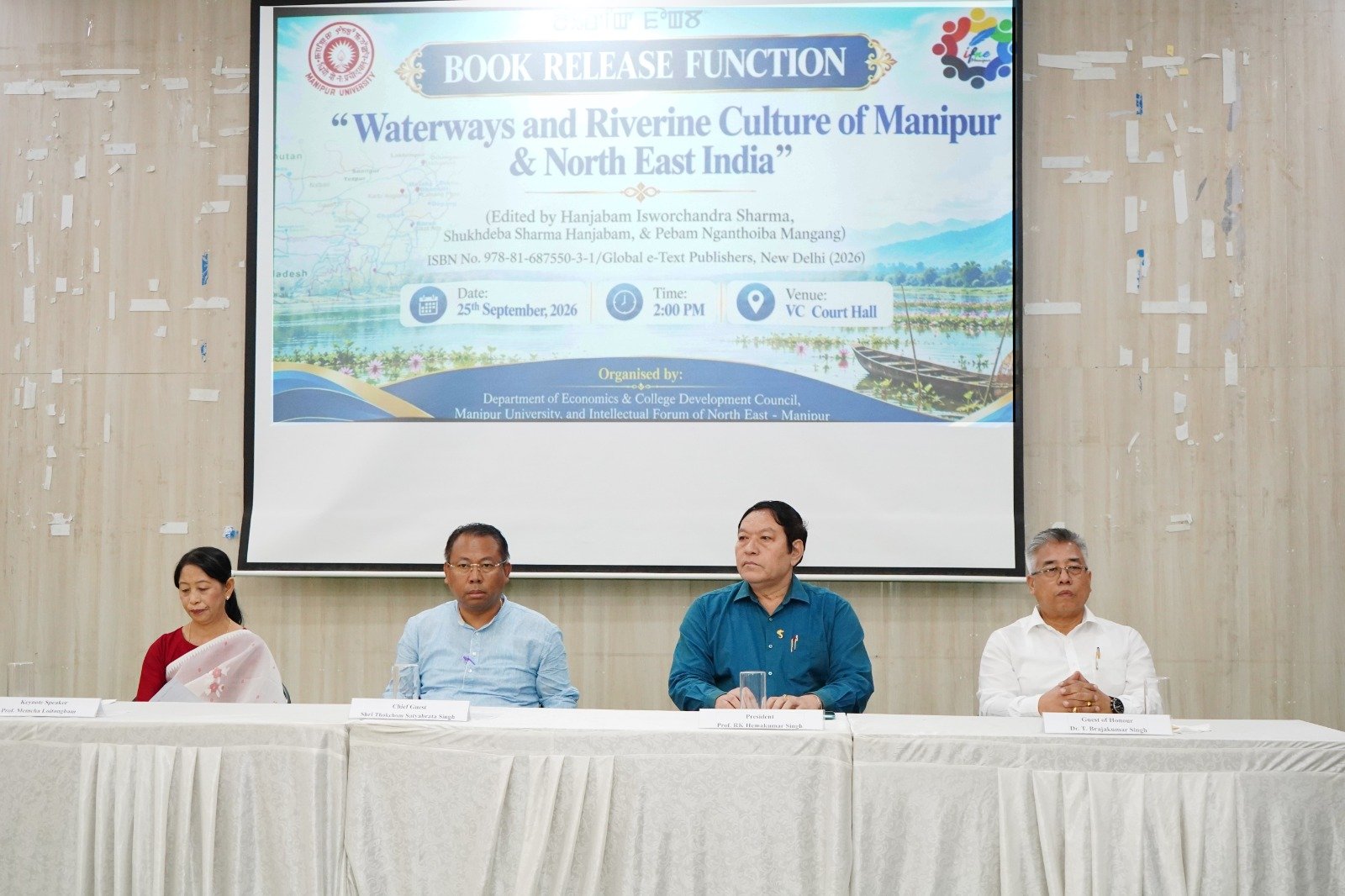
The book, edited by Prof. Hanjabam Isworchandra Sharma, Prof. Shukhdeba Sharma Hanijabam and Pebam Nganthoiba Mangang, was released at the VC Court Hall, Manipur University.
The programme was organised by the Department of Economics and College Development Council, Manipur University, in association with the Intellectual Forum of North East–Manipur.
Manipur Legislative Assembly Speaker Thokchom Satyabrata Singh attended as Chief Guest, while Manipur University Vice-Chancellor Prof. R.K. Hemakumar Singh presided over the function. Dr. T. Brajakumar Singh, Director, Environment and Climate Change, Government of Manipur, attended as Guest of Honour. Prof. Memcha Loitongbam, Dean, School of Social Sciences, Manipur University, delivered the keynote address.
13 articles on rivers, livelihoods and culture
Welcoming the gathering, Prof. Damodar Nepram, Head of the Department of Economics, said the volume contains 13 articles dealing with the rivers and waterways of Manipur and Northeast India.
The contributions range from drainage systems and ancient waterways to riverine culture, livelihoods and the relationship between communities and rivers.
Prof. Damodar said rivers have played a vital role in shaping the region’s history, culture and economy. He expressed confidence that the volume would serve as a useful reference for students, researchers, policymakers and others interested in the subject.
‘A river carries more than just water’
Delivering the keynote address, Prof. Memcha Loitongbam said the volume examines waterways from geographical, historical, ecological, economic, social and cultural perspectives.
A river, she said, is much more than a channel through which water flows. It can provide livelihoods, serve as a route of communication, carry collective memory, form part of cultural identity and connect communities.
Referring to the Imphal, Iril, Thoubal, Nambul, Sekmai and Khuga rivers, the Barak river system and Loktak Lake, Prof. Memcha said Manipur’s waterways have long been linked with fisheries, agriculture, biodiversity, livelihoods and cultural life. Historically, rivers also connected hills, valleys, villages and towns and facilitated the movement of people, goods and ideas.
She highlighted the traditional ecological knowledge developed by communities living around rivers and wetlands. Knowledge of seasonal water levels, fishing, agriculture, aquatic plants, floods and natural-resource management may not always find a place in formal academic literature, she said, but remains an important part of the region’s social and cultural heritage.
Prof. Memcha also drew attention to growing pressure on rivers and wetlands from pollution, waste disposal, encroachment, land-use change and erosion.
These challenges, she said, are not merely environmental. They are also connected with livelihoods, inequality, communities, traditional occupations, culture and social change.
She stressed the need for interdisciplinary research, cooperation and community participation, particularly because rivers and ecological systems do not stop at administrative boundaries.
Concluding her address, she observed that “a river carries more than just water” and called for development that respects ecological systems, modern science that learns from local knowledge and infrastructure that understands the landscape.
Research must connect with policy and practice
Guest of Honour Dr. T. Brajakumar Singh congratulated the editors and contributors and said the publication could become an important reference for scholars studying the relationship between environment, culture and society.
He appealed to the present generation to protect the environmental resources inherited from earlier generations and pass them on to those who follow.
Manipur’s communities and culture have historically been closely connected with river systems, he said, making the protection of waterways inseparable from the protection of the State’s ecological and cultural inheritance.
Dr. Brajakumar expressed concern over the pressures created by development and human activities on ecosystems. Environmental resources provide essential ecosystem services to humans and other living organisms, he said, but unsustainable use and excessive human demands have increasingly disturbed that relationship.
He raised a larger question: what would remain of a riverine culture if the rivers themselves lose their water and ecological health?
Calling for a stronger connection between research, policy and practice, Dr. Brajakumar said environmental policies should be supported by scientific studies, factual data and research carried out by experts.
At the same time, he urged researchers to undertake studies responding to Manipur’s actual environmental needs instead of depending excessively on secondary information.
He also stressed the importance of documenting indigenous and traditional knowledge about how earlier generations conserved rivers and other natural resources.
Citing the Nambul River, Dr. Brajakumar referred to the impact of urbanisation, waste disposal and other human activities. River rejuvenation, he said, should not be restricted to individual rivers but form part of a sustained effort to protect Manipur’s waterways and maintain environmental flows.
He further emphasised the ecological relationship among Manipur’s hills, wetlands and rivers, saying the health of one cannot be considered separately from the others.
Volume grew out of 2024 interdisciplinary seminar
Introducing the volume, Prof. Hanjabam Isworchandra Sharma traced its origins to an interdisciplinary seminar held on December 27 and 28, 2024.
He described the publication as a “kaleidoscopic endeavour” bringing together environmental studies, geography, history, folklore and literature, sociology, economics and culture.
Prof. Isworchandra said the 13 contributions have been organised under three broad thematic areas.
The first deals with the drainage system, watercraft and riverine culture of Manipur. The second examines navigation, livelihoods and the environment in Manipur, including boat-making, river navigation, changing riverine ecosystems, water bodies and livelihoods around Loktak Lake.
The wider section extends the discussion to inland waterways and connectivity in Northeast India, traditional economy and environment, and the socio-economic and cultural dimensions of the Brahmaputra.
Speaker calls for research that offers solutions
Chief Guest Thokchom Satyabrata Singh congratulated the editors, contributors and organisers for bringing out a publication dealing with an issue closely connected with the life and environment of the region.
Expressing concern over changes in rivers and the wider environment, the Speaker said academic research should move beyond identifying problems and contribute towards finding practical solutions.
Research findings and academic discussions could also contribute to policymaking and implementation, he said.
Referring to changes in rivers, vegetation and rainfall patterns, Satyabrata stressed greater public awareness and responsibility in protecting natural resources and expressed hope that the volume would generate wider discussion on Manipur’s waterways and environmental challenges.
Environmental protection is a shared responsibility: VC
In his presidential address, Vice-Chancellor Prof. R.K. Hemakumar Singh highlighted the importance of protecting rivers and their surrounding environment.
He drew attention to the deterioration of water bodies and the consequences of human activities, stressing that environmental protection cannot remain the responsibility of the government alone.
Individual responsibility, including keeping rivers and surrounding areas free from waste, is equally important, he said.
Prof. Hemakumar expressed hope that the publication would encourage further research, self-reflection and public discussion on waterways and environmental protection, while contributing towards a stronger sense of collective responsibility.
As part of the programme, copies of Waterways and Riverine Culture of Manipur & North East India were presented to contributors of the volume. Copies were also presented to Heads of Departments of Manipur University to extend the publication’s academic reach within the University.
Dr. Pebam Nganthoiba Mangang of the Intellectual Forum of North East–Manipur delivered the vote of thanks.
The programme concluded with the hope that the volume would encourage further research and public discussion on the relationship between waterways, communities, culture, livelihoods and environmental sustainability across Manipur and Northeast India.