Twenty artisans from six handicraft producer companies join six-day Entrepreneurship Training programme focusing on business skills, digital marketing, financial management and wider market access.
IMPHAL, November 2, 2026: The Ministry of Textiles is exploring the possibility of introducing a specialised academic course in traditional arts and crafts at Manipur University, potentially opening a new avenue for integrating Manipur’s rich handicraft traditions with formal education, skill development and entrepreneurship.
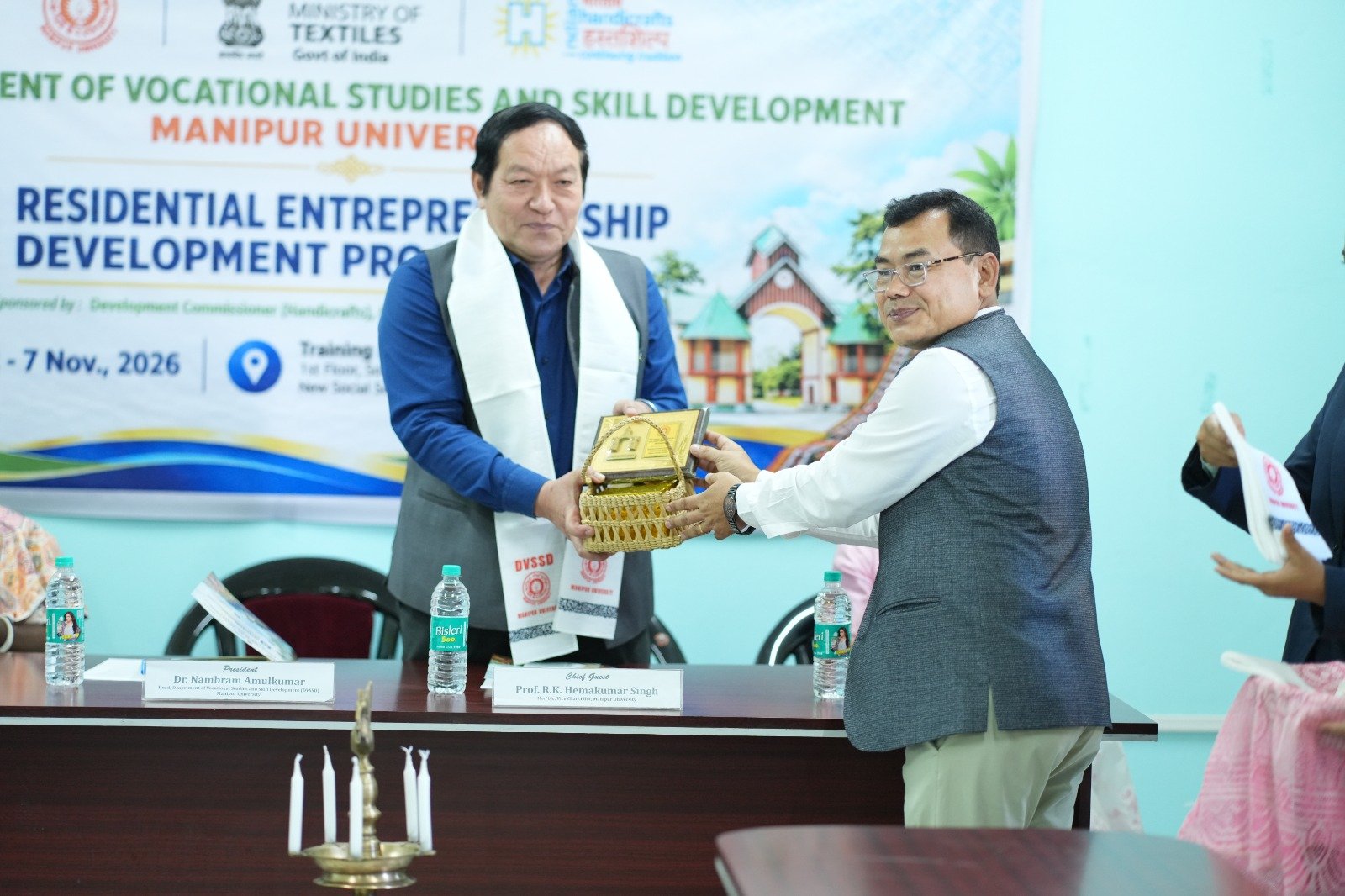
The proposal was disclosed by Pampa Karmakar, Assistant Director (Handicrafts), Handicrafts Service Centre, Porompat, during the inauguration of a six-day residential Entrepreneurship Development Programme (EDP) for handicraft artisans at Manipur University on Monday.
Karmakar said the Ministry was interested in strengthening institutional cooperation between universities and traditional handicraft entrepreneurs. She proposed consultations with the University’s faculty and administration to examine the academic and infrastructural requirements for introducing such a course.
A structured questionnaire would be provided to the University to facilitate the consultation, she said, adding that the University’s suggestions could be placed before senior Ministry officials at an upcoming national-level programme.
The proposal remains at an exploratory stage, with any academic initiative subject to further consideration.
The entrepreneurship programme, organised by the Department of Vocational Studies and Skill Development (DVSSD), Manipur University, will continue until November 7. It is sponsored by the Office of the Development Commissioner (Handicrafts), North Eastern Regional Office, Guwahati, under the Ministry of Textiles, in coordination with the Handicrafts Service Centre, Porompat.
Twenty registered artisans representing six handicraft producer companies are participating in the training. The companies include Heeri Konba Handloom & Handicraft, Loijing Loya Handicraft, Gyanis Handicraft, Kauna Eastern Company Limited, Aahenba and Citizen Welfare Handicraft Producer Companies.
The inaugural function was attended by Manipur University Vice-Chancellor Prof. R.K. Hemakumar Singh as Chief Guest, while Prof. Memcha Loitongbam, Dean of the School of Social Sciences, and Pampa Karmakar attended as Guests of Honour. Dr. Nambram Amulkumar, Head of DVSSD, presided over the function.
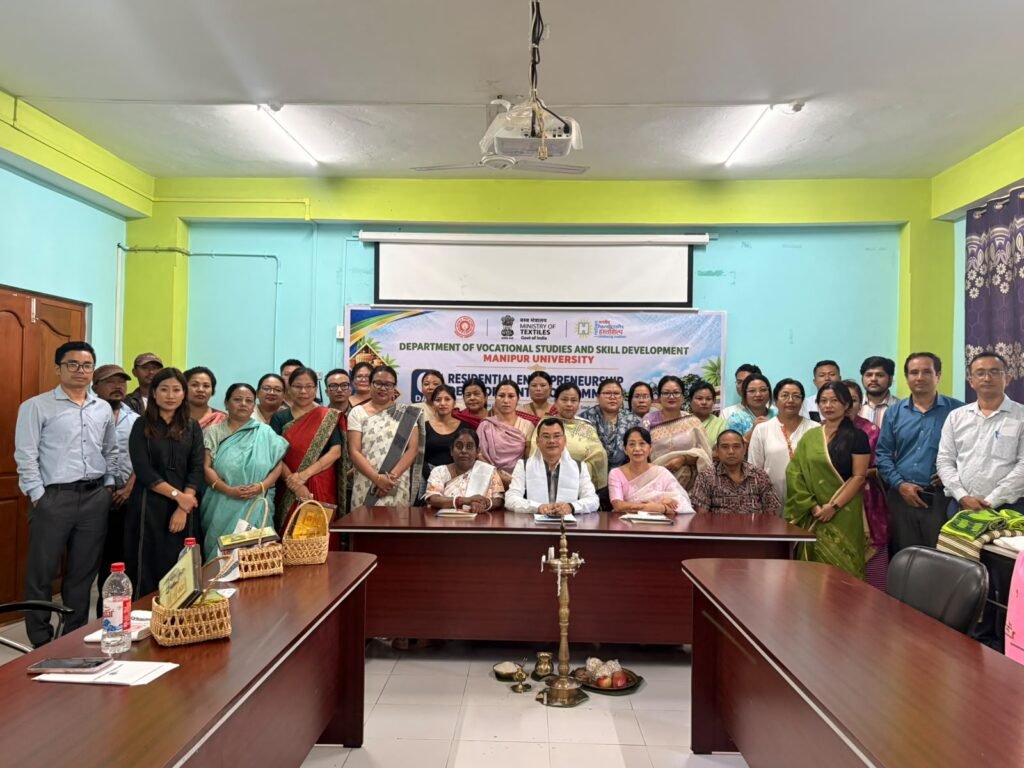
Artisans urged to explore markets beyond Manipur
Addressing the gathering, Vice Chancellor Prof. RK Hemakumar stressed that traditional craftsmanship alone would not be sufficient for artisans to compete in an increasingly demanding market.
He encouraged participants to acquire practical knowledge of enterprise development, financial management, GST, credit facilities, marketing and export procedures.
The Vice-Chancellor urged artisans to look beyond the local market and explore opportunities in other Indian states and overseas.
He also encouraged participants to interact with resource persons, document the training sessions and share what they learned with fellow artisans after returning to their respective enterprises.
Referring to the national vision of Viksit Bharat 2047, he said entrepreneurship required determination, continuous learning and individual initiative. Artisans, he observed, must demonstrate their capabilities through both the quality and marketability of their products.
Linking traditional knowledge with academic expertise
Speaking as Guest of Honour, Prof. Memcha Loitongbam, Dean of the School of Social Sciences, emphasised that entrepreneurship was not merely about establishing a business or making large investments. It involved transforming ideas into productive economic activities, generating employment and contributing to the wider development of society.
She observed that entrepreneurs could not succeed through individual effort alone and required a supportive ecosystem involving finance, information technology, institutional guidance and market opportunities.
Highlighting Manipur’s rich tradition of craftsmanship, Prof. Memcha said the State possessed considerable traditional skills and talent. However, she stressed that possessing skills alone was insufficient unless artisans continuously improved their knowledge, developed their products and adapted to changing market demands.
She pointed out that advances in information technology had made it possible for entrepreneurs operating from Manipur to reach customers across the world. Training programmes such as the EDP could help artisans identify sources of financial assistance, technical support and other resources necessary to translate their business ideas into commercially viable enterprises.
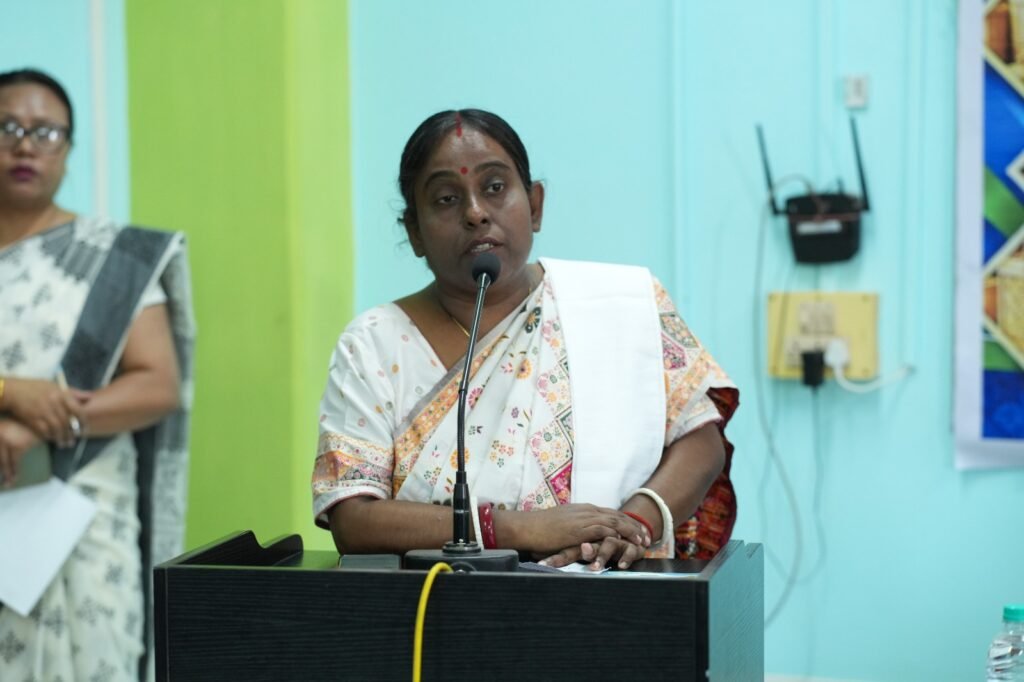
Earlier Pampa Karmakar also emphasised that universities and practising artisans had complementary strengths.
While academic institutions could provide theoretical knowledge, research support and technical expertise, artisans possessed practical experience accumulated through years of traditional craftsmanship.
Closer cooperation between the two could help preserve traditional skills while encouraging innovation, product development and entrepreneurship, she said. She also indicated the possibility of Ministry support for a crafts-based academic initiative, subject to further examination.
Dr. Kangjam Mukhara Devi, faculty member of DVSSD, said entrepreneurship should not be understood merely as starting a business or making investments. It also involved generating employment and contributing to the wider economy.
She observed that Manipur possessed considerable traditional skills but artisans often required stronger institutional support in finance, technology, marketing and business planning to turn their craftsmanship into commercially sustainable enterprises.
She welcomed the proposed academic initiative and called for interactive training that combined classroom knowledge with the practical experience of artisans.
Manipur University offers technical and incubation support
In his presidential address, Dr. Nambram Amulkumar said the Department had already interacted with participating artisans to understand the challenges confronting their businesses.
Marketing difficulties, financial management, production efficiency and resource utilisation were among the concerns identified during the interaction.
He drew attention to the University’s incubation facilities and technical equipment, including Computer Numerical Control (CNC) machines, which artisans could potentially utilise for product development and other enterprise-related activities.
Amulkumar assured the participants that the University’s engagement would extend beyond the six-day training programme. Artisans could continue approaching the Department for technical guidance, knowledge-sharing and access to available facilities.
He cautioned that financial assistance alone could not ensure business success without planning, patience and sustained effort.
He also announced that another six-day Entrepreneurship Development Programme for handicraft artisans would be organised at Manipur University from November 16 to 21, 2026.
Training in e-commerce, financial literacy and exports
The programme covers entrepreneurship and enterprise development, product design, marketing, financial literacy, banking, GST, credit management, digital marketing, e-commerce, export management and legal compliance for producer companies.
Participants will also be introduced to online marketing and procurement platforms, including India Handmade and the Government e-Marketplace (GeM).
Practical sessions will cover digital payments, product photography, export documentation and business planning, alongside case studies designed to help participants apply the lessons to their enterprises.
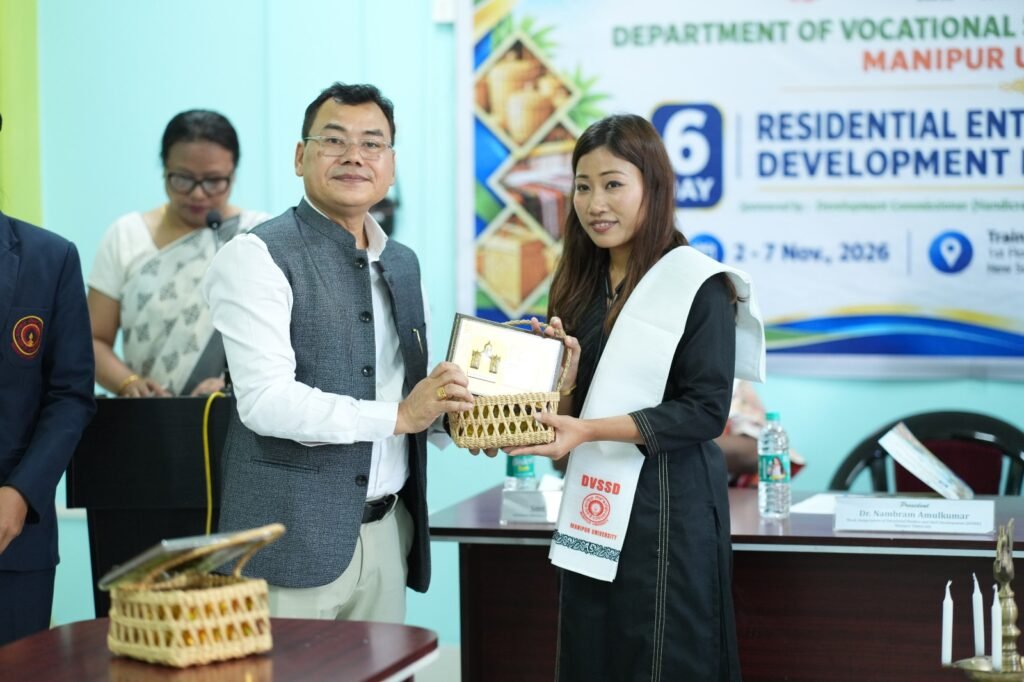
The programme also involves Shri Madhurjya Rabha, Handicraft Promotion Officer, Office of the Development Commissioner (Handicrafts), Ministry of Textiles, Government of India; Langpoklakpam Ajanta Devi, Empanelled Designer, Development Commissioner (Handicrafts), North Eastern Regional Office; and Ms. Maibam Surjamala Devi, Designer-cum-State Coordinator, Export Promotion Council for Handicrafts. Dr. Kangjam Mukhara Devi delivered the welcome address, while Dr. Huidrom Jiten Kumar Singh, faculty member of DVSSD, proposed the vote of thanks.
The programme brings together academic expertise, government support and practising artisans at a time when traditional handicraft producers are seeking stronger business capabilities and access to markets beyond Manipur.
For the participating artisans, the immediate objective is to acquire the knowledge required to run sustainable enterprises. The proposed academic course, if taken forward, could create a longer-term institutional link between Manipur’s traditional craftsmanship and higher education.