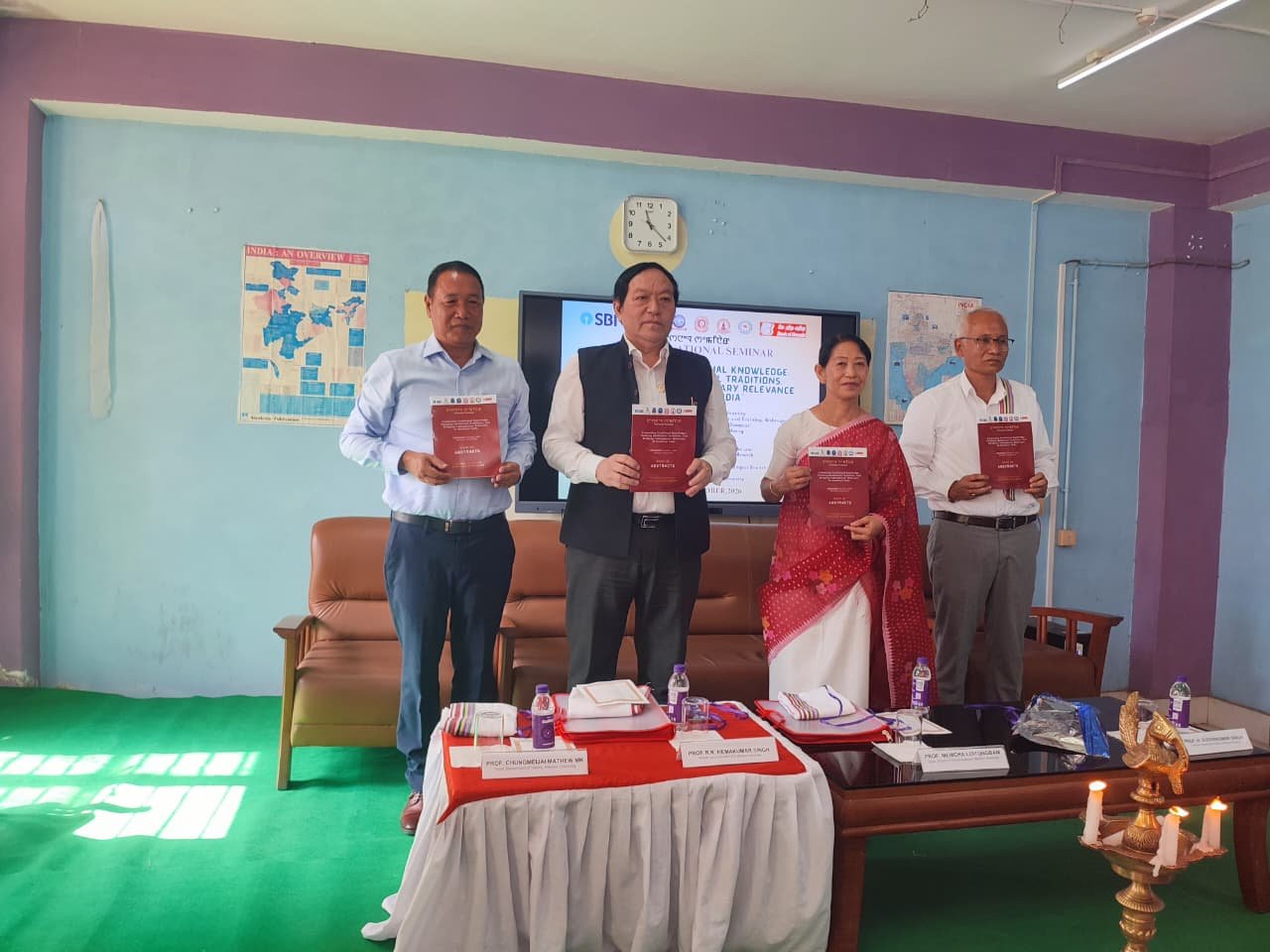
Imphal, October 30, 2026: A two-day national seminar on “Connecting Traditional Knowledge, Thinking Intellectual Traditions, and Bridging Contemporary Relevance in Northeast India” opened at the Department of History, Manipur University today, bringing together academics, resource persons, research scholars and students to examine how the region’s traditional knowledge can contribute to present-day needs.
The seminar, being held on October 30 and 31, is jointly organised by the Department of History, Manipur University; The Thokchom Ibotombi Institute of Teacher Education and Training, Bishnupur; Mount Everest College (Autonomous), Senapati; Kamakhya Pemton College, Hiyangthang; and Biramangol College, Sawombung. The Department of Art and Culture, Government of Manipur, and Bank of Baroda, Manipur University Branch, are collaborating partners, while the State Bank of India, Manipur University Campus Branch, is the sponsor.
Prof. R.K. Hemakumar Singh, Vice-Chancellor, Manipur University, attended as Chief Guest, while Prof. Memcha Loitongbam, Dean, School of Social Sciences, presided over the inaugural function.
Declaring the seminar open, Prof. RK Hemakumar appreciated the organisers’ persistence in bringing the programme to fruition on their third attempt. He welcomed the cooperation among the participating institutions and emphasised the importance of a multidisciplinary approach to connecting traditional knowledge with modern technology in the context of the National Education Policy 2020.The Vice-Chancellor appealed to research scholars and students to make full use of the opportunity to interact with experts, seek guidance and exchange research materials. He assured the organisers of support from the University and urged them to publish the seminar proceedings as a lasting academic record.
In her presidential address, Prof. Memcha Loitongbam called for a practical examination of how inherited knowledge could help address challenges involving livelihoods, environmental protection, education and relations between communities.
She highlighted the potential of handloom, handicrafts, indigenous foods and other traditional skills to support livelihoods when connected with better design, branding, digital tools and access to finance. Referring to community practices in managing forests, water and land, she urged scholars to document what remains useful and assess traditions critically.
Prof. Memcha also stressed the relevance of shared histories to rebuilding trust. Historians, she said, have a responsibility to present the past accurately and fairly, without turning it into a weapon. She encouraged participants to consider how the seminar’s discussions could reach classrooms, communities and policymakers, with due recognition and benefits for the communities holding such knowledge.
Introducing the seminar, Convenor Prof. H. Sudhirkumar Singh said that an understanding of Indian Knowledge Systems would remain incomplete without incorporating the indigenous knowledge of Northeast India’s diverse communities.
He emphasised that documenting and celebrating traditional knowledge must be accompanied by efforts to connect it with contemporary needs, innovation and resilience. He invited participants to use the seminar as a platform for creative and critical academic discussion across disciplines.
Delivering the welcome address, Prof. Chungmeijai Mathew MK, Chairperson, Department of History, welcomed the dignitaries and participants and expressed hope that the technical sessions would generate productive exchanges and further academic cooperation. Dr Bedavati Laishram, Organising Committee Member proposed the vote of thanks.
Niomchung Jatak Chiru, Coordinator, IQAC of Mount Everest College (Autonomous), Senapati, described the collaboration with Manipur University as a homecoming for many of the college’s teachers. The speaker called for documenting traditional knowledge before it is lost, developing academic frameworks to study it, and translating research into useful inputs for education, environmental protection and governance.
The seminar will continue on October 31 with academic sessions examining different dimensions of traditional knowledge and intellectual traditions in Northeast India.