VSK Manipur brings together academics and journalists to examine cultural preservation, history education and the challenges of social harmony.
Imphal, November 2, 2026: The relevance of RSS chief Mohan Bhagwat’s Vijayadashami speech to Manipur’s social and cultural circumstances came under discussion at a public discourse organised by Vishwa Samvad Kendra (VSK), Manipur, in Imphal on Sunday.
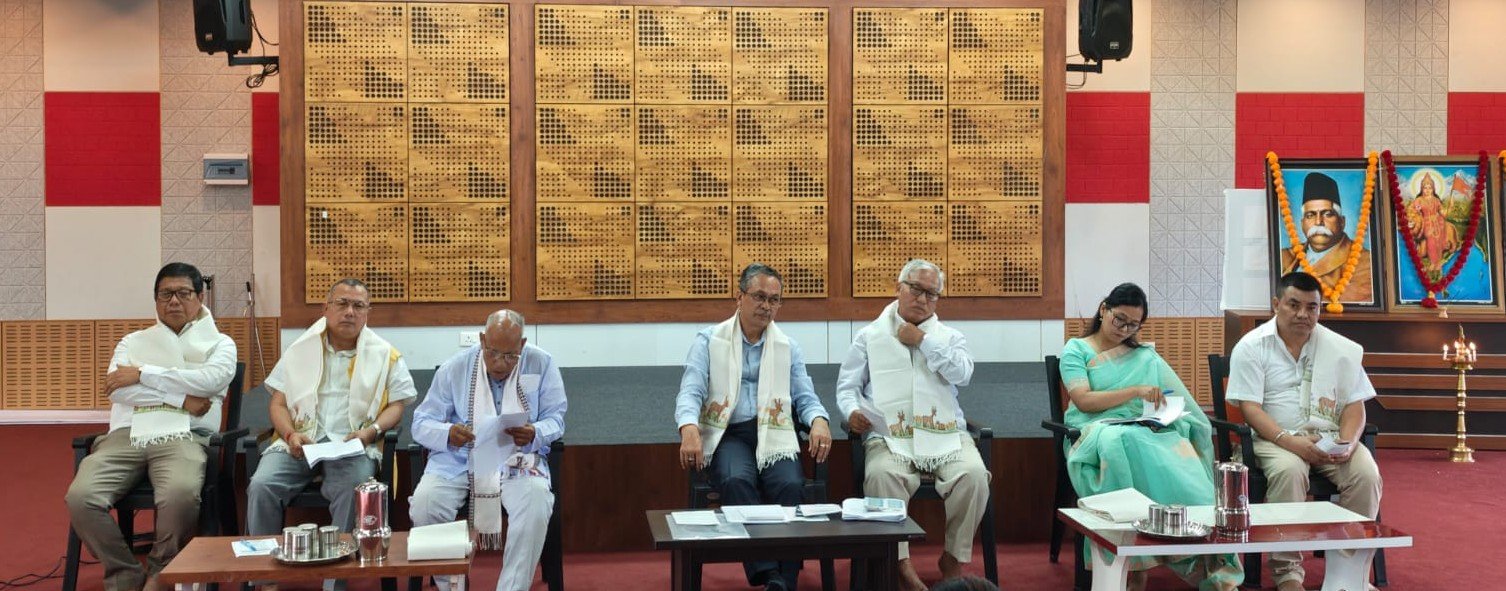
Held at Bhaskara Prabha, Konjeng Leikai, Imphal West, the programme brought together university academics, journalists and intellectuals who examined the relationship between cultural identity, national unity, historical awareness and the responsibilities of citizens in a society facing divisions.
The discussion went beyond the themes of Bhagwat’s address to consider how cultural traditions can be preserved, how history should be taught to younger generations and why social harmony requires practical efforts rather than declarations of unity alone.
Among the participants were Dhanamanjuri University Vice-Chancellor Prof. Wahengbam Chandbabu Singh; The Morning Bell Editor-in-Chief Laimayum Bashanta Sharma; DMCTE Associate Professor Kh. Dineshkumar Singh; senior journalist Manindra Konsam; India Today NE correspondent Naorem Mohen; and Manipur University Assistant Professor Dr. Aribam Indira.
Cultural Identity Must Survive Beyond Ceremonies
One of the major themes of the discourse was Swa, a concept associated with awareness of one’s own cultural and civilisational identity.
Speaking on the subject, Laimayum Bashanta Sharma highlighted the importance of language, inherited values and cultural consciousness in sustaining a community’s identity.
The discussion drew attention to changing language practices within families and concerns that younger generations are becoming increasingly disconnected from their cultural inheritance.
Participants examined why the preservation of indigenous traditions should not be limited to religious ceremonies or occasional cultural events. The transmission of language, historical knowledge and social values through families and educational institutions was identified as equally important.
The issue has particular relevance in Manipur, where communities maintain distinct linguistic and cultural traditions while sharing a wider social and geographical space.
History Education and the Question of Whose Stories Are Told
The manner in which history is presented to students also emerged as a significant subject.
Kh. Dineshkumar Singh’s contribution brought attention to concerns over the relative emphasis placed on ruling dynasties and colonial administrations in historical narratives, compared with the achievements, experiences and knowledge traditions of indigenous communities.
The discussion stressed that history education should help students understand the circumstances that shaped society, including past achievements and mistakes, instead of concentrating primarily on the succession of rulers and political administrations.
The broader question was how historical learning could contribute to a better understanding of contemporary social challenges.
Senior journalist Manindra Konsam also reflected on changing social attitudes and the misunderstandings that can contribute to divisions within communities.
The need for dialogue, greater public awareness and constructive engagement emerged as an important part of the discussion.
Unity Should Not Erase Cultural Differences
Dr. Aribam Indira, Assistant Professor in the Department of Life Sciences at Manipur University, examined the relationship between India’s civilisational identity and its cultural diversity.
Referring to the Vijayadashami address, she discussed how attachment to Bharat as a common motherland, a sense of shared ancestry and universal human values could provide a foundation for national unity despite differences in religion, language and regional traditions.
At the same time, she emphasised that national unity should not require communities to abandon their distinct identities.
The discussion recognised that smaller communities may have genuine concerns about the preservation of their traditions and that mutual respect is essential to maintaining a common sense of belonging.
Her observations also addressed the danger of allowing exaggerated fears or narrow cultural pride to create unnecessary divisions.
Manipur’s Present Situation Brings Vigilance into Focus
The discourse also addressed questions of public responsibility and social vigilance in the context of Manipur’s prevailing circumstances.
Journalist Naorem Mohen drew attention to the need to understand vigilance beyond ceremonial observances and place it within the everyday responsibilities of citizens, institutions and public authorities.
In a state that has experienced prolonged unrest, the discussion brought the protection of human life, public accountability and the responsibility to prevent further social divisions into focus.
The role of journalism was also examined, particularly how public communication can expose shortcomings and demand accountability without unnecessarily encouraging mistrust between communities.
The discussions underlined the distinction between responsible criticism of institutions and communication that could intensify existing tensions.
Participants also considered the responsibilities of leaders and civil society organisations in responding to social problems through meaningful engagement rather than confrontation driven by emotion.
From Civilisational Ideals to Public Responsibility
Professor Wahengbam Chandbabu Singh, Vice-Chancellor of Dhanamanjuri University, reflected on the importance of understanding India’s civilisational heritage and the need to strengthen cultural consciousness among younger generations. His remarks addressed the concept of Swa, particularly the significance of one’s mother tongue, cultural traditions and historical inheritance in shaping individual and collective identity.
He drew attention to the responsibilities of the education system in transmitting historical knowledge and cultural values. The discussion highlighted concerns that younger generations may develop an incomplete understanding of their own heritage when education concentrates largely on political rulers and historical conflicts without adequately examining the social, intellectual and cultural contributions of earlier generations.
Reflecting on contemporary social challenges, Professor Chandbabu Singh also discussed the importance of correcting misconceptions and addressing divisions through constructive engagement. He emphasised the need to understand the underlying causes of social problems rather than allowing disagreements to deepen.
Moderating the session, senior RSS pracharak Laishram Jatra Singh placed the Vijayadashami address within the broader context of India’s civilisational thought and its potential contribution to global peace.
Drawing on the teachings of Swami Vivekananda, he emphasised the importance of self-confidence, moral strength and collective responsibility in building a harmonious society. He also linked India’s aspiration to contribute to world peace with the need to strengthen social understanding and cohesion within the country.
The programme reflected a recurring concern: that cultural pride and philosophical ideals carry greater meaning when they are translated into conduct, education and social responsibility. The discourse began with a welcome address by Wahengbam Rorrkychand Singh and concluded with a vote of thanks delivered by Irom Pradip Singh.
The gathering provided a platform for considering how the ideas raised in Bhagwat’s Vijayadashami speech could be examined in the context of Manipur, particularly at a time when questions of identity, coexistence and social trust continue to shape public life.