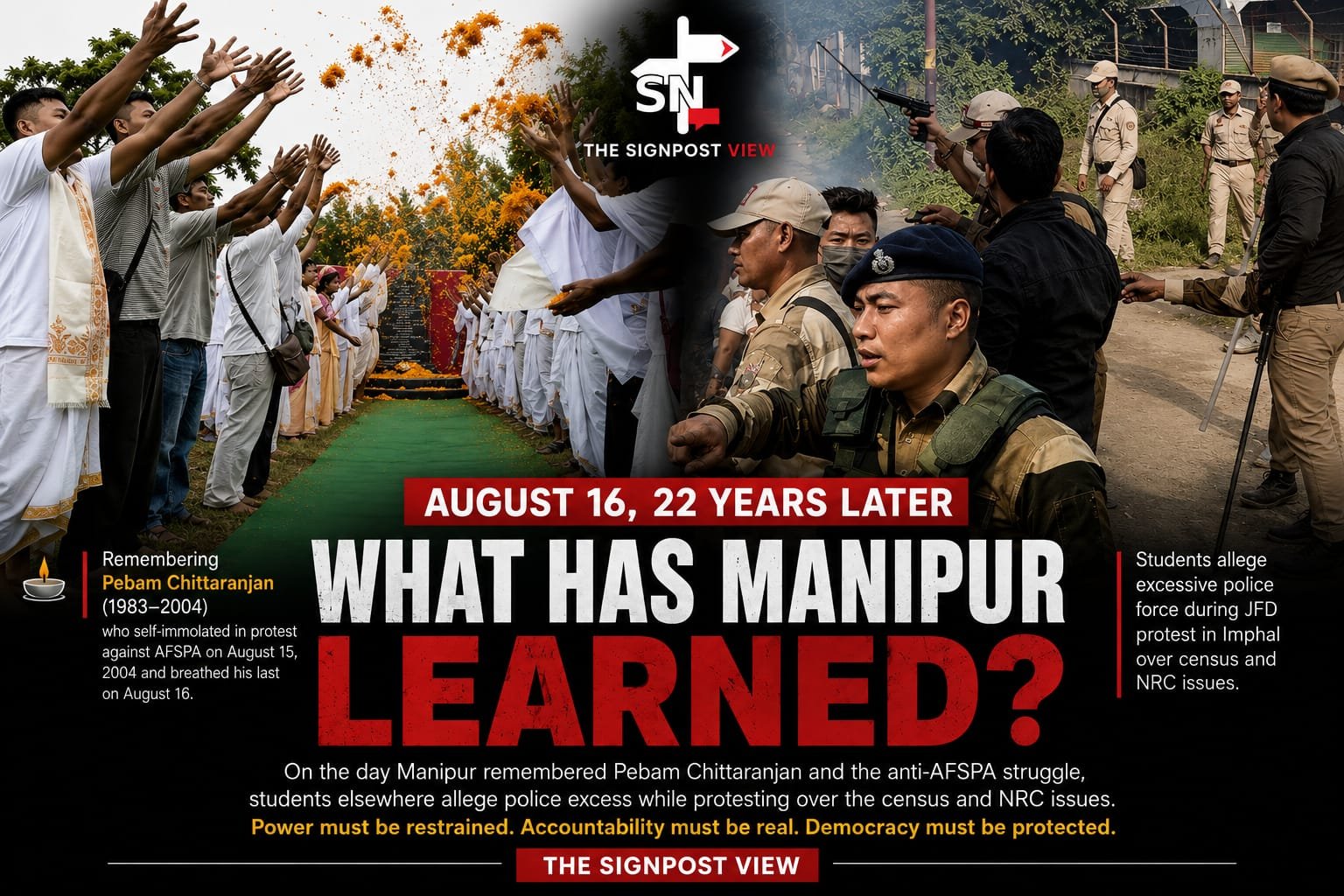
On the day Manipur remembered Pebam Chittaranjan and the anti-AFSPA struggle, another generation of students alleged excessive police force while protesting over the deferment of census and implementation of NRC. The two events are different, but together they raise an enduring question about state power, accountability and democratic rights.
Twenty-two years after Pebam Chittaranjan died following his self-immolation in protest against the Armed Forces (Special Powers) Act, Manipur continues to remember his sacrifice. But remembrance acquires meaning only when it forces society and the State to confront the questions that produced that sacrifice.
On August 16, the Manipuri Students’ Federation observed the 22nd Students’ Martyrdom Day in Chittaranjan’s memory. Students marched from Imphal College to Sega Road Takhellambam Leikai, where floral tributes were offered and speakers renewed the demand for complete withdrawal of AFSPA from Manipur.
Chittaranjan had set himself on fire at Bishnupur on August 15, 2004 in protest against AFSPA. He succumbed to his injuries the following day.
Twenty-two years later, AFSPA has certainly retreated geographically, but it has not disappeared from Manipur. Under the latest notification issued by the Union Ministry of Home Affairs on March 23, 2026, the entire State, excluding areas falling under 13 police stations in five districts, remains declared a disturbed area under AFSPA for six months from April 1, unless withdrawn earlier.
That alone makes Students’ Martyrdom Day more than an exercise in historical remembrance. But what happened elsewhere in Imphal on the very same day gives the anniversary an uncomfortable contemporary relevance.
Two scenes, one day
August 16, 2026 presented Manipur with two very different scenes involving its young people. At Takhellambam Leikai, students and civil society representatives remembered a man whose death became one of the defining symbols of Manipur’s movement against AFSPA. They spoke about human rights, extraordinary state power and accountability.
Elsewhere, another group of students confronted the power of the State in the present tense. The Campaign for Just and Fair Delimitation has been opposing the census exercise until, among other demands, and the NRC is updated. Torch rallies were taken out at several locations, while protesters raised slogans opposing the census under the prevailing circumstances.
Those demands can and should be debated. Census, delimitation, citizenship and the displacement crisis involve complicated constitutional, demographic and political questions. Democratic disagreement over them is legitimate. What cannot be treated casually is how that disagreement is policed.
The JFD Students’ Wing alleged that police used excessive force against students protesting at the Directorate of Census in Imphal East on August 16. Its convenor, Naorem Wangamba, alleged that personnel fired several rounds of tear gas shells and what the organisation described as “mock bombs”, and that women students were shoved into ditches or drains. The organisation said three students sustained injuries.
The Students’ Wing subsequently demanded that the Government suspend Imphal East Commando DSP Dhiraj within 24 hours and initiate appropriate action against him, warning of stronger protests if its demand was ignored.
The two events are not the same It would be wrong to draw a simplistic equivalence between AFSPA and the policing of a civilian demonstration.
They operate under different laws and circumstances. AFSPA gives specified extraordinary powers to armed forces operating in areas declared disturbed. Civil policing of demonstrations belongs to a different legal and institutional framework.
But there is a democratic principle connecting the two: The coercive power of the State must always be exercised with restraint, proportionality and accountability.
Police have a duty to maintain public order. Protesters are equally bound by law. Where a demonstration becomes violent or poses a genuine threat to public safety, lawful intervention may be necessary. But the existence of that authority does not eliminate the obligation to explain how force was used and why.
If police intervention on August 16 was necessary, the authorities should say what circumstances necessitated it, what level of force was authorised and whether established procedures were followed. Transparency protects protesters, but it also protects professional police personnel from sweeping or politically motivated accusations.
What has changed in 22 years?
This is where the coincidence of August 16 becomes difficult to ignore. On one side of Imphal, young people showered flowers in memory of Pebam Chittaranjan. On another, young people were confronting police while asserting their own political demands.
A memorial tells us what happened yesterday. What happened elsewhere in Imphal on the same day asks what we have learned from it. The lesson of Chittaranjan cannot simply be that Manipur should remember a young man who died in 2004. Nor should his death be romanticised as a model for political action.
The deeper lesson must concern the circumstances in which citizens begin to believe that ordinary democratic mechanisms cannot make those exercising power listen to them. That is why the question extends beyond AFSPA.
Manipur has endured more than three years of conflict, mass displacement, deep ethnic division and profound distrust. Thousands of citizens continue to live away from their homes.
In such an environment, institutional restraint is not weakness. It is one of the foundations upon which public confidence must eventually be rebuilt.
From remembrance to accountability
AFSPA has been withdrawn from parts of Manipur over the years. That represents change. But the larger debate surrounding extraordinary powers, accountability and the relationship between citizens and security institutions remains unfinished.
Instead of allowing Students’ Martyrdom Day to become an annual exchange of familiar slogans, Manipur and New Delhi should confront measurable questions.
Where are extraordinary powers still considered necessary? On what security assessment? What benchmarks would permit their further withdrawal? What mechanisms ensure accountability when allegations of abuse arise?
The same culture of accountability must apply to ordinary policing. A democracy cannot demand respect for law from its citizens while treating scrutiny of state power as an inconvenience. For Manipur’s younger generation, there is perhaps an even more important lesson. Democracy cannot depend upon martyrdom.
Young people must be able to question governments, organise, march, disagree and demand answers without believing that suffering is the only language through which authority will hear them. And governments must be able to maintain public order without allowing legitimate policing to become indistinguishable, in the public mind, from punishment for dissent.
Twenty-two years after Pebam Chittaranjan, the most meaningful tribute would therefore not be another wreath alone.
It would be a Manipur where citizens can protest without fear, police can perform their lawful duties without political misuse, allegations of excessive force are investigated credibly, and extraordinary security powers become increasingly unnecessary because democratic institutions have earned public trust.
Power exercised without explanation breeds distrust. Power subjected to accountability strengthens democracy. That is the unfinished lesson of August 16. And twenty-two years later, Manipur must ask itself: Have we merely remembered the sacrifice—or have we learned from it?