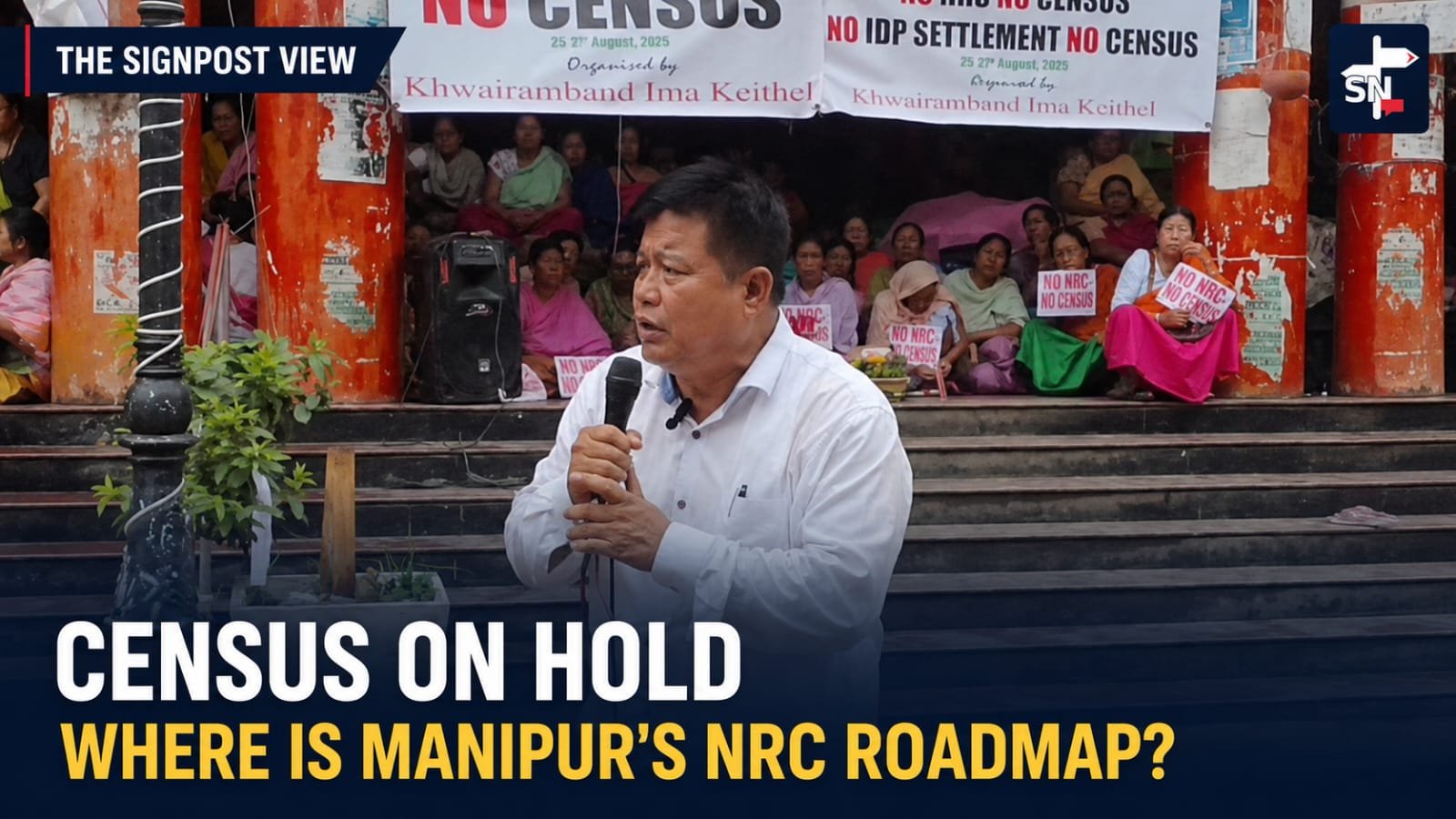
The decision to defer the Census house-listing exercise in Manipur is a significant concession to a sustained public demand. It deserves acknowledgement. But the political importance of the decision should not obscure its administrative limits. A Census exercise has been postponed; a framework for implementing the National Register of Citizens has still to be placed before the people.
Following the August 31 meeting chaired by Union Home Minister Amit Shah, the Chief Minister’s Secretariat announced that the proposed Census exercise would be deferred in consideration of public sentiment. Separately, the High Court proceedings resulted in house-listing being kept in abeyance, with the next hearing reported for October 12. Neither development should be presented as a judicial endorsement of a particular NRC cut-off or as a completed decision on how citizenship verification will proceed.
The distinction is already apparent outside government offices. On September 1, women vendors at Khwairamband Keithel continued their protest, seeking an order for NRC updation. Asem Nirmala, a representative of the vendors, explained that their objection was to the sequence of the exercises, not to the Census itself. The question before the Government has therefore moved beyond whether it has heard the demand. It must explain what it intends to do with it.
From assurance to authority
An NRC cannot be administered through statements of political support. It requires a legal basis, defined responsibilities, accessible records and procedures that officials and applicants can understand in the same way.
Section 14A of the Citizenship Act, 1955 provides for the Central Government to maintain a National Register of Indian Citizens and establishes the role of the national registration authority. The 2003 registration rules set out verification procedures. Assam’s exercise, however, has special provisions under Rule 4A and its Schedule. Those provisions cannot simply be treated as Manipur’s ready-made framework.
This makes a written response from the Centre indispensable. Under which provisions would an exercise in Manipur proceed? What decisions or notifications are required? Which responsibilities would fall on the State, and which would remain with the Union Government?
The demand for 1951 as the base year also needs an explicit answer. It formed part of the demands reported in connection with the High Court petitions. The Government should explain how the proposed reference year would operate, which records could establish eligibility, and how the criteria would accommodate citizenship acquired lawfully under the applicable provisions of the Citizenship Act. A political demand and an operative legal criterion are not interchangeable.
Leaving these matters unsettled invites different expectations among citizens, officials and political organisations. The resulting confusion would weaken the very exercise that its supporters want to make credible.
Verification without collective suspicion
The case for a reliable citizenship register must rest on the quality of verification. It cannot depend on treating an entire community as an extension of a migration allegation.
Historical records of entry, settlement or assistance should be examined wherever relevant. But an entry in an old file and the present citizenship status of an individual are different questions. Citizenship law provides several routes of acquisition, including birth, descent, registration and naturalisation, subject to their respective conditions. A family’s history must be investigated through the applicable law, not converted into a verdict by association.
The Census must also be described accurately. It collects population information; it is not itself a grant of citizenship. The Government’s own explanation of Census 2027 describes enumeration as covering all persons, while citizenship is governed by a separate statutory framework. Keeping that distinction clear strengthens a serious argument for verification. Confusing the two makes public anxiety easier to exploit.
Manipur needs answers that can withstand scrutiny. Allegations of irregular entry or fraudulent documentation should be tested, and established wrongdoing should invite lawful action. Equally, ethnicity, religion, language or residence in a particular district must not become substitutes for evidence.
Assam’s warning is about the process
A people-centred examination of the NRC must ask what happens between submitting an application and receiving a decision. The security of the records, the conduct of the verifying officer and the opportunity to correct an error are not secondary details. They determine whether the register deserves public confidence.
Assam offers a documented warning. In its Report No. 4 of 2022, the Comptroller and Auditor General criticised inadequately planned software development in the NRC project and identified risks of data tampering without an audit trail. This was a finding about weaknesses in the system, not proof that every disputed entry had been manipulated.
For Manipur, the implication is practical. Records should be traceable to their sources. Changes should identify the officer responsible and preserve the reason for the change. Access to personal information should be controlled, and the system should undergo independent technical scrutiny before decisions with serious consequences are made
Digitization alone cannot provide these protections. A poorly designed digital process can reproduce an administrative mistake across thousands of records with remarkable speed.
The displaced citizen must not bear the cost
Any proposed documentation exercise in Manipur must be designed around the circumstances of internally displaced families. For a household unable to return safely to its village, access to an old school, local office or family record cannot be assumed. Where papers have been destroyed or left behind, the State must provide a workable method of recovering and verifying evidence.
A citizen should not have to choose between personal safety and attendance at a verification hearing. Documentation assistance should therefore precede strict application deadlines. Mobile assistance centres, access to official record repositories, certified replacement documents and safe arrangements for hearings should form part of the preparatory work. These facilities must reach displaced people from every community.
The same care is needed where names have been recorded differently across languages, where a woman’s records span her parental and marital homes, or where an elderly applicant cannot explain an entry made decades earlier. Such discrepancies require examination. They should not, by themselves, be treated as conclusive evidence of foreign nationality.
Every adverse decision should give understandable reasons. Applicants must have a meaningful opportunity to answer the evidence, obtain assistance and use an accessible appeal mechanism. The general 2003 rules themselves provide for hearings and appeals; the Government must explain the precise safeguards applicable to any proposed Manipur exercise.
Firm verification and fair treatment are mutually reinforcing. A process that excludes genuine citizens through avoidable mistakes undermines its own legitimacy and diverts attention from cases that warrant investigation.
Put the next steps on record
The Assembly should require a consolidated statement from the Government covering the legal route, the proposed criteria, the condition of available records, the cost of implementation and the arrangements for independent scrutiny. It should also seek a timetable for preparatory decisions, public consultation and progress reports.
That timetable need not promise an unrealistic completion date. It must, however, identify who is responsible for each stage and when the public will receive the next substantive answer. Consultation should include those supporting the demand, those worried about wrongful exclusion, and displaced families whose practical difficulties may otherwise remain outside the discussion.
NRC preparation must not become a reason to defer rehabilitation, education, healthcare or safe movement. Citizenship verification cannot perform the work of rebuilding a home or restoring a livelihood. The Government has responsibilities in all these areas, and it must discharge them together.
The Census pause has created an opportunity to replace uncertainty with a credible programme of action. Its value will be measured by the quality of the decisions that follow. The Centre must clarify the legal route; the State must prepare the records and administrative capacity; and both must guarantee that genuine citizens have an effective means of establishing their rights.
Manipur’s demand for a reliable NRC should now be carried forward through a transparent, evidence-based and people-centred process. A register intended to protect citizenship must be worthy of the citizens whose lives it will affect.