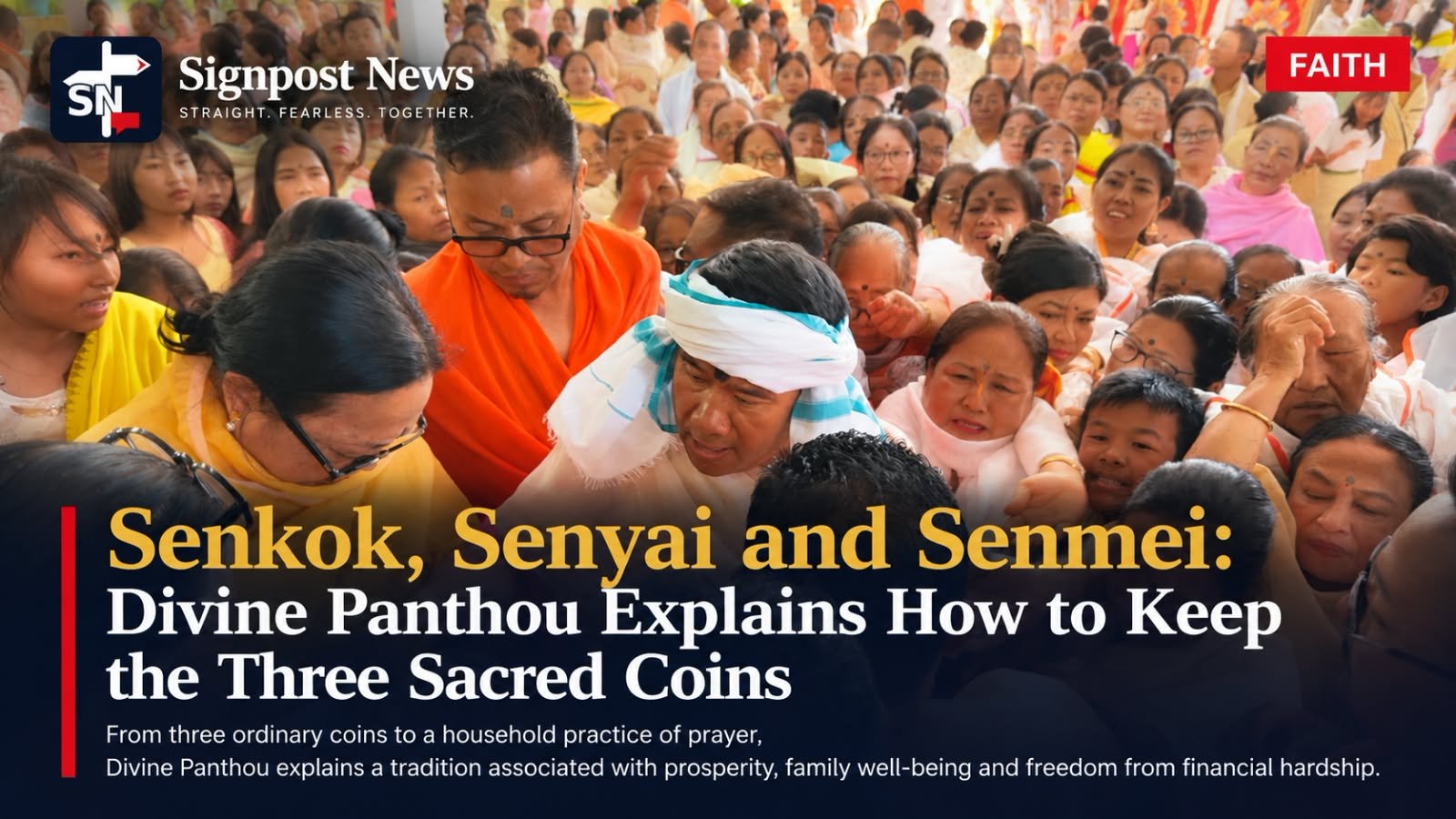
From three ordinary coins to a household practice of prayer, Divine Panthou explains a tradition associated with prosperity, family well-being and freedom from financial hardship.
FAITH & WISDOM | DIVINE PANTHOU
The sacred coins known as Senkok Senyai occupy a special place in the religious lives of Divine Panthou’s devotees. Thousands seek these blessings during the annual Panthou Sanglen Laipung Halao Thouni Ilaat, believing that they bring prosperity, happiness and protection from financial hardship. Yet the significance of the practice extends beyond receiving a coin at a religious gathering. Divine Panthou has explained that devotees should take three ordinary coins, associate them with the sacred names Senkok, Senyai and Senmei, and preserve them respectfully in their homes while observing a simple weekly prayer.
The teaching offers an insight into the origin of Senkok Senyai, the purpose of the three coins and the manner in which devotees are expected to maintain the religious observance. It also reveals a concern that runs through Divine Panthou’s explanation: no household should have to endure unnecessary suffering because of the absence of money needed for everyday life.
The teaching assumes particular significance following the opening of the 32nd Panthou Sanglen Laipung Halao Thouni Ilaat at Meitei Laikol, Selloi Langmaiching, on Sunday, October 11, 2026. Held on the first day of Mera in the traditional Meitei lunar calendar, the celebration attracted more than 3,000 devotees, according to the organisers. People from different communities gathered with Kwaklei flowers, rice, fruits, vegetables and other offerings to seek Divine Panthou’s blessings. Traditional religious observances, devotional performances and the seven Salai flags representing the ancestral lineages of the Meitei people formed part of the occasion.
The origin of Senkok Senyai
Recalling the beginnings of the practice, Divine Panthou described Senkok Senyai as an unusual chapter in his own life, one whose significance was not fully understood at the time. He referred to the first day of Mera, which falls on Monday in 1995, when he began distributing sacred coins among those who had gathered.
Divine Panthou recalled an important incident from the early days of his spiritual journey. He narrated how, on Langban Nongma Panba, the first day of the traditional Meitei month of Langban, he first became known to devotees as a divine presence, an event described in Meiteilon as safongba. As word spread, people began arriving in increasing numbers. Some came out of curiosity, hoping to see him for themselves, while others came with prayers and the desire to receive his blessings. Many brought one-rupee coins as humble offerings. These coins were collected and carefully preserved within the sacred premises.
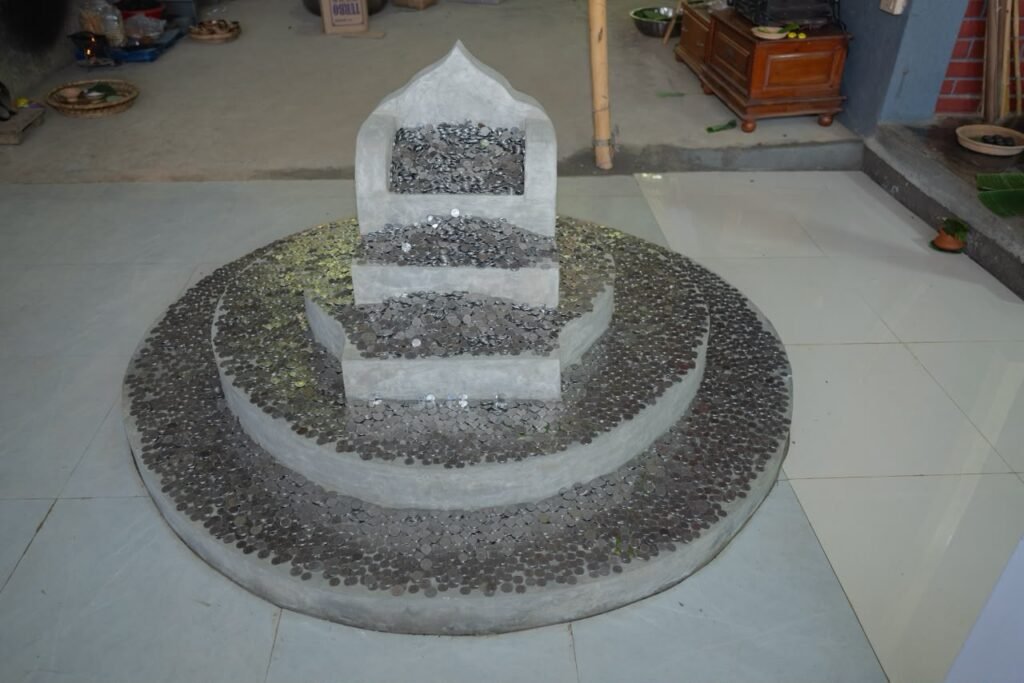
On the first day of Mera, Divine Panthou distributed the coins among devotees under the name Senkok Senyai, without knowing how many people would come or whether the coins would be sufficient for everyone. The remaining coins were placed in an earthen vessel.
The account presents the beginning of Senkok Senyai not as the creation of a specially manufactured religious object but as the transformation of ordinary coins into symbols of divine blessings through prayer and devotion. What had originally been offered by worshippers became associated with a wider prayer for the welfare of humanity.
Divine Panthou explained that his intention was to seek blessings for people who struggle with financial hardship. Money is necessary to sustain human life, provide food, maintain a household and fulfil family responsibilities. His prayer therefore extends to people with employment and those without regular work, to families facing economic difficulties and to anyone who suffers because of insufficient financial resources.
Three ordinary coins: Senkok, Senyai and Senmei
One of the most important aspects of Divine Panthou’s instruction concerns the three coins themselves. He told devotees to take three ordinary coins and associate them with the sacred names Senkok, Senyai and Senmei.
This distinction is important. The teaching does not require devotees to obtain three different kinds of specially manufactured coins. Rather, three ordinary coins are given religious significance through the observance and the blessings associated with Divine Panthou.
The instruction also helps explain the accessible nature of the practice. The spiritual value of the coins does not depend on their denomination, metal or commercial worth. What matters to devotees is the reverence with which they are preserved and the prayers offered in connection with them.
For followers, the three coins become sacred reminders of their aspirations for a stable livelihood, sufficient financial resources and happiness within the family.
How to preserve the sacred coins at home
Divine Panthou provided practical instructions for preserving the three coins. Devotees should place them within a small piece of clean cloth, described in the teaching as a piece of Laigi phidon or phanek, and then keep them inside an earthen vessel (Chafu Ahingba).
The vessel should be placed respectfully in a suitable location within the home, preferably near the household’s urep, where appropriate. If sufficient space is unavailable, devotees may choose another clean and convenient location. The teaching also permits the coins to be kept in a money box or cupboard when necessary.
The emphasis is on respect, cleanliness and proper preservation. The coins should not be treated casually as ordinary spending money once they have been dedicated to the religious observance.
The earthen vessel and cloth also connect the practice with familiar elements of traditional household religious life. Instead of requiring elaborate arrangements, Divine Panthou’s instructions allow the observance to be maintained within the ordinary domestic setting.
Friday morning prayer at 7 am
Divine Panthou instructed devotees to offer prayers every Friday morning at approximately 7 am. The weekly observance is intended to maintain a continuing relationship between the household and the blessings associated with Senkok, Senyai and Senmei.
The prayer may be accompanied by simple offerings, including white flowers, water or rice. Devotees may offer what is available to them, according to their circumstances. Even a few sincere words of prayer are meaningful within the teaching.
During the observance, devotees are encouraged to pray for relief from financial hardship and for the well-being of their families. The prayer expresses the hope that the household will have sufficient means to meet its needs and that its members may live with happiness and dignity.
There is no requirement in the teaching for costly offerings or elaborate ceremonies. This simplicity is particularly significant because the blessing is associated with people who may themselves be experiencing economic difficulties. A household struggling to make ends meet is not expected to spend beyond its means to participate in the observance.
What blessings are associated with the three coins?
The principal blessing associated with Senkok, Senyai and Senmei is prosperity, particularly freedom from the hardship caused by insufficient money. Divine Panthou’s explanation reflects an understanding that financial insecurity can affect every aspect of human life, from the ability to purchase food to the education of children and the care of family members.
His prayer is directed towards the well-being of all households. It is not confined to the wealthy, the employed or those belonging to a particular social group. In his teaching, the need for financial security is a common human concern, and the desire to overcome deprivation is shared by people from different circumstances.
The blessing also carries a wider meaning of happiness and contentment. Divine Panthou expressed his wish that people should move away from suffering and experience greater happiness in their lives. The sacred coins therefore represent not merely the desire to possess money but the hope that material difficulties will not prevent families from living peacefully and with dignity.
For devotees, this is the religious meaning of the three coins. They are preserved as symbols of divine blessings and remembered through weekly prayer. Their significance lies in faith rather than in any intrinsic financial value.
The teaching should not be understood as a guarantee that keeping the coins will automatically produce wealth or eliminate economic problems. Such outcomes depend on many material circumstances, including work, opportunity and the wider economy. The religious practice expresses a prayer for prosperity and offers spiritual reassurance to those who observe it.
A blessing intended for every household
One of the most meaningful aspects of Divine Panthou’s explanation is the breadth of his prayer. He spoke of the need for people to have money because human life requires resources for survival. Whether a person has regular employment or not, the household must still meet its daily needs.
His concern was that financial deprivation should not become a permanent source of suffering. Through Senkok Senyai, he expressed a prayer that families might receive sufficient means to live and that people experiencing hardship might find relief.
This understanding gives the sacred coins a humanitarian dimension. The desire for prosperity is connected with the ability to care for children, support elderly family members, maintain a livelihood and fulfil responsibilities towards others.
The practice also reflects a principle found in many religious traditions: sacred objects acquire their meaning through devotion, prayer and the values associated with them. Their worth cannot be measured solely by their material composition.
For the devotees of Divine Panthou, Senkok, Senyai and Senmei are therefore more than three coins. They represent a continuing prayer for the household and a reminder that human well-being includes both material security and spiritual contentment.
Keeping the blessing alive through prayer
The annual distribution of Senkok Senyai attracts large numbers of devotees, but Divine Panthou’s instructions make clear that the religious practice is not limited to a single day of celebration. The three coins are to be preserved within the home, and the Sunday morning prayer provides an opportunity to renew the devotion associated with them.
The observance requires neither expensive offerings nor elaborate arrangements. Three ordinary coins, a small piece of cloth, a suitable place for preservation and a sincere weekly prayer form the basis of the practice as explained in the teaching.
In this simplicity lies much of its spiritual appeal. A household does not need to possess great wealth to pray for prosperity. A person experiencing hardship does not need to make an expensive offering to seek blessings. The practice is centred on devotion and the hope that every family may have sufficient means to live.
As devotees continue to observe the Mera celebration at Meitei Laikol, Divine Panthou’s explanation provides a clearer understanding of what Senkok Senyai represents and how the blessing is to be preserved beyond the annual gathering.
The three coins may be ordinary in their material form, but for devotees they carry an extraordinary prayer: that no household should remain trapped in financial suffering, and that every family may find the means to live with dignity, peace and happiness.