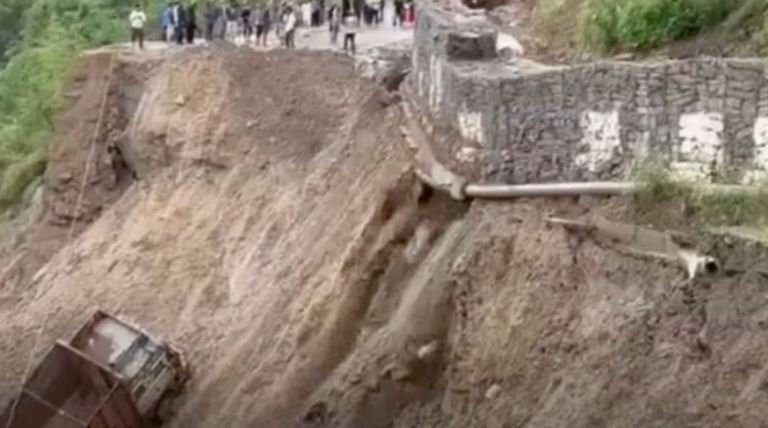
Researchers from Nagaland University have recommended a GIS-based strategy to effectively tackle soil erosion in Northeast India, following a detailed study in the erosion-prone Siji Watershed of Assam’s Gai river basin.
The study highlighted how Geographic Information System (GIS)-based modelling can precisely identify areas vulnerable to soil erosion and sediment transport. The team employed the Revised Universal Soil Loss Equation (RUSLE) integrated with GIS modelling to analyse critical factors including rainfall intensity, soil characteristics, slope length and steepness, land use patterns, and existing conservation practices.
Key findings revealed that areas covered with dense forests and gentle slopes experienced significantly lower soil erosion, while barren lands and regions heavily impacted by human activities faced a much higher risk of degradation.
Vice Chancellor of Nagaland University, Prof. Jagadish K. Patnaik, emphasised the importance of the research, stating: “Integrating geospatial technology would be effective in guiding conservation efforts so as to ensure reduced soil erosion and promote sustainable land practices, ultimately protecting the environment in the Northeast.”
M S Rawat from the university’s Department of Geography recommended adopting an Integrated Watershed Management (IWM) approach. “We recommend an Integrated Watershed Management (IWM) approach. This includes developing sustainable land use plans and implementing mechanical and biological measures such as contouring, terracing, and vegetation cover to reduce soil loss and improve water management,” he said.
The IWM approach provides a detailed, location-specific understanding of how natural and human factors interact within a defined drainage area. It helps identify erosion-prone zones, quantify soil loss, and prioritise high-risk areas for focused intervention.
Researchers believe this integrated strategy will lead to long-term sustainability by maintaining soil quality across the Northeast, enhancing agricultural productivity, and contributing to a rise in water levels through better water retention and reduced sedimentation.
The study offers a scalable model that could be implemented across other hilly and erosion-vulnerable regions of Northeast India, including parts of Nagaland, Meghalaya, and Arunachal Pradesh, where steep terrain and intense monsoon rains exacerbate land degradation.