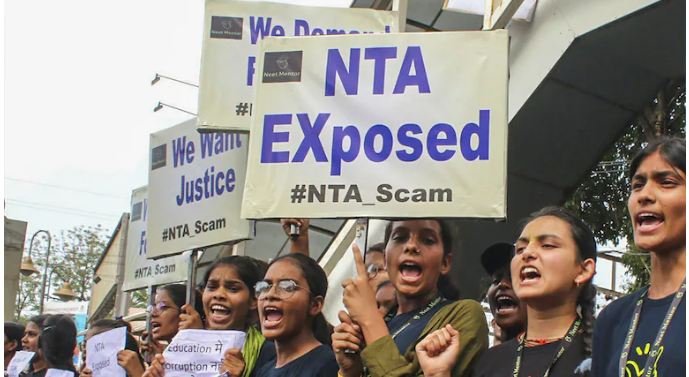
National Testing Agency (NTA) cancelling NEET 2026 has crushed the dreams of lakhs of rural students from the dusty villages of Jharkhand’s Palamu, the conflict-torn hamlets of Manipur, the flood-ravaged fields of Bihar, and small towns across Rajasthan, Uttar Pradesh, and Odisha.
These sons and daughters of farmers, daily-wage labourers, and first-generation families had sacrificed years of blood, sweat, and their families’ limited savings, not for glamour, but for the honourable goal of becoming doctors who would serve their own under-served communities. That sacred dream now lies in ruins because of the National Testing Agency’s spectacular failure.
For students from Manipur, this cancellation is yet another devastating blow. Already battered by the prolonged ethnic crisis since 2023, which disrupted schooling, destroyed infrastructure, forced mass displacements, and shattered normal life for years, these young aspirants had somehow rebuilt their preparation amid unimaginable hardship — only for the national exam system to fail them once more.
The National Testing Agency’s abrupt cancellation of NEET 2026 is not a mere administrative correction. It is a profound betrayal — one that will impose unbearable financial, emotional, and generational burdens, particularly on rural students who have already stretched their families to breaking point.
Let us speak plainly. For a rural family in India, preparing a child for NEET is an act of economic heroism bordering on desperation. Parents who till small patches of land, drive autorickshaws, or work as daily wage labourers decide to invest their life’s savings — often borrowed at crushing interest rates from local moneylenders — into their child’s coaching.
Major institutes like Allen Career Institute or Aakash charge anywhere between Rs 1.3 lakh to Rs 2.4 lakh for classroom programmes. Two-year integrated packages easily cross Rs 3.5 lakh. Add hostel fees (Rs 8,000–15,000 per month), mess charges, transportation to coaching hubs like Kota, Sikar, or Patna, books, test series, and incidental expenses, and the total burden routinely touches Rs 5–7 lakh or more per student.
This is not pocket change for a family earning Rs 10,000–20,000 a month. It often means selling a small plot of ancestral land, taking multiple loans, or forcing younger siblings to drop out of school or college to cut costs. Rural girls, in particular, face added pressure — many families view investing in a daughter’s medical education as a one-way ticket to family upliftment, yet the uncertainty now threatens to turn that investment into a sunk cost.
These students leave their villages at 15 or 16, live in cramped hostels far from home, survive on basic food, and study 14–16 hours a day under intense pressure. Their only lifeline is the belief that one honest attempt could change everything. That lifeline has been cut.
The paper leak scandal — with “guess papers” reportedly circulating in coaching hubs like Sikar up to a month in advance, allegedly sold for as much as Rs 7.3 lakh even the night before the exam — exposed deep rot. “Mastermind” figures have been detained, investigations span multiple states, and the matter is now with the CBI. Yet, in the end, it is not the leaksters or negligent officials who will pay the heaviest price. It is the honest rural student who followed every rule.
Consider the double blow faced by candidates in places like Palamu, Jharkhand. Many Hindi-medium students arrived at centres only to wait in vain for question papers. Some stood outside halls for nearly an hour, frustration boiling over into protests. Even after interventions, the exam resumed late and under chaos.
These students had already spent money travelling to the centre, staying overnight, and preparing mentally for what they hoped would be their one shot. Now, the entire national exam stands cancelled. Their travel costs, lost wages for accompanying family members, and emotional investment — all wasted. And they must do it again.
For rural families, every additional rupee spent on re-preparation is extracted from already depleted resources. Coaching centres will not offer refunds for the previous year’s fees. Hostels in Kota or elsewhere demand fresh deposits. Travel to new exam cities (whenever announced) will cost more.
Many students cannot simply return to their villages and study from home — they lack the competitive environment, reliable electricity, high-speed internet for mock tests, or access to quality teachers. They are forced to remain in expensive urban coaching ecosystems, paying rent indefinitely while the re-exam date floats in uncertainty.
This financial haemorrhage comes at a time when many rural households are still recovering from previous shocks — demonetisation memories, pandemic losses, crop failures due to erratic monsoons, and rising inflation on essentials. A second loan at 24–36% annual interest is common in villages. Some families will mortgage jewellery or the last remaining land. Others will quietly abandon the dream, pushing the bright child into low-paying local jobs while the debt lingers for years.
The mental toll is equally devastating. One aspirant from Palamu told the media reporters he expected over 650 marks in his first attempt. Now he says, “It is not necessary that we will score the same next time.” That uncertainty gnaws at the soul. Peak performance in NEET demands razor-sharp focus, not lingering doubt about whether the system will fail again.
Burnout, anxiety, and depression are already rampant among NEET 2026 aspirants. This cancellation pours fuel on that fire. Rural students, often first-generation learners with limited emotional support networks, suffer in silence. Parents back home, who sacrificed meals and comforts, now face the shame of explaining to relatives why “the exam was cancelled” and more money is needed.
This is not the first time. Since its introduction in 2013, the National Eligibility cum Entrance Test (NEET) has been mired in a series of intense controversies that have repeatedly shaken public confidence in India’s single-window medical entrance examination.
What began as a landmark reform to streamline admissions to medical colleges across the country quickly became a subject of legal battles, student distress, and widespread allegations of malpractice.
In 2013, NEET was rolled out as a unified national-level test for undergraduate medical admissions. However, just months later, on July 18, 2013, the Supreme Court declared it unconstitutional, effectively halting its implementation. The exam was revived in 2016 when the apex court recalled its earlier verdict, paving the way for NEET to become the sole gateway for medical seats in India.
The following year, in 2017, tragedy struck when S. Anitha, a determined aspirant from Tamil Nadu who had legally challenged the NEET policy, died by suicide after failing to secure admission. Her death ignited massive political opposition to the exam in the state, highlighting the immense pressure and regional disparities faced by students.
In 2019, a major impersonation racket was exposed, revealing how several candidates had hired proxy writers to appear for the test and secure coveted medical college seats. The scandal led to numerous arrests and prompted authorities to introduce stricter biometric verification and enhanced security protocols during the examination and counselling processes.
The year 2020 brought fresh challenges when the conduct of NEET amid the COVID-19 pandemic sparked nationwide outrage. Students and opposition parties demanded a postponement, citing serious health risks, restricted transportation, and flooding in several regions. Despite these concerns, the Supreme Court permitted the exam to proceed, prioritising the academic calendar.
In 2022, another controversy erupted in Kerala when female candidates alleged that they were asked to remove innerwear containing metal hooks before entering examination centres, raising serious questions about privacy, dignity, and gender sensitivity in the examination process.
The most recent and perhaps the most damaging episode unfolded in 2024 with NEET-UG. Allegations of paper leaks, irregularities in the award of grace marks, and an unusually high number of candidates securing perfect scores triggered massive protests and legal interventions.
Although the Supreme Court, in July 2024, declined to order a nationwide re-test—observing insufficient evidence of a systemic breach that could invalidate the entire examination—the episode has left a lasting shadow of distrust over the integrity of the process.
A Parliamentary panel headed by Digvijaya Singh highlighted repeated failures across NTA exams. Recommendations for more pen-and-paper modes, citing leak-resistant models like CBSE and UPSC, were made but apparently ignored.
Yet instead of systemic overhaul — stronger security, decentralised conduct, or accountability for officials — we get blanket cancellation after the fact. The students pay for institutional incompetence.
The human stories are heartbreaking. Imagine a farmer in rural Manipur or Bihar who borrowed Rs 4 lakh, sent his son to Kota, and lived on reduced rations for two years. The boy clears the first hurdle only for the exam to be scrapped. The family now stares at another year of debt servicing without any doctor’s salary in sight. Daughters face added societal pressure — “invest more and she might get married better,” but repeated failures invite whispers and early marriage proposals. Rural India’s social fabric, already strained, frays further.
Economically, the ripple effects are wider. Delaying an entire batch of medical students means fewer doctors entering the system in 2027–28, hitting rural healthcare hardest. India already suffers acute shortages in primary health centres and district hospitals. Aspirants from villages are more likely to serve there upon qualifying. By punishing them, we punish the very communities waiting for better medical access.
The NTA claims the decision was taken “in the interest of students” to preserve the “trust on which the national examination system rests.” These words ring hollow from an agency that deployed over 6,000 observers, 1.5 lakh CCTVs, and claimed foolproof logistics, only to see leaks and logistical collapses.
Trust is not restored by making victims suffer twice. True trust would have meant preventing the leak, swift arrests, and conducting the exam with ironclad integrity. Instead, we have greater damage: millions of families losing faith not just in NTA, but in the idea that hard work and merit can overcome systemic failures in India.
For Northeast students, including those from Manipur, the cancellation of NEET 2026 pain feels familiar. Regions already battling ethnic tensions, infrastructure gaps, and economic marginalisation see education as the primary ladder for progress. Many travel to mainland coaching hubs, facing homesickness, cultural adjustment, and higher costs. A cancelled exam adds layers of isolation and financial strain at a time when local opportunities remain limited.
What should have been done? Targeted re-exams for proven leak-affected centres, strict action against culprits, and compensation or extra attempts for genuine victims. Blanket cancellation is the lazy, blunt instrument that hurts the innocent most. The “greater damage” the NTA feared was to its own image, not to students. The real lasting damage is to rural India’s faith in competitive meritocracy.
Lakhs of students now stand at a crossroads. Some will push through with borrowed resolve and money. Many will break. The ones who drop out represent not just personal tragedies but a national loss — untapped talent that could have healed, taught, and led. India’s demographic dividend turns sour when its most ambitious rural youth are forced to accept that systemic leaks and cancellations can erase years of sacrifice overnight.
The Government of India must do better. Announce the re-exam date immediately with full logistical guarantees. Provide financial relief — fee waivers, travel reimbursements, or subsidised coaching for economically weaker rural candidates. Strengthen NTA with decentralised, transparent processes. Punish not just the middlemen but officials whose negligence enabled this.
Until then, this cancellation remains what it truly is: a heartless tax on the poor’s aspirations. Rural students did not leak the paper. They did not fail the system. The system failed them — twice over, and now demands they pay for it with their savings, their mental peace, and their futures.
In the villages tonight, mothers will lie awake counting debts, fathers will stare at barren fields wondering how to fund another year, and young dreamers will fight tears while opening textbooks again under dim bulbs. Their resilience is admirable, but our institutions’ indifference is unforgivable.
This is not merely an NEET 2026 cancellation. It is a cancellation of hope for countless rural families who dared to dream big on limited means. India owes them justice, not another uncertain date.