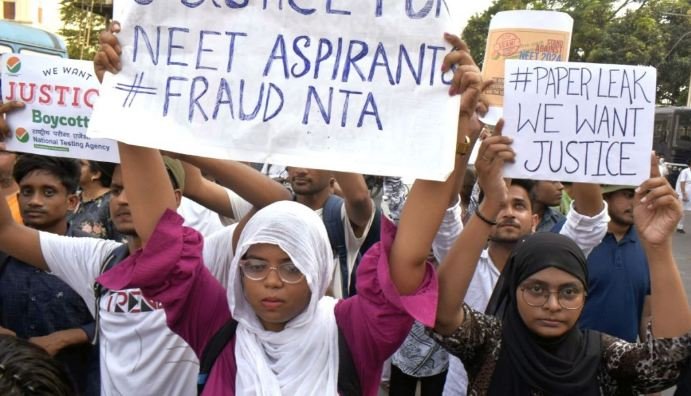
The cancellation of the 2026 NEET exam, just days after it was held on May 3, is not a simple mistake. It is the latest proof that NEET has turned into India’s biggest education scam. Over 22 lakh students poured their blood, sweat, and sleepless nights into this exam, only to see their dreams shattered because of a paper leak in Rajasthan. The innocent majority is once again being punished for the crimes of a few.
This is not the first time. Leaks and serious irregularities happened in 2024 as well, and similar scandals rocked JEE Main earlier. The National Testing Agency (NTA) has repeatedly failed to conduct this high-stakes examination with honesty and competence. What was sold as a fair, merit-based system has now become a recurring national tragedy and a cruel joke on lakhs of young aspirants every year.
The human cost is heartbreaking. Most students start preparing right after Class 10, sacrificing their entire teenage life — friends, family time, sports, health, and mental peace. Many study 14 to 16 hours a day in a brutal routine. For them, NEET is not just an exam; it is their only ticket to a better future. Forcing them to reappear at short notice is nothing short of psychological torture. The anxiety, depression, and burnout that follow destroy young minds. Students from distant states like Manipur, Kashmir, Mizoram, or even the Northeast are dragged into this mess just because of a leak in one corner of Rajasthan.
This is not centralisation — this is institutional cruelty. NEET’s biggest problem is that it is a single point of massive failure. With over 22 lakh candidates, one breach — whether by insiders, organised gangs, or hackers — brings the entire system down. CBI investigations take forever. Arrests happen, news fades, and life moves on while students continue to suffer. Had the authorities taken strong action after previous leaks, today’s crisis could have been avoided. But the casual attitude continues, and public trust has completely collapsed.
Tamil Nadu is showing the right path. Chief Minister C. Joseph Vijay has strongly reiterated that NEET must be scrapped. In his recent statements after the 2026 cancellation, CM Vijay called the repeated paper leaks “proof of serious structural failure” in the national exam system. He emphasised how NEET unfairly hurts students from rural areas, government schools, and Tamil-medium backgrounds who study under the state syllabus.
He has demanded that the Union Government abolish NEET and allow states to admit students to MBBS, BDS, and AYUSH courses based on Class 12 marks. His firm stand has once again highlighted what many states have been saying for years. Voices from Kerala had also warned against this centralised model. Their concerns have now been proven right again and again.
Decentralising medical admissions is the sensible solution. If a leak happens, it will affect only one state instead of destroying the hopes of 22 lakh students nationwide. States can design their own processes or give more weight to Class 12 performance according to their local syllabus, language, and educational realities. This will greatly reduce the insane all-India pressure and break the monopoly of big coaching factories. Most importantly, problems can be solved quickly without traumatising students from Manipur to Maharashtra or Kashmir to Kanyakumari.
India’s aspiring doctors deserve a system that is fair, secure, and compassionate. NEET, in its present form, has failed on all three counts. It has become a stressful, leak-prone lottery that benefits coaching empires more than genuine talent.
The NEET scam runs much deeper than the latest 2026 Rajasthan paper leak. For years, the exam has been plagued by organised syndicates leaking question papers, allowing a few to walk away with unfair advantage while millions of honest students suffer.
Impersonation rackets and proxy candidates have become disturbingly common, with fraudsters colluding with centre officials and using identity theft to sneak ineligible people into the exam hall. Weak security, poor supervision, and loopholes in registration processes have turned the entire system into a playground for manipulation. The insane pressure, cut-throat competition, and societal expectations push even some desperate students towards bribery, cheating, or unethical shortcuts.
This rot did not start yesterday. NEET was first introduced in 2013 as a single national test, only for the Supreme Court to declare it unconstitutional within months. It was revived in 2016, but the controversies never stopped. In 2017, the tragic suicide of Tamil Nadu’s S. Anitha, who fought against NEET and failed to secure a seat, sparked massive outrage and exposed the regional injustice and unbearable stress the exam imposes.
In 2019, a major impersonation racket was busted, leading to arrests and stricter biometric checks. The 2020 COVID year saw the exam being forced through despite health risks, floods, and transport issues, drawing widespread criticism. In 2022, Kerala witnessed shameful incidents where female candidates were allegedly asked to remove innerwear with metal hooks before entering centres, raising serious concerns about dignity and gender sensitivity.
The 2024 NEET scandal pushed the crisis to another level with massive paper leaks, arbitrary grace marks, and an unusually high number of perfect scorers, triggering protests and court battles.
Enough is enough. The Government of India must listen to states like Tamil Nadu and treat this as a complete systemic collapse. Swift punishment for the guilty is necessary, but real change is more urgent.
Our students — especially those from the Northeast facing extra challenges of distance, conflict, and limited resources — cannot be sacrificed year after year. From leaks and proxies to dignity violations and administrative arrogance, NEET has repeatedly proven it is no longer a fair merit test — it has become India’s biggest education scam that keeps breaking young dreams year after year.
It is time to retire this failed experiment called NEET and build a better, decentralised, and student-friendly system. India’s future doctors and millions of dreaming youngsters have waited long enough.