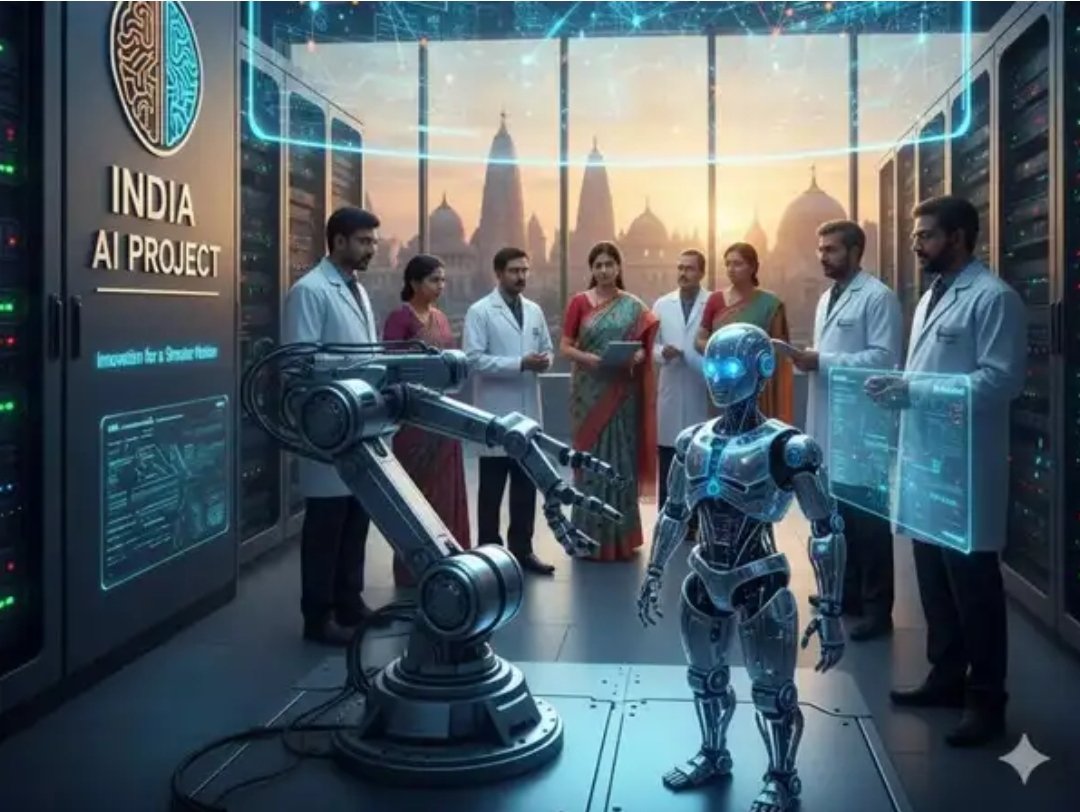
India stands at a defining moment in its technological journey. The question is not whether to embrace artificial intelligence (AI) but how swiftly and comprehensively we can make it a cornerstone of our national progress. Our history of bypassing outdated systems—leapfrogging from telegraphs to mobile phones and from cash to UPI—demonstrates a unique ability to adopt transformative technologies at scale.
AI offers a similar opportunity to redefine India’s future, embedding it into our infrastructure to drive economic growth, social equity, and global leadership. With Indian-origin talent powering global AI breakthroughs, a robust patent portfolio, and the ambitious IndiaAI Mission, we have a strong foundation.
Yet, to truly lead, we must accelerate investment, reskill our workforce, and integrate AI into public services with unprecedented urgency. The stakes are high: hesitation could relegate us to being mere consumers of foreign AI, while bold action could position India as a global pacesetter.Our track record of technological leapfrogging offers both inspiration and a blueprint.
In the 1990s, while developed nations were mired in landline infrastructure, India embraced mobile technology, rapidly scaling to over 1.2 billion subscribers today, the world’s second-largest smartphone market. This leap connected remote villages, empowered small businesses, and birthed a vibrant digital economy.
Similarly, the Unified Payments Interface (UPI), launched in 2016, sidestepped the credit card-dominated systems of the West. Now processing over 13 billion transactions monthly, UPI has transformed financial access, enabling everyone from street vendors to corporations to transact seamlessly. These successes highlight India’s knack for identifying inefficiencies in legacy systems and adopting scalable, inclusive solutions.
AI is the next frontier, promising to revolutionize sectors from agriculture to governance, provided we act decisively.The potential of AI to transform India is immense, particularly given our unique challenges and demographic strengths. With a population of 1.4 billion, half under 30, India has the human capital to harness AI for innovation. In agriculture, which employs nearly half our workforce, AI-driven tools could optimize irrigation and predict crop diseases, boosting yields by up to 20%, as seen in pilot projects in Maharashtra.
In education, AI tutors could personalize learning for millions in rural schools, narrowing literacy gaps. Healthcare could benefit from AI diagnostics, easing the load on doctors in a country with just 0.7 physicians per 1,000 people. Urban centers like Bengaluru could use AI to manage traffic, cutting congestion and emissions.
By weaving AI into our infrastructure—like electricity or highways—we can address systemic issues like poverty, climate change, and inefficiency, positioning India as a model for the Global South.India’s AI journey is not starting from scratch. Our human capital is a global force: one in four top AI researchers worldwide is of Indian origin, contributing to advancements at institutions like MIT and companies like Google.
Domestically, India ranks fifth globally in generative AI patents, covering innovations in text generation, image synthesis, and automated coding, according to the World Intellectual Property Organization. This intellectual prowess is complemented by the IndiaAI Mission, launched with Rs 10,372 crore to build a robust AI ecosystem. The mission supports multilingual AI models, high-performance computing centers, and ethical guidelines, ensuring AI serves India’s diverse linguistic and cultural landscape.
Projects like BharatGen, a government-funded multimodal language model, and Hanooman’s Everest 1.0, supporting 35 Indian languages, underscore our commitment to inclusive AI.Yet, this foundation, while promising, is insufficient to compete with global AI leaders. The Rs 10,372 crore investment, though significant, is dwarfed by the billions poured into AI by the US and China. American tech giants like Microsoft invest over $20 billion annually in AI R&D, while China’s government has committed $15 billion by 2025.
India’s allocation, spread over five years, is modest for a nation of our scale and ambition. Without a dramatic increase in funding, we risk relying on foreign AI models that may not understand our languages, cultures, or priorities. To avoid this, India must triple its AI investment, targeting both public and private sectors to create a self-reliant ecosystem.The private sector must lead the charge.
Currently, Indian companies allocate just 2% of revenue to technology, compared to 4-6% in tech-driven economies like South Korea. Doubling this to 4% is critical, with tax incentives to spur AI research in startups and conglomerates alike. Firms like Reliance and Infosys are already exploring AI for logistics and IT services, but smaller enterprises must join in.
For example, startups in Hyderabad could develop vernacular AI assistants, while manufacturers in Chennai adopt AI for quality control. Such investments would drive innovation in areas like natural language processing for Indian languages, unlocking markets for millions of non-English speakers.Reskilling is equally urgent. AI will disrupt jobs, automating tasks in sectors like BPO and data processing, which employ millions.
A 2023 PwC report estimates that 30% of India’s jobs could be automated by 2030. Yet, this disruption is an opportunity to shift workers toward roles requiring uniquely human skills—creativity, empathy, and collaboration. Designers, therapists, and project managers will remain in demand, but only if we prepare.
The government’s Skill India program should expand to include AI literacy, offering free courses in machine learning, data ethics, and AI application development. Partnerships with platforms like Udemy or local universities could certify 50 million workers by 2030. Rural reskilling hubs, targeting women and youth, could integrate AI training into existing schemes like Digital India, creating a pipeline of AI moderators and developers for the gig economy.The public sector must set the pace, integrating AI into governance to demonstrate its value.
In education, AI could transform overcrowded classrooms in states like Uttar Pradesh, where adaptive learning platforms could tailor lessons to individual students. In healthcare, AI tools could prioritize patients in public hospitals, as seen in Tamil Nadu’s pilot programs for diabetic retinopathy screening. The judiciary, burdened by 40 million pending cases, could use AI to summarize documents and suggest precedents, reducing delays.
Smart cities like Ahmedabad could deploy AI for traffic management, cutting travel times by 15-20%, as shown in global case studies. These applications require robust data privacy laws, building on the Digital Personal Data Protection Act, and international collaboration to adopt best practices without compromising sovereignty.Incremental AI adoption can yield exponential gains.
In agriculture, AI-driven precision farming has increased yields by 15% in trials, potentially adding billions to GDP if scaled nationally. In public services, even small improvements—like AI chatbots for citizen queries—could save millions of hours annually. The IndiaAI Mission’s pillars, such as the 34,000-GPU compute capacity and the AIKosha platform, provide the infrastructure, but execution is key. Events like the India-AI Impact Summit 2026 will showcase use cases, while challenges like the IndiaAI Face Authentication initiative (launched October 2025) drive innovation in areas like identity verification.
To realize this vision, India must move beyond incrementalism. The government should increase AI funding to Rs 30,000 crore over the next five years, prioritizing compute infrastructure and R&D. Public-private partnerships, like those with NVIDIA and NASSCOM, should expand to include global leaders while fostering homegrown startups.
Ethical AI frameworks must evolve to address biases, particularly in multilingual models, ensuring inclusivity. Citizens, too, have a role—embracing AI literacy and supporting policies that prioritize technology.In conclusion, India’s AI moment is now.
Our history of leapfrogging, coupled with our talent and the IndiaAI Mission, positions us to lead. But leadership demands bold action: tripling investments, reskilling millions, and embedding AI in public life. Delay risks dependence on foreign systems; urgency ensures sovereignty and prosperity. Let’s seize this opportunity to build an AI-powered India that not only competes but defines the global future.