The Press Information Bureau (PIB) reports that the newly announced GST reforms for 2025 are poised to transform Manipur’s economy, boosting small-scale industries, traditional crafts, and agro-based livelihoods. Aimed at fostering inclusive growth and easing business operations, these reforms are expected to enhance affordability, stimulate demand, and strengthen the global competitiveness of Manipur’s unique products, from Arabica coffee to handloom textiles.
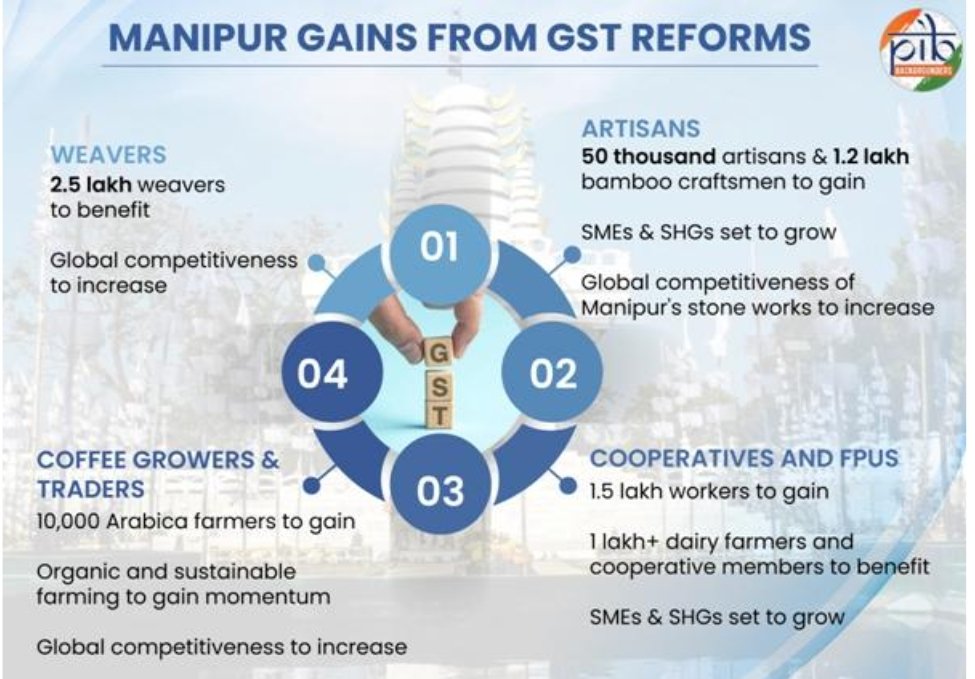
In the highlands of Ukhrul, Senapati, and Chandel, around 10,000 farmers cultivate high-quality Arabica coffee. The GST reduction from 18% to 5% on packaged coffee is set to lower costs for producers and consumers, boosting profitability and demand in domestic and export markets. The reforms also encourage sustainable and organic farming practices, further strengthening the sector’s growth.
The state bamboo and cane craft sector, employing 1.2 lakh artisans in districts like Churachandpur and Tamenglong, will benefit from a GST cut from 12% to 5% on furniture, baskets, and mats. This reduction is expected to lower product prices, drive demand, and support small and medium enterprises (SMEs) and self-help groups (SHGs), preserving traditional craftsmanship.
The state’s iconic handloom textiles, including Phanek and Innaphi, crafted by 2.5 lakh weavers—mostly women—in Imphal, Thoubal, and Bishnupur, will gain from a GST reduction from 12% to 5%. This move enhances affordability and market competitiveness, promoting Manipur’s rich weaving heritage on a global stage while providing economic stability to artisans.
Approximately 50,000 artisans in Imphal, Churachandpur, and Ukhrul, known for their intricate stone carving and sculpture, will benefit from a GST cut from 12% to 5% on ceramic tableware. This tax relief reduces costs, making Manipur’s stone products more competitive globally while preserving traditional techniques.
Manipur’s processed food industry, centered in Imphal, Senapati, and Chandel, employs 1.5 lakh workers, primarily rural women, in producing pickles, bamboo shoots, and fermented foods. The GST reduction from 12% to 5% on these items will lower prices, expand market reach, and boost the profitability of SMEs and SHGs.Dairy Industry Gets a Lift
Over 1 lakh dairy farmers and cooperative members in Imphal, Thoubal, and Bishnupur will benefit from a GST reduction to Nil or 5% on ghee, butter, paneer, and cheese. This change is expected to make dairy products more affordable, improve profit margins, and enhance competitiveness in domestic and export markets.
The 2025 GST reforms, as announced by PIB, mark a pivotal moment for Manipur, reducing tax burdens across critical sectors and empowering local farmers, artisans, and entrepreneurs. By fostering affordability and market competitiveness, these changes position Manipur as a key contributor to India’s economic growth, particularly in the Northeast.