FAITH & WISDOM | DIVINE PANTHOU
Faith should bring a human being closer to truth. It should teach restraint, compassion and respect. But what happens when the faith that is supposed to guide us becomes a reason to look down upon another person?
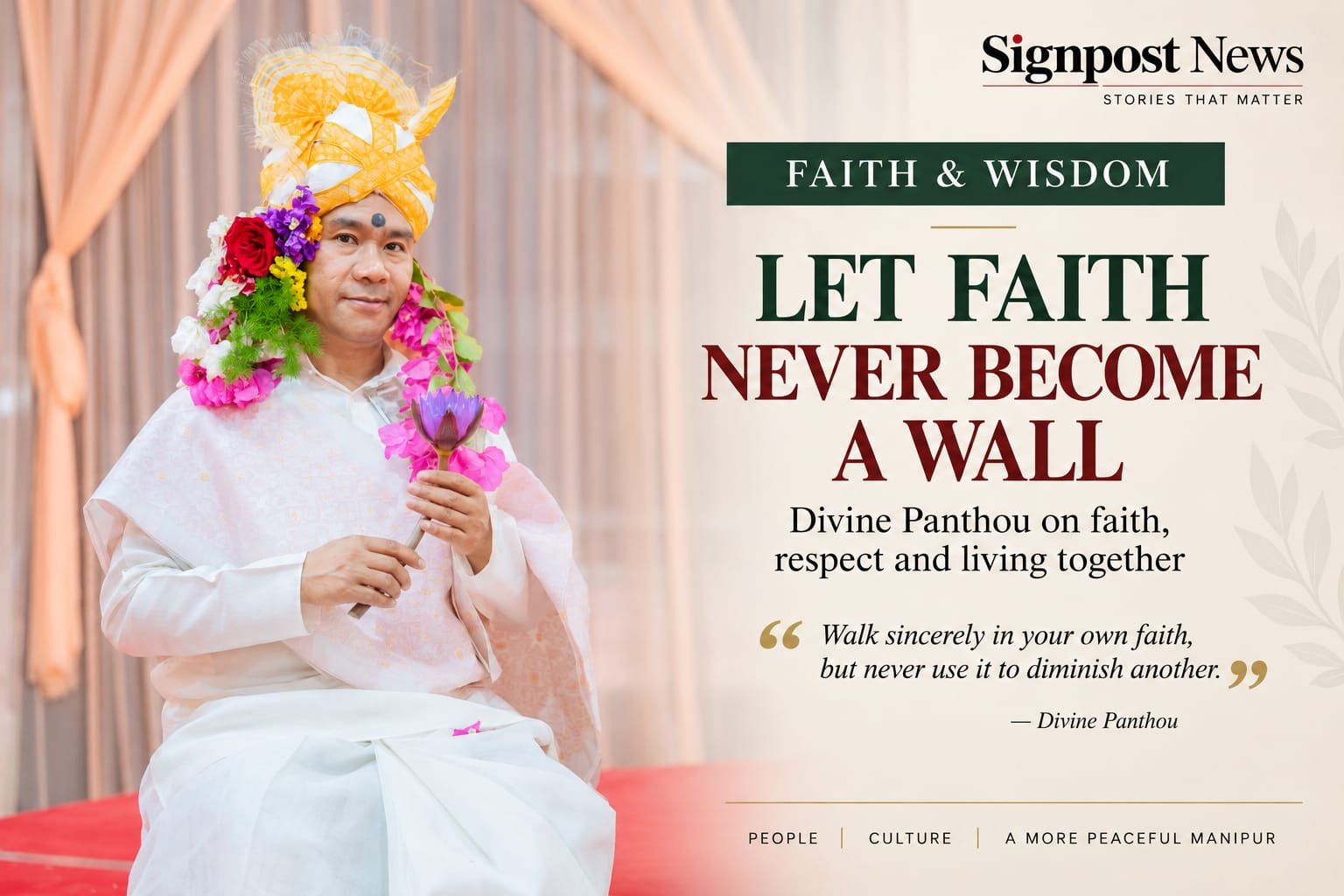
One of Divine Panthou’s teachings offers a remarkably simple answer: practise your own faith sincerely, but never use it to diminish another.
The message comes from Meitei religion, yet there is nothing narrow about it. It speaks to something every religious society eventually has to confront — whether devotion will make us better human beings or merely strengthen the walls between us.
Follow Your Faith, Without Belittling Another
There is no contradiction between being deeply rooted in one’s own faith and respecting somebody who follows another path.
Divine Panthou’s teaching asks people to understand and practise their own laining. A tradition survives when its people know it, practise it and pass its values to the next generation.
But preserving one’s faith does not require insulting another.
That distinction is important.
Religious confidence and religious intolerance are not the same thing. A person who understands his or her own tradition does not need the humiliation of another tradition to establish its worth.
Respecting another person’s belief does not make our own belief weaker.
It may, in fact, show that our faith has become mature enough to live beside difference.
Faith Must Be Seen in Conduct
Religion is often identified through names, rituals, places of worship, dress and festivals. These are important parts of religious and cultural life.
But Divine Panthou’s teaching directs attention to something more difficult: conduct.
What does our faith make of us?
Does it make us kinder?
Does it teach us to control our words before hurting someone?
Does it allow us to recognise dignity in a person whose belief is different from ours?
If religious practice does not influence how one human being treats another, something essential has been missed.
Faith cannot remain only inside a place of worship. It follows us home. It enters the marketplace. It travels with us to our workplace. It appears in the language we use for neighbours and strangers.
That is where its real test begins.
Difference Need Not Become Division
No society is made up of people who think exactly alike.
People inherit different religions, traditions, languages and ways of understanding the world. Even within the same faith, people may disagree.
Difference itself is therefore not the danger.
The danger begins when difference becomes contempt — when we start believing that another person deserves less respect simply because his prayer, identity or inherited tradition is different from ours.
Divine Panthou’s message offers another possibility.
Hold firmly to your own laining. Understand it. Preserve it. Teach it to the next generation.
And allow another person the same dignity.
A peaceful society does not require everyone to follow the same spiritual path. It requires people to ensure that their respective paths are not turned into weapons against one another.
A Teaching Manipur Can Reflect Upon
This message has particular meaning in a land as culturally and religiously diverse as Manipur.
Our traditions are precious precisely because generations before us preserved them. Protecting that inheritance is a responsibility. But cultural and religious preservation need not produce hostility towards somebody else’s inheritance.
There is enough space for conviction without contempt.
There is enough space to say, “This is my faith,” without adding, “Therefore yours has no value.”
Perhaps this is where religious wisdom becomes social wisdom.
The strength of a faith is not measured by how loudly its followers can proclaim it. It can also be measured by the kind of human beings it produces — people capable of conviction without hatred, identity without arrogance and devotion without cruelty.
Divine Panthou’s teaching ultimately brings us back to a very simple principle.
Know your faith. Live your faith. Preserve your faith. But never make another human being smaller in order to make your own faith appear greater.
That may be one of the most difficult forms of religious discipline.
It may also be one of the most necessary.
This article is part of Signpost News’ Faith & Wisdom series, which presents teachings and reflections on faith, humanity, ethical living and our relationship with the natural world.