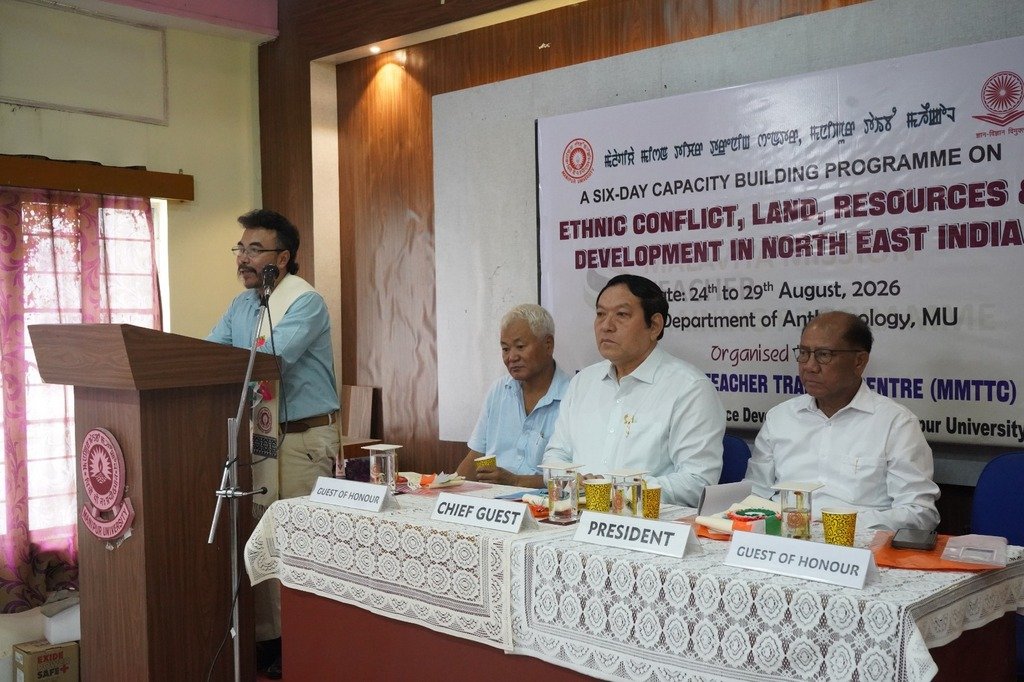
Imphal, August 24, 2026: A six-day Capacity-Building Programme on “Ethnic Conflict, Land, Resources and Development in North East India” commenced at Manipur University on Monday, bringing together academics, researchers and experts from diverse disciplines for sustained deliberations on conflict, identity, land, demographic change, governance, peace-building and sustainable development in the Northeast, with particular reference to Manipur.
The programme, being organised by the Malaviya Mission Teacher Training Centre (MMTTC), Manipur University, under the Ministry of Education, Government of India, from August 24 to 29, 2026, is being held at the Conference Hall of the Department of Anthropology, Manipur University.
Prof. R.K. Hemakumar Singh, Vice-Chancellor (In-charge), Manipur University, attended the inaugural programme as Chief Guest. Prof. M.C. Arunkumar, Dean, School of Human and Environmental Sciences, and Prof. Haobijam Vokendro Singh, Head, Department of Anthropology, were the Guests of Honour, while Prof. R.K. Bhubon Singh, Director, MMTTC-MU, presided over the programme.
Addressing the gathering, Prof. R.K. Hemakumar Singh described the theme as highly relevant to the present situation and said the six-day programme would provide an important academic platform for eminent scholars to discuss issues confronting Manipur and the wider Northeast.
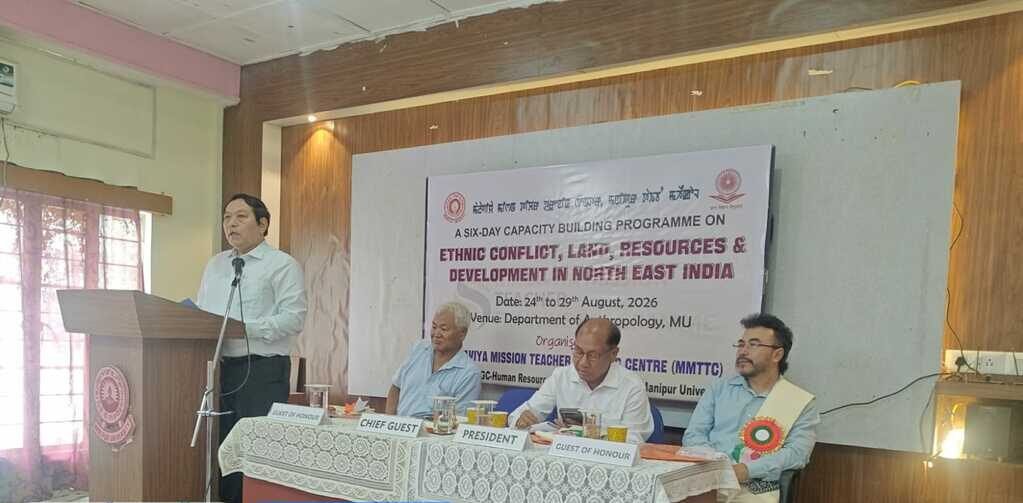
Noting that Manipur has been experiencing a prolonged crisis for nearly three years, the Vice-Chancellor stressed the importance of preserving the outcomes of such academic deliberations for future reference.
He urged the organisers and resource persons to prepare a concise report on the discussions and explore ways to preserve the proceedings in the University Library and, if possible, make them accessible online.
“We are discussing today for our future,” Prof. RK Hemakumar said, stressing that the University should create a proper academic record of its efforts and deliberations relating to the ongoing crisis in the State.
Prof. R.K. Bhubon Singh, Director, MMTTC-MU, said the programme had been conceived against the backdrop of continuing ethnic tensions and the complex relationship between identity, land, resources, governance and development in the Northeast.
Referring to the continuing violence in Manipur, Prof. Bhubon highlighted historical grievances, overlapping claims over land and political space, socio-economic disparities, insurgency, governance deficits and cross-border dynamics as some of the challenges that require serious academic examination.
He said the idea for the six-day programme developed further following an earlier academic interaction on contested diversity, violence and development held on July 5. While many experts had discussed the Manipur crisis through television and other public platforms, he felt there was a need to move beyond oral discussions and create a systematic academic record.
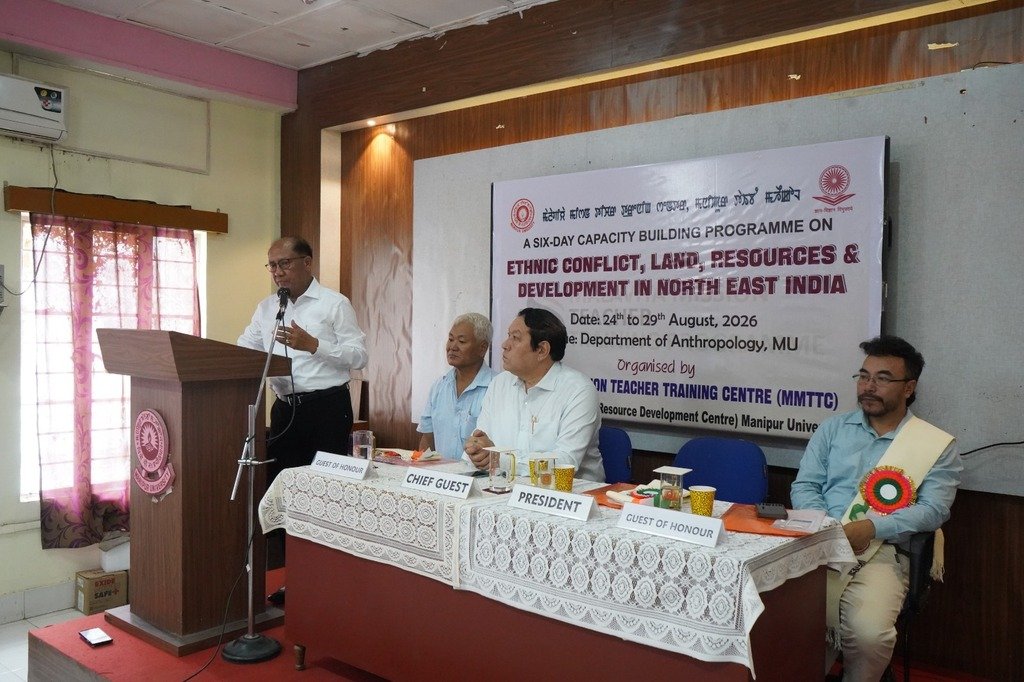
Prof. Bhubon said the programme therefore seeks to provide space for rigorous academic debate and documentation.
He emphasised that a lasting solution to ethnic conflict requires moving beyond a predominantly security-centred approach towards peace-building, reconciliation, equitable development, effective governance and respect for the diverse identities and experiences of communities.
The programme, he said, would allow scholars from different disciplines to exchange ideas and examine possibilities for sustainable peace in Northeast India, particularly Manipur. He also announced that the organisers intend to compile the papers presented during the six-day programme and publish them in book form so that the academic deliberations remain available as reference material for researchers and future generations.
Speaking on the role of teachers and academic institutions, Prof. M.C. Arunkumar said the National Education Policy 2020 places teachers at the centre of the educational process and therefore requires teachers themselves to continuously update their knowledge, skills and understanding.
He observed that education has undergone enormous changes over the past several decades and teachers today are preparing students for a rapidly changing world. Capacity-building programmes, he said, should consequently be understood not simply as one person teaching another but as platforms where teachers and scholars “refresh ourselves, refresh our ideas and refresh our skills” through interaction.
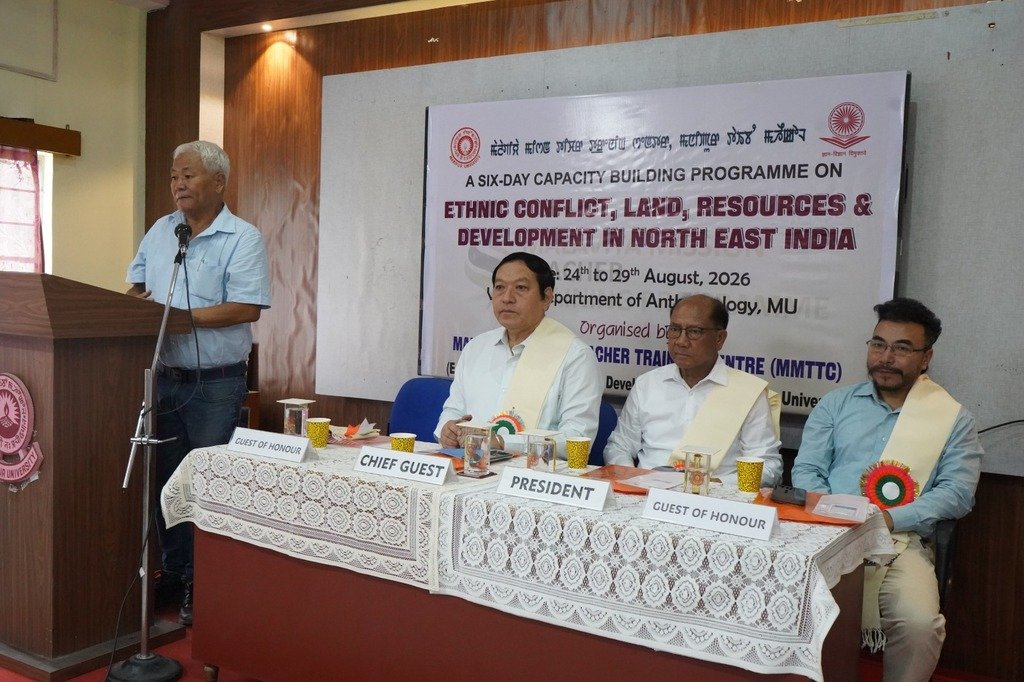
Prof. Arunkumar called upon the participants to critically examine concepts frequently used in contemporary public discourse, including ethnicity, ethnic conflict, indigenous people, native communities, land rights and development. He said academic institutions have a responsibility to distinguish rigorous definitions and evidence-based understanding from loosely used political terminology.
He also encouraged participants to debate questions surrounding land ownership, customary systems and individual rights, particularly in tribal societies, and to explore democratic approaches to development rather than models imposed without sufficient engagement with communities.
Calling for vigorous but constructive debate during the programme, he expressed hope that the six days would contribute towards clearer and more democratic understandings of education, land, identity and development.
Prof. Haobijam Vokendro Singh, Head of the Department of Anthropology, said the programme builds upon earlier academic work examining Manipur’s diversity, conflict and historical experience.
He said the organisers had deliberately brought together resource persons from different fields and allowed them to select subjects within the broad themes and sub-themes according to their respective areas of expertise, encouraging independent academic inquiry rather than prescribing particular viewpoints.
Prof. Vokendro said the programme would examine issues including land, border security, demographic change, federalism, ethnic relations, governance, history, cultural heritage and the interconnectedness of Manipur’s communities.
He stressed the importance of recording academic arguments in written form. Resource persons have therefore been requested to submit manuscripts of their presentations following prescribed academic referencing standards, with the intention of bringing out a publication based on the deliberations.
The six-day Capacity-Building Programme will feature a series of academic presentations by scholars, experts, journalists and practitioners from diverse disciplines, examining ethnic conflict, displacement, demographic change, land and natural resources, border security, governance, federalism, history, cultural heritage and peace-building in Manipur and Northeast India.
On August 24, Dr. L. Muhindro will present a paper titled “Human Security and Ethnic Conflict in Manipur: The Vulnerability of Internally Displaced Persons,” while Prof. Rena Laisram will speak on “Role of History in Peace Building: Illustrations from North East India.” Dr. Th. Bharat will present on “Conflict and Displacement.”
On August 25, journalist Pradip Phanjoubam will speak on “The Causes and Consequences of Ethnic Violence in Manipur: A Way Forward.” Dr. L. Bishwanjit Singh will present “When Exit is Not a Choice: Moreh and the Future of India’s Act East Policy,” while Dr. G. Amarjit Sharma will deliberate on “Ethnic Diversity and the Limits of Asymmetrical Power Sharing and Consociational Theories.” Prof. Lilee will address the theme “Women, Youth and Vulnerable Groups in Conflict Situations.”
The sessions on August 26 will include a presentation by Prof. Premananda on “Illegal Migrants and Change in Demographic Pattern: Manipur Chapter.” Dr. Atom Sunil Singh will present “Contested Frontiers: The Geopolitics of Land, Resources and Connectivity in North-East India — Terrain, Governance, Indigenous Rights and Uneven Development.” Dr. Konthoujam Khelchandra will speak on “Water, Wetlands and Environmental Justice in North East India: Resource Conflicts, Livelihoods and Pathways to Sustainable Governance,” while Prof. Chinglen Maisnam will address “Federalism and Autonomy: Issues and Challenges with Special Reference to Manipur.”
On August 27, Thangjam Brojen will present “Strategic Challenges in India’s North-East: The Manipur Crisis and Pathways to Sustainable Security and Peace.” Prof. H. Vokendro Singh will speak on “Evidence of the Common Origin of the Hill and Valley Ethnic People of Manipur from Folklore and Puya.” Prof. R.K. Narendra will examine “Demographic Dynamics in Manipur: Past to Present,” while Dr. Nameirakpam Surjitkumar will present “Conflict Transformation and Peace Building in North-East India: A Framework.”
The programme on August 28 will feature Dr. Laishram Suresh, who will present “The Aboriginal Tribes of Manipur.” Prof. L. Suraj Singh will speak on “India-Myanmar Relations and the Northeast India Dynamics: The Way Ahead,” while Dr. L. Sadhana will deliberate on “Role of Museums in Promoting Community Identity and Cultural Heritage of Manipur: History.” The day’s academic programme will also include an MCQ component.
On the concluding day, August 29, Lt. Gen. (Dr.) Konsam Himalay will present “Borderland, Security and Governance in North-East India.” Prof. Bhagat Oinam will speak on “Challenges to the Peace-Building Process in Manipur,” while Binalakshmi Nepram will present “Armed Conflict, Small Arms and Narcotic Trafficking in Manipur and Looking at Indigenous Pathways to Peacemaking.” The programme will conclude with the valedictory session.
Through these presentations and interactions, the six-day programme seeks to bring together perspectives from anthropology, history, demography, international relations, security studies, environmental studies, governance, cultural studies, journalism and peace-building. The organisers also propose to document the academic deliberations and papers for publication, creating a reference that could contribute to future research, public understanding and informed discourse on conflict, reconciliation and sustainable development in Manipur and the wider Northeast.