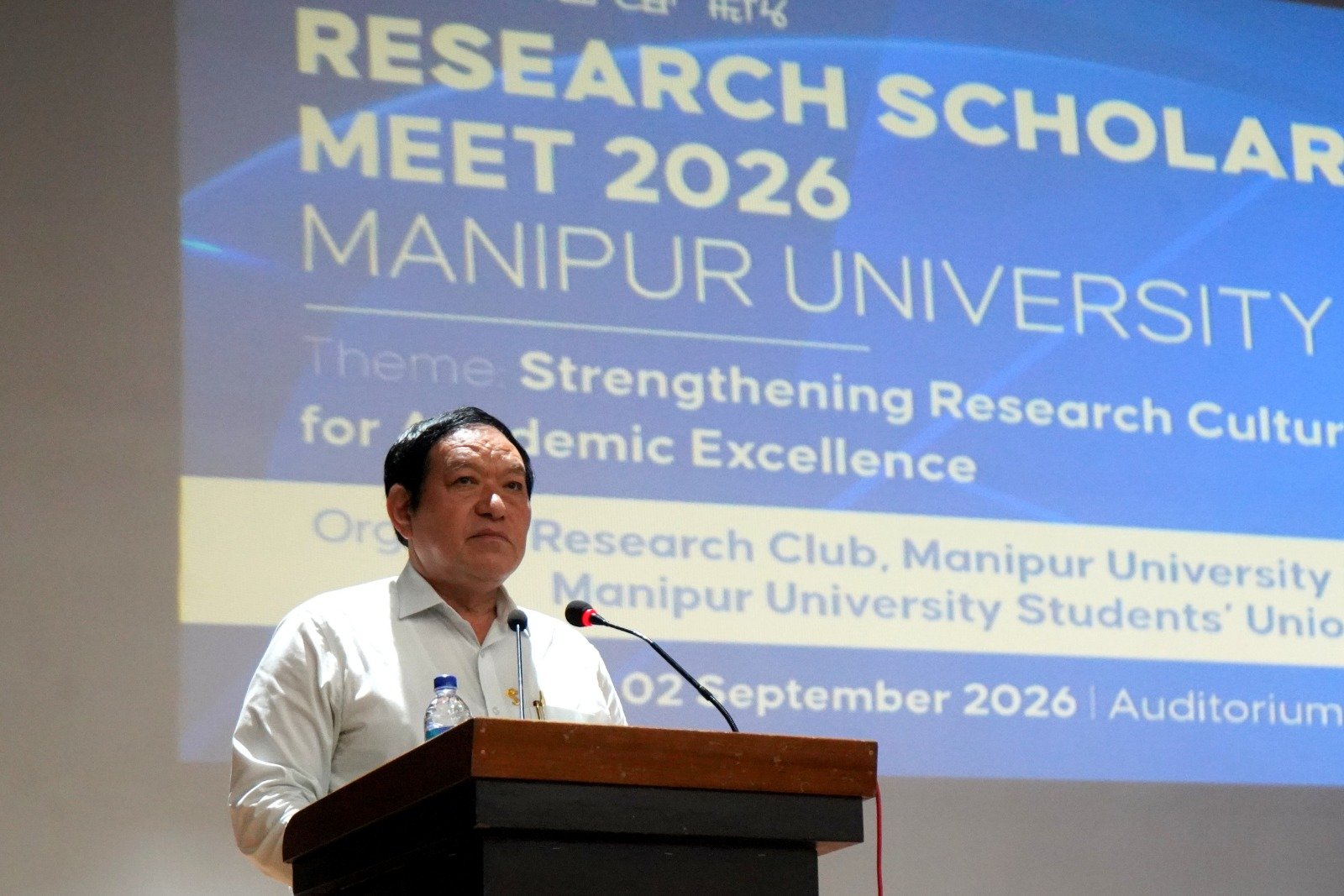
Imphal, September 2, 2026: Manipur University has called for a stronger research ecosystem built around merit, collaboration, quality publication and social relevance, with Vice-Chancellor (in-charge) Prof. R.K. Hemakumar Singh stressing that research should ultimately produce knowledge that contributes not only to academic careers but also to society.
The call came at the Research Scholars’ Meet 2026, organised by the Research Club, Manipur University, in collaboration with MUSU 2025–26 at the University Auditorium on Wednesday under the theme “Strengthening Research Culture for Academic Excellence.”
Beyond the ceremonial gathering, the meet brought several issues concerning the future of research at Manipur University into focus — from attracting JRF and NET-qualified scholars and improving postgraduate research training under the National Education Policy (NEP) 2020 to collaborative scholarship, quality academic publishing and the proposed four-year Integrated Teacher Education Programme (ITEP).
A major academic highlight was the launch of Research Update, the research journal of Manipur University, envisioned as a platform through which scholars can disseminate their work and strengthen academic exchange within and beyond the University.
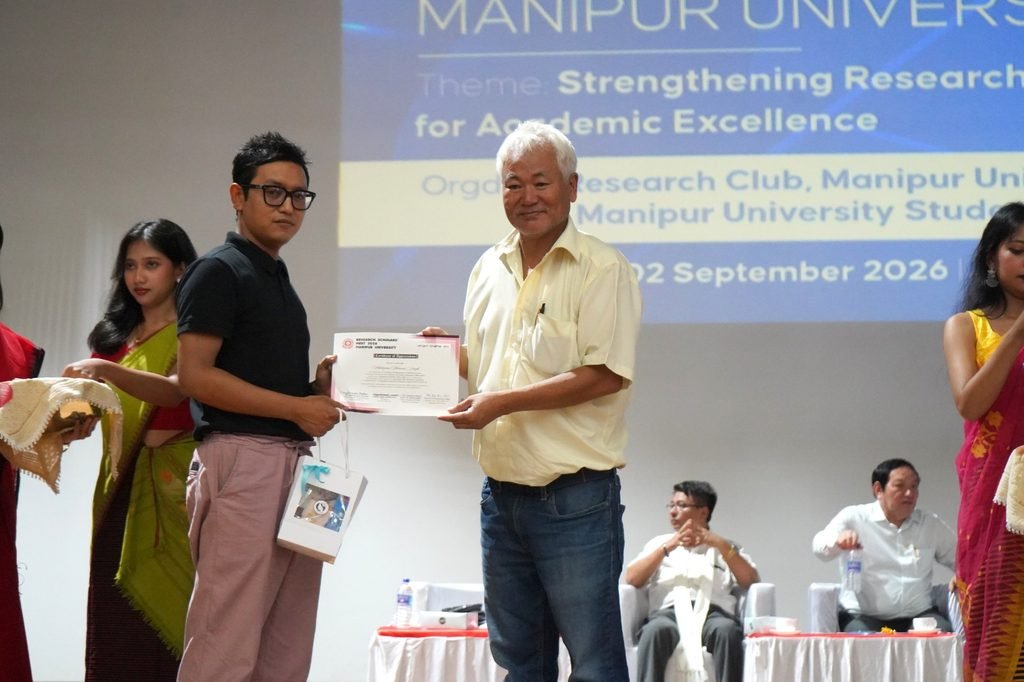
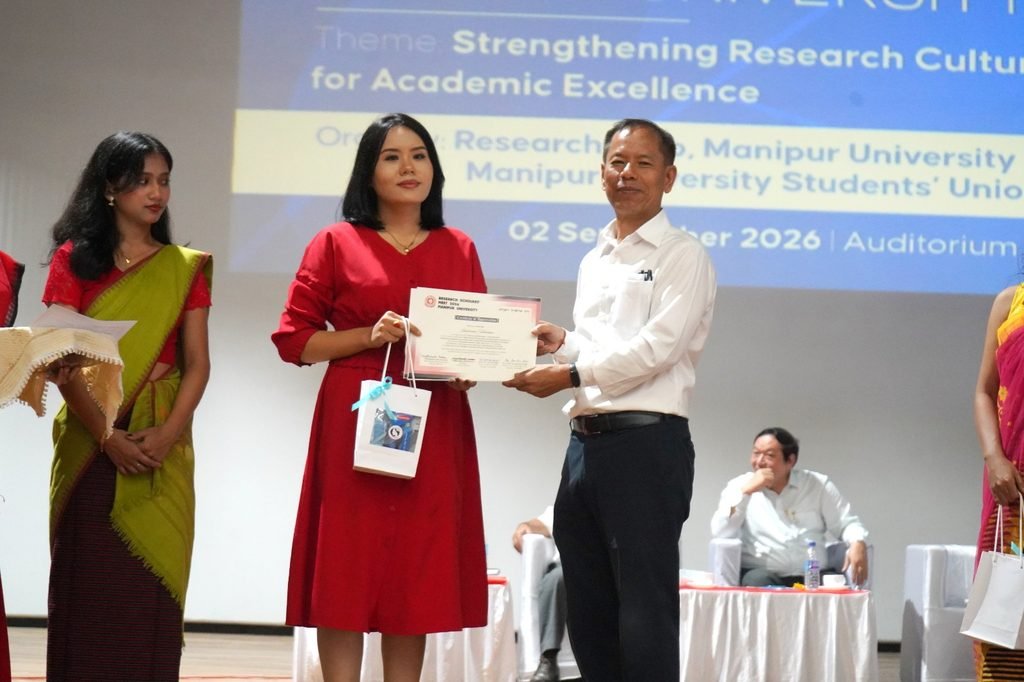
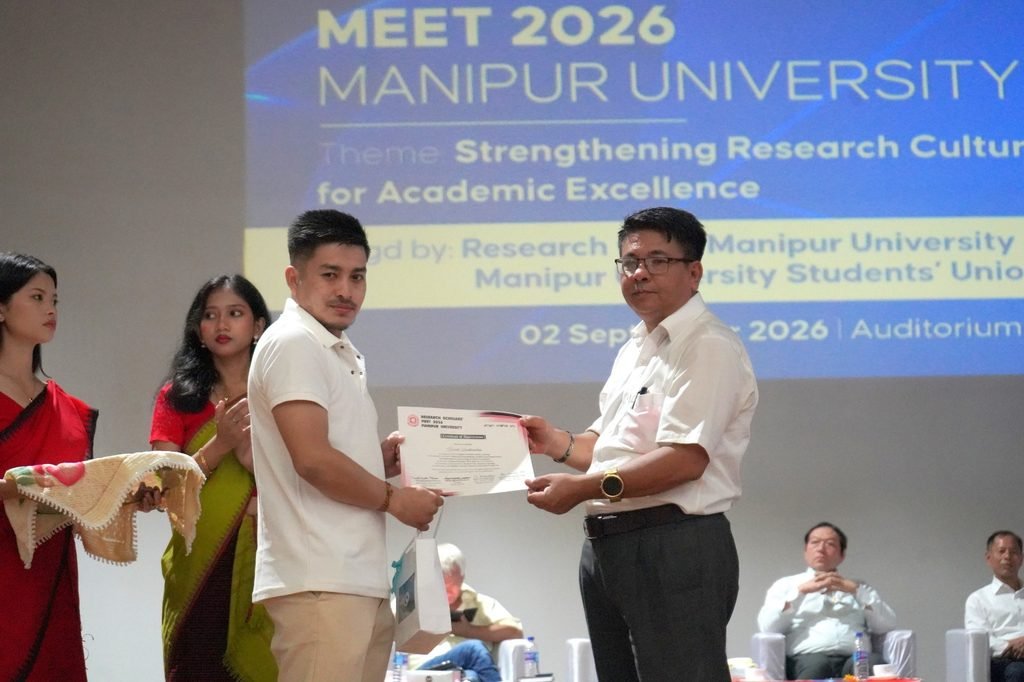
The programme also felicitated 18 scholars awarded Doctor of Philosophy (PhD) degrees, 22 awardees, four achievers and eight contributors to Research Update.
VC Flags Need to Attract More Qualified Research Scholars
Addressing the gathering as Chief Guest, Prof. Hemakumar linked the academic standing of a university to both the quality of students entering the institution and the academic output produced by them.
Using the analogy of admission as an “inlet” and examination and academic achievement as an “outlet”, he argued that universities must attract capable students and provide an environment in which their academic potential can develop.
He placed particular emphasis on merit and transparency in admission, especially in the present circumstances in Manipur, and recalled his experience in academic administration where, he said, merit had to be protected despite recommendations and external pressures.
The Vice-Chancellor also drew attention to what he described as the relatively small number of JRF and NET-qualified candidates joining the University as research scholars. He called for efforts to attract more qualified researchers and examine ways of filling available research seats.
The issue has wider implications for the University. Research strength is determined not merely by the number of departments or available seats, but by the ability of an institution to attract scholars capable of sustaining long-term research, producing credible publications and building academic networks.
Prof. Hemakumar cautioned against expecting meaningful research or quality publications to emerge overnight. Comparing the development of a researcher to a seed growing into a productive plant, he said research requires time, sustained effort, an enabling academic environment and commitment from both scholars and supervisors.
He also advocated greater collaborative research, observing that contemporary scholarship increasingly depends on researchers and institutions sharing knowledge, expertise, facilities and resources instead of working entirely within disciplinary or institutional silos.
More importantly, he said research should not conclude merely with the award of a degree or publication of a paper. Research output should reach quality academic journals and contribute meaningfully to society.
ITEP Preparations Moving Forward
The Vice-Chancellor also provided an update on Manipur University’s efforts to introduce the four-year Integrated Teacher Education Programme (ITEP).
According to Prof. Hemakumar, substantial preparatory work has already been undertaken through a committee constituted earlier, while the remaining academic and regulatory processes are being taken forward.
These include finalisation of the required ordinances, other academic and regulatory requirements, besides compliance relating to faculty, infrastructure and institutional inspection.
The University, he indicated, would seek to complete the remaining process at the earliest while meeting the applicable norms.
A Research Movement Dating Back to 1990–91
The meet also revisited an important but less widely remembered chapter in Manipur University’s academic history.
Prof. M.C. Arunkumar, Dean, Human and Environmental Science and Editor-in-Chief of Research Update, traced the origin of the Research Club, Manipur University, to around 1990–91, when a group of like-minded researchers came together to establish a common intellectual platform on the campus.
He recalled that noted writer and Sahitya Akademi Award winner Yumlembam Ibomcha Singh was among those who initiated the movement along with other scholars.
The idea was to provide researchers with a space for intellectual interaction and exchange beyond the confines of individual disciplines.
More than three decades later, Prof. Arunkumar urged the present generation of scholars to preserve that tradition by strengthening academic discussion, interdisciplinary engagement, collaborative research and scholarly publication.
He said Research Update could play an important role in that effort by giving researchers a platform to communicate and disseminate their work.
NEP Brings Research Earlier Into Postgraduate Education
Prof. Angom Dilip Kumar Singh, Director of the Research & Development Cell, focused on another structural change confronting universities — the increasing integration of research into postgraduate education under NEP 2020.
Referring particularly to the research component in the fourth semester of postgraduate programmes, he stressed that project-based research needs adequate academic weight within the evolving credit framework.
The significance goes beyond completing a semester project.
Prof. Dilip Kumar said postgraduate students should systematically learn problem identification, research design, methodology, data collection and analysis, academic writing and publication-oriented research.
Building these skills before students enter doctoral programmes, he said, could improve the quality of future PhD scholars and strengthen the University’s overall research environment. Prof. Angom Dilip Kumar Singh also stressed the importance of research ethics, urging scholars to uphold academic integrity, responsible research practices and ethical standards throughout their research and publication process.
Research Must Remain Connected to Society
Prof. Ch. Ibohal Singh, Dean, Students’ Welfare, highlighted the contribution research scholars make to the academic standing of a university and encouraged young researchers to pursue scholarship with discipline, commitment and intellectual curiosity.
He also stressed that academic research should remain relevant to larger societal needs.
A productive research culture, he indicated, cannot be built by scholars alone. It requires cooperation among research scholars, supervisors, faculty members and the University administration. Prof. Ch. Ibohal Singh also emphasised the growing importance of a multidisciplinary approach to research, encouraging scholars to move beyond disciplinary boundaries and draw on knowledge and perspectives from different fields to address complex research problems.
Earlier, Chingkheihunba Haobam, Research Scholar Representative, MUSU 2025–26, delivered the welcome and keynote address.
Nongpoknganba Yambem, President, MUSU 2025–26, who presided over the programme, acknowledged the contributions of research scholars, faculty members, awardees, achievers, journal contributors and organisers.
The Guests of Honour included Prof. Ch. Ibohal Singh; Prof. M.C. Arunkumar; and Prof. Angom Dilip Kumar Singh.
A special Thang-Ta performance added a cultural component to the programme, while Moirangthem David Singh, Research Scholar, PESS, Manipur University, proposed the vote of thanks.
Why the Manipur University Research Scholars’ Meet 2026 Matters
For Manipur University, the larger significance of the meet lies beyond the number of scholars felicitated or the launch of another academic journal.
The discussions pointed towards a more fundamental challenge: how to build an institutional environment in which research begins early, attracts capable scholars, crosses disciplinary boundaries, produces credible publications and eventually serves society.
The revival of a research platform whose roots go back to 1990–91, the attempt to strengthen postgraduate research under NEP 2020, the push to attract JRF and NET-qualified scholars and the effort to expand Research Update together indicate an opportunity for Manipur University to place research more firmly at the centre of its academic identity.
The real measure of that effort, however, will come after the meet — in the quality of research produced, the collaborations created, the journals in which scholars publish and the extent to which knowledge generated inside the University reaches the society outside its gates.