Five-day programme focuses on earthquake research, scientific skills and seismic monitoring in Northeast India
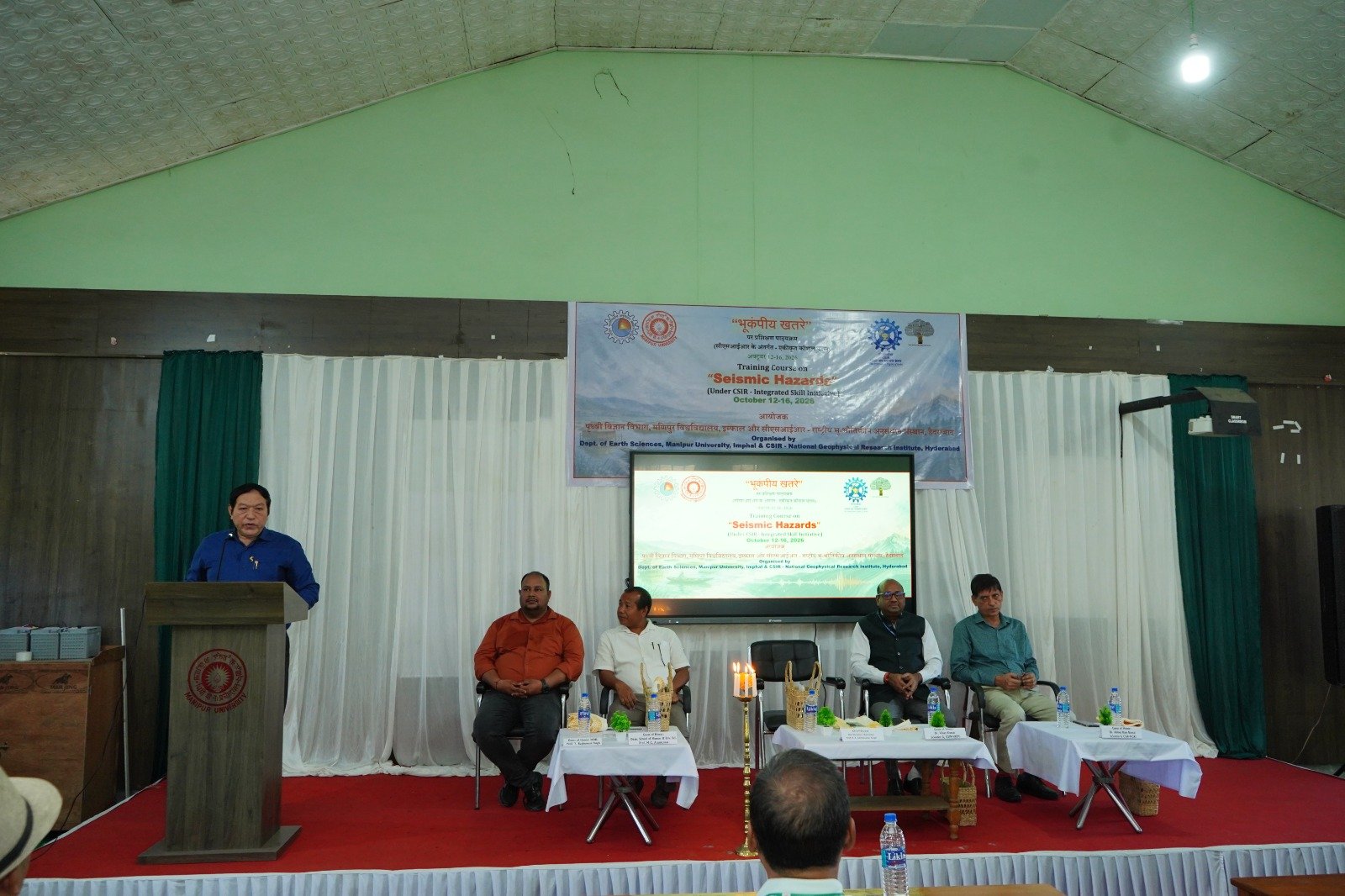
Imphal, October 16, 2026: A five-day training programme on seismic hazard assessment, jointly organised by the Department of Earth Sciences, Manipur University, and the CSIR-National Geophysical Research Institute (CSIR-NGRI), Hyderabad, concluded at Manipur University, Canchipur, under the CSIR-Integrated Skill Initiative, under the Ministry of Science and Technology, Government of India on Friday.
Held from October 12 to 16 under the CSIR-Integrated Skill Initiative, the programme brought together 39 participants from different academic institutions to strengthen scientific knowledge, technical skills and research capacity in earthquake studies, particularly in Northeast India.
The valedictory ceremony was attended by Dr. Tourangbam Brajkumar Singh, Director of the Department of Environment and Climate Change, Government of Manipur, as Chief Guest.
Addressing the gathering, Dr. Brajkumar emphasised the importance of specialised scientific training in Manipur, considering the region’s vulnerability to earthquakes. He stressed the need for systematic seismic studies to better understand the state’s earthquake potential and provide scientific inputs for disaster preparedness and risk reduction.
The programme was inaugurated on October 12 by Prof. R.K. Hemakumar Singh, Vice-Chancellor of Manipur University. In his address, the Vice-Chancellor highlighted the importance of skill development initiatives in Northeast India, where earthquakes and other geological hazards remain significant concerns.
He called for organising similar programmes on a larger scale, with wider participation from colleges and academic institutions across the region, to strengthen local scientific expertise.
Dr. Abhey Ram Bansal, Scientist G at CSIR-NGRI and Nodal Person of the programme, outlined the objectives of the CSIR-Integrated Skill Initiative. He emphasised practical, research-oriented training for students and young professionals and the need to extend specialised scientific learning opportunities to institutions across the country.
Dr. Vinay Kumar, Scientist G at CSIR-HRDC, also attended the inaugural programme and explained the role of CSIR training initiatives in developing scientific and technical expertise.
Building Local Expertise in Earthquake Research
Dr. Avinash Kumar Chauhan, Assistant Professor and Training Coordinator, Department of Earth Sciences, Manipur University, said the programme was designed to provide students and young researchers with a deeper understanding of earthquakes and seismic hazards.
He observed that Northeast India’s susceptibility to seismic activity makes specialised training particularly important for developing research capabilities within the region.
According to Dr. Chauhan, the programme was especially relevant for postgraduate students and PhD scholars, helping them understand existing seismic conditions and assess potential earthquake hazards through scientific research.
He also expressed hope that continued collaboration between Manipur University, CSIR-NGRI, other CSIR laboratories and national research institutions would create more opportunities for advanced scientific training and access to specialised research facilities.
The programme attracted participants from Manipur, Arunachal Pradesh and Meghalaya, representing institutions including Manipur University, Osmania University, the Centre for Earth Science and Himalayan Studies, Delhi University, NIT Manipur and Bangalore University.
Women accounted for more than 50 per cent of the 39 participants, reflecting encouraging female participation in specialised scientific and technical training.
Scientists Visit Manipur University Seismic Observatory
An important component of the programme was a visit by CSIR-NGRI scientists to the Manipur University Seismic Observatory, where they examined the condition of installed instruments and interacted with university personnel on seismic monitoring infrastructure.
The visit provided an opportunity to discuss the role of scientific observation, monitoring equipment and reliable seismic data in understanding earthquake activity and supporting hazard assessment.
The Department of Earth Sciences also organised a tree plantation programme to mark the occasion.
Earlier, Prof. Y. Raghumani Singh, Head of the Department of Earth Sciences, welcomed the visiting scientists, dignitaries and participants. He highlighted the department’s contribution to earth science education and research and welcomed the opportunity to strengthen academic collaboration with national research institutions.
Faculty members of the department attended both the inaugural and valedictory programmes.
The vote of thanks at the concluding ceremony was proposed by Dr. Avinash Kumar Chauhan, who acknowledged the contributions of CSIR-NGRI, the university administration, resource persons, faculty members, student volunteers and participants.
The five-day programme concluded with renewed emphasis on strengthening seismological research and technical capacity in Northeast India.
For a region where earthquake hazards remain a serious public safety concern, such collaborations can help build the scientific expertise required for long-term seismic monitoring, hazard assessment and disaster risk reduction.