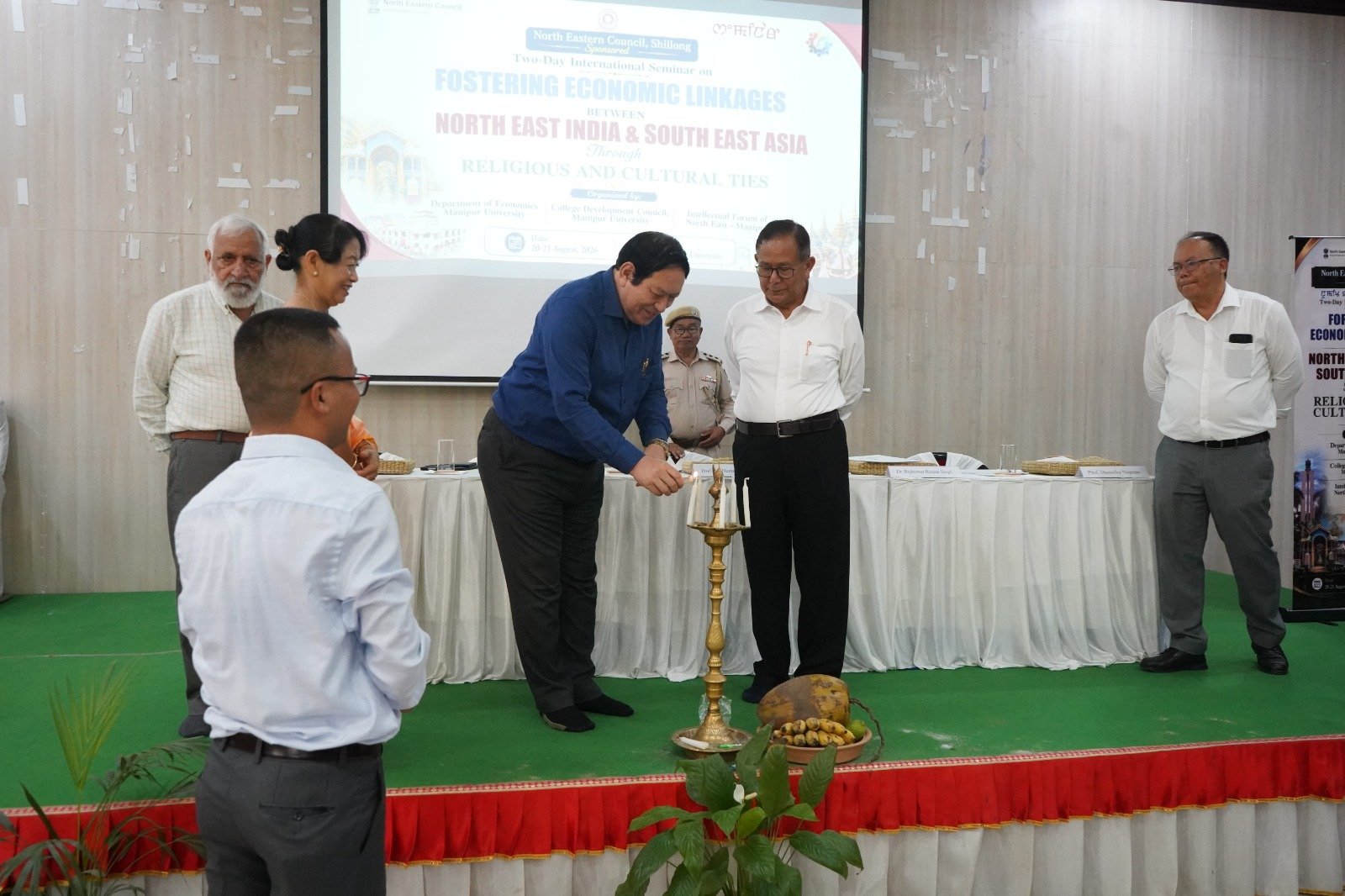
Imphal, August 20, 2026: Northeast India must be placed at the centre of India’s engagement with Southeast Asia, with shared religious and cultural traditions serving as the foundation for stronger economic cooperation, speakers said at an international seminar held at Manipur University on Thursday.
The two-day seminar, “Fostering Economic Linkages Between North East India and South East Asia Through Religious and Cultural Ties,” is sponsored by the North Eastern Council, Shillong, under the Ministry of Development of Northeastern Region (MDoNER), of the Government of India. It is jointly organised by the Department of Economics and College Development Council of Manipur University and the Intellectual Forum of North East–Manipur. The programme began with the official MU Anthem and State song.
The two-day seminar featured a distinguished gathering of academicians, former policymakers, administrators, researchers and cultural experts. The inaugural dignitaries included Dr Rajkumar Ranjan Singh, former Union Minister of State for External Affairs and Education; Prof. R.K. Hemakumar Singh, Vice-Chancellor-in-Charge of Manipur University; and Prof. Kuldip Chand Agnihotri, former Vice-Chancellor of the Central University of Himachal Pradesh. Professor Memcha Loitongbam, Dean of the School of Social Sciences and Prof Damodar Nepram, Chairman, Organising Committee and Head, Department o Economics, Manipur University also graced the inaugural function of the seminar.
The academic sessions brought together Sunil Mohanty, Formerly Assistant Professor, Department of Political Science, University of Delhi; Khwairakpam Rajen Singh, Prof. M.C. Arun Kumar, Sorokhaibam Manglemmjao Singh, Dr Nongthombam Jiten, Dr Yaiphaba Ningthoujam, Wangam Somorjit, Dr Anuradha Oinam, Prof. L. Suraj Singh, Dr Thiyam Bharat Singh, Thangjam Anil, Dr Atom Sunil Singh and Dr Shreeda Chongtham, besides faculty members, research scholars and students.
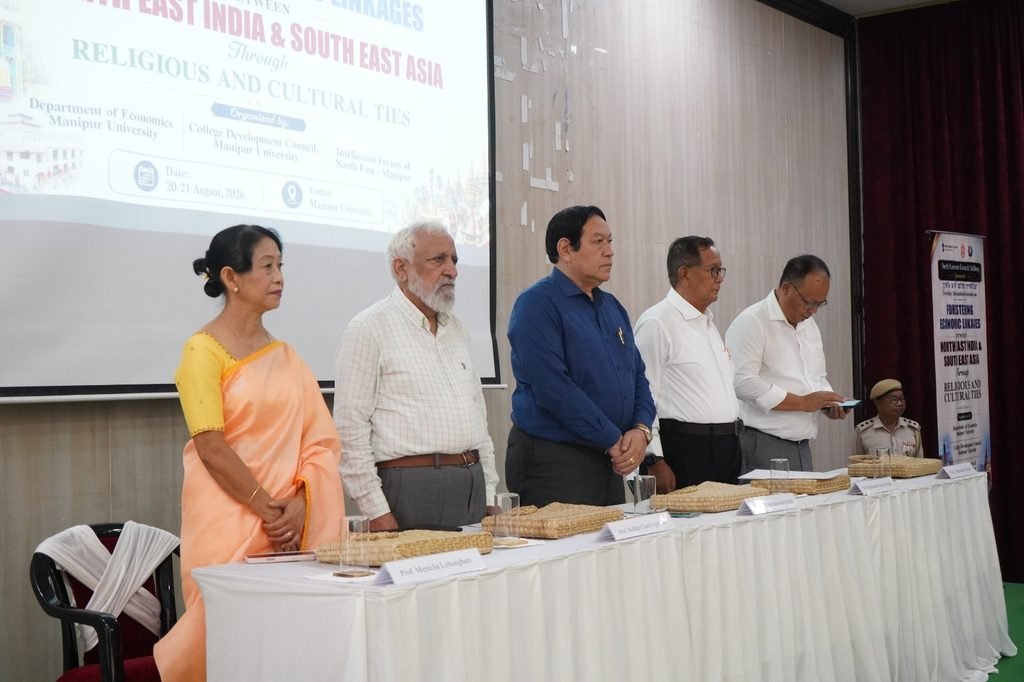
Delivering the keynote address, former Union Minister of State for External Affairs and Education Dr Rajkumar Ranjan Singh said the Act East Policy must flow from the Northeast rather than being framed in New Delhi and delivered to the region.
“I told my colleagues that India’s Act East Policy could not succeed as a policy drafted in Delhi and delivered to the Northeast. It had to be a policy that flowed from the Northeast outward,” he said.
Describing the Moreh–Tamu crossing as “a threshold between two halves of the same cultural continuum,” Dr Ranjan Singh said economic connectivity could not be built through trade statistics and logistics corridors alone. It must draw strength from Buddhism, Vaishnavism, Sanamahism, oral epics, textile traditions and centuries of migration and marriage across the region. He also stressed that peace and ethnic harmony within the Northeast were essential for any meaningful regional integration.
Chief Guest Professor R.K. Hemakumar Singh, Vice-Chancellor in-charge of Manipur University, said the Northeast’s potential as a religious and cultural hub between India and Southeast Asia remained largely untapped.
He said stronger cultural bonds could generate forward and backward economic linkages, promote pilgrimage and heritage tourism, attract infrastructure investment and create direct and indirect employment. Handloom, handicrafts, agro-products, hospitality and transport could particularly benefit by connecting local producers with national and international markets. He expressed hope that the seminar would help establish Manipur University as a knowledge hub and academic bridge between India, Myanmar and Southeast Asia.
Guest of Honour Professor Kuldip Chand Agnihotri, Executive Vice-Chairman of the Haryana Sahitya Evam Sanskriti Academy and former Vice-Chancellor of the Central University of Himachal Pradesh, described Northeast India as one of the historic gateways connecting India with Southeast Asia.
He said the Moreh route once linked India with the wider Southeast Asian region and proposed reviving cultural and pilgrimage circuits through Myanmar, Thailand and Cambodia. He suggested routes connecting Moreh with Angkor Wat and linking Kaina in Manipur with Vrindavan. Manipur University, because of its strategic location, could play a major role in rebuilding the region’s intellectual and cultural bridges, he said.
Professor Memcha Loitongbam, Dean of the School of Social Sciences, presided over the function and called for people-centred regional integration involving artisans, entrepreneurs, women-led enterprises, young innovators and cultural institutions.
Professor Damodar Nepram delivered the welcome address, while Co-convenor Prof Hanjabam Shukhdeba Sharma, Director, College Development Council, Manipur University proposed the Vote of Thanks. Professor Hanjabam Isworchandra Sharma is the seminar convenor and Professor Sougrakpam Dharmen Singh is one of the co-convenors. The inaugural function concluded with the Vande Mataram and the National Anthem.