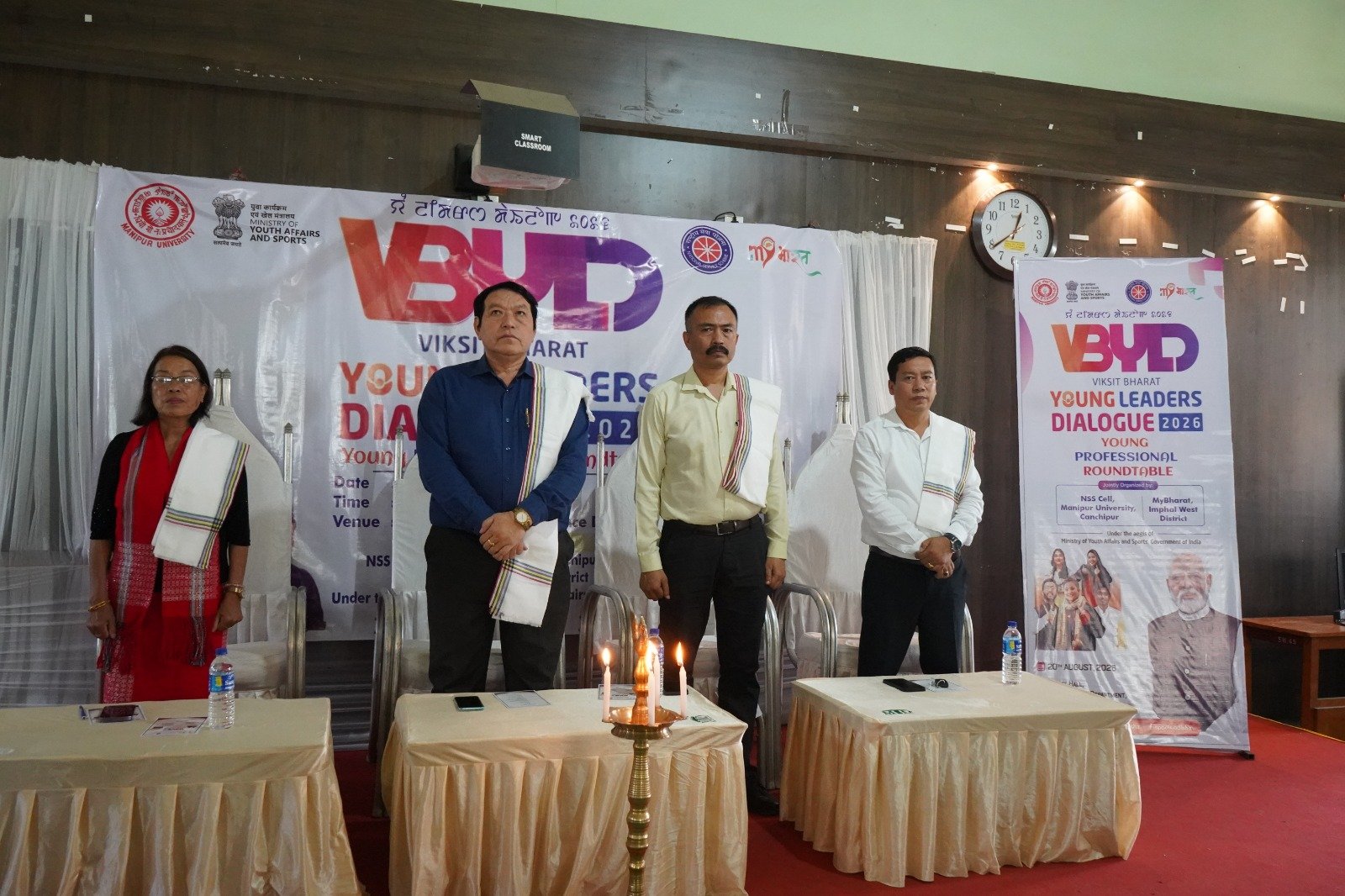
Imphal, August 20, 2026: More than 100 students registered for the Viksit Bharat Young Leaders Dialogue 2026 – Young Professional Roundtable, organised jointly by the NSS Cell, Manipur University, and MY Bharat, Imphal West District, at the Senate Hall, Department of Earth Sciences, Manipur University, on Thursday.
The programme was held under the aegis of the Ministry of Youth Affairs and Sports, Government of India, with the objective of encouraging young people to embrace leadership, civic responsibility and active participation in nation-building, while contributing towards the vision of Viksit Bharat 2047. The programme began with the official NSS song, followed by Vande Mataram and the National Anthem.
Prof. R.K. Hemakumar Singh, Vice-Chancellor-in-Charge, Manipur University, attended the inaugural session as the Chief Guest. W. Paulina Monsang, State Director, MY Bharat Manipur, presided over the function, while Prof. M. Premjit Singh, Registrar, Manipur University, and Prof. L. Santosh Singh, Programme Coordinator, NSS Cell, Manipur University, attended as Guests of Honour.
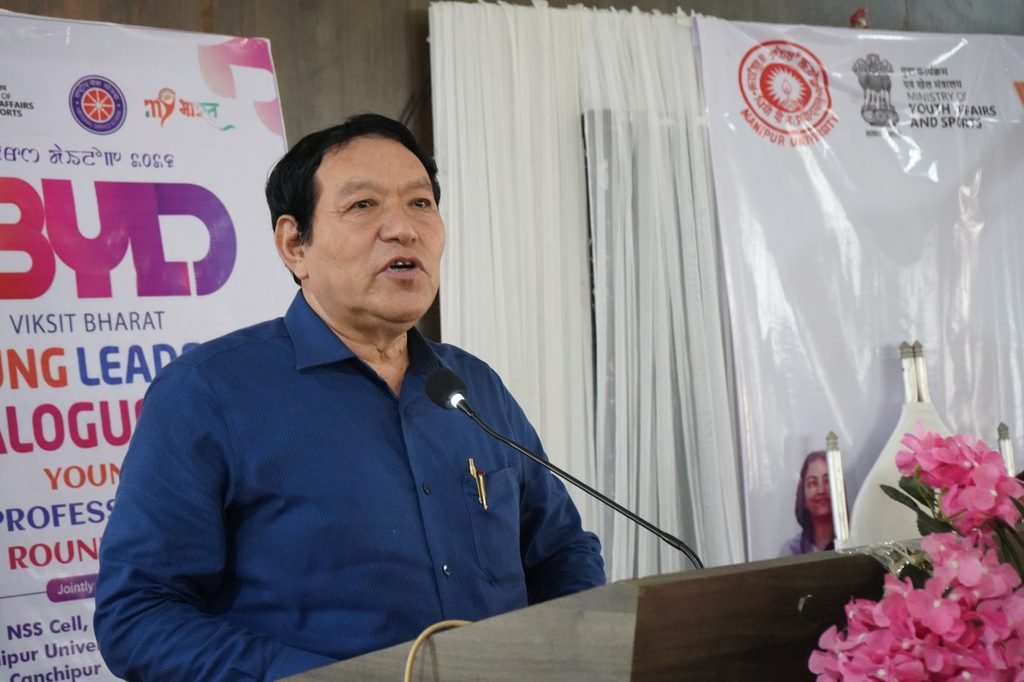
Addressing the participants, Prof. R.K. Hemakumar Singh stressed that the true value of such a programme lay not merely in winning a prize or securing recognition, but in acquiring knowledge, developing values and learning how to confront challenges at every stage of life.
He encouraged the young participants to make full use of the opportunity provided by the presence of distinguished panellists. He said that a meaningful dialogue should not end with the asking of questions, but should help participants understand the issues more deeply and leave the programme with greater knowledge and satisfaction.
Speaking on the changing role of young people, Prof. M. Premjit Singh said the familiar expression that “youth are the leaders of tomorrow” had become inadequate in the face of emerging challenges such as climate change, social injustice and other pressing contemporary issues.
He observed that young people could no longer wait for tomorrow to act and must begin assuming responsibility today. In the digital age, he said, the youth have the ability to spread awareness about events and injustices occurring in any part of the world within a very short time.
Prof. Premjit further emphasised that leadership was not about imposing the views of an individual upon others. A successful leader, he said, must listen to different opinions, allow people to express their viewpoints and bring those perspectives together to arrive at the best possible course of action.
W. Paulina Monsang encouraged the participants to look beyond prizes and competition and recognise the greater importance of knowledge, character and the ability to face challenges. She underlined the need to encourage young leaders, particularly at a time when Manipur and the country are confronting complex social challenges.
She also urged the students to participate actively in the dialogue, raise questions and use the interaction with experts to improve their understanding rather than treating the programme merely as a competition.
Earlier, welcoming the dignitaries and participants, Prof. L. Santosh Singh said the Viksit Bharat Young Leaders Dialogue and Young Professional Roundtable had been initiated by the Ministry of Youth Affairs and Sports to mobilise India’s youth, promote values and encourage their active participation in nation-building.
He said the programme sought to inspire young citizens to contribute meaningfully towards realising the vision of a developed India by 2047.
The youth dialogue and panel discussion featured Dr Sapam Dilipkumar Singh, Assistant Professor, Department of Law, Manipur University, and Prof. Nameirakpam Bijen Meetei, former Head of the Department of Political Science, Manipur University, as panellists.
The panellists interacted with the young participants on leadership, democratic engagement, public responsibility and the role of youth in addressing contemporary challenges. Students were encouraged to express their views, raise questions and take part in a constructive exchange of ideas.
The programme included an inaugural session, youth dialogue, roundtable interaction and distribution of certificates to the participants. It concluded with closing remarks and a vote of thanks.