Imphal, October 5, 2026: Manipur University has launched a six-day interdisciplinary programme on advanced research methodology in life sciences, combining academic lectures with hands-on laboratory training to help college and university teachers keep pace with emerging research techniques.
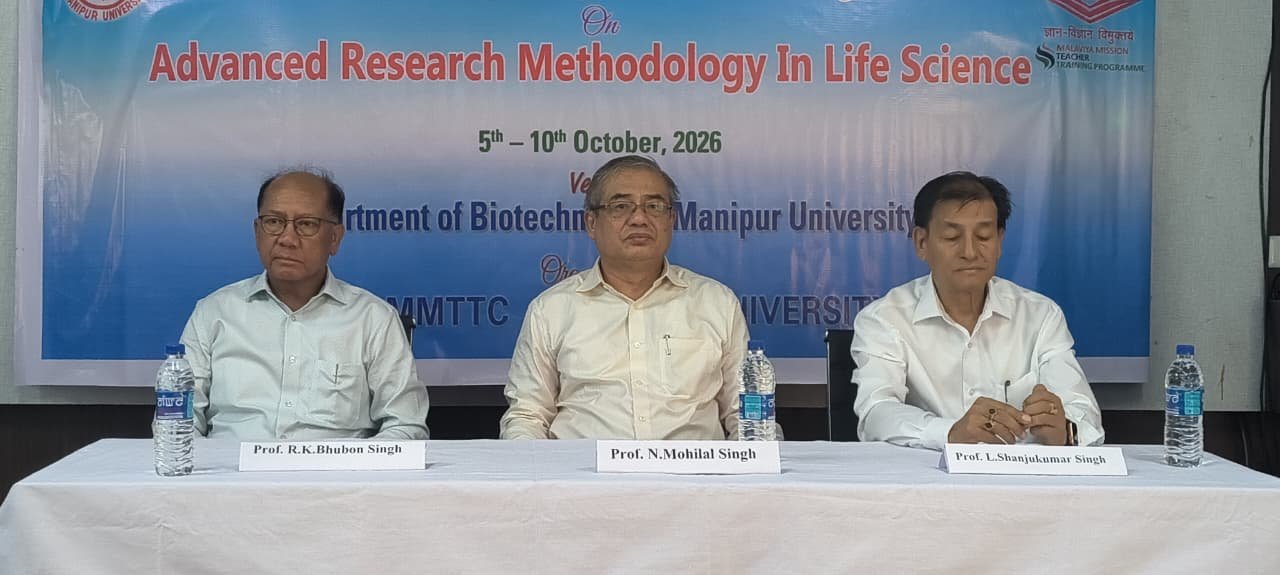
The programme, titled “Advanced Research Methodology in Life Sciences,” is being organised by the UGC–Malaviya Mission Teacher Training Centre (MMTTC), Manipur University, under the Ministry of Education, Government of India, in collaboration with the Department of Biotechnology. It was inaugurated at the Department of Biotechnology on Monday.
Unlike a programme confined largely to classroom lectures, the six-day training has been designed to expose participants to experimental research methods, laboratory facilities and sophisticated instruments available at Manipur University. Participation has been restricted to 25 teachers to allow closer academic interaction and meaningful practical engagement.
The participants have been drawn from a wide range of colleges and academic institutions across Manipur, bringing together teachers and researchers from different branches of the life sciences. Institutions represented include T.S. Paul Manipur Women’s College, D.M. College of Science, S. Kula Women’s College, G.P. Women’s College, Thambal Marik College, Oinam, Pravabati College, Lilong Haoreibi College, Kamakhya Pemton College, Pettigrew College, Western College, Konthoujam, Pandit Deen Dayal Upadhyay Institute, the Department of Zoology, Manipur University, and NIELIT Imphal. Their areas of specialisation range from biotechnology, genetics and biochemistry to plant physiology, cytogenetics, parasitology, genetic engineering, medicinal plants, phytopharmacology and zoology.
Speaking at the inaugural programme, Prof. R.K. Bhubhon Singh, Director of UGC–MMTTC, said rapid developments in biotechnology and other areas of life sciences have made it necessary for teachers to understand emerging techniques not only theoretically but also through practical exposure.
Teachers may learn about new scientific developments and subsequently introduce them in their classrooms, but hands-on exposure to experimental methods can help them understand such techniques more effectively and communicate that knowledge better to students, he said.
The programme has therefore been structured around lectures, demonstrations and practical training. According to Prof. Bhubhon, the larger objective is not limited to what the 25 participants learn during the six days. The participating teachers are expected to take the research knowledge, techniques and orientation acquired during the programme back to their institutions and share them with students and academic colleagues.
Prof. N. Mohilal Meitei, Dean, School of Life Sciences, Manipur University, welcomed the participants and described the six-day programme as an important opportunity to bridge the gap between theoretical knowledge and practical research in the life sciences. He observed that while textbooks provide strong theoretical foundations, modern life-science research increasingly demands laboratory exposure, precision instrumentation and deeper exploration at the molecular level. Emphasising the value of hands-on training, he said the programme would help participants translate abstract scientific concepts into practical expertise and encourage them to explore new research areas and develop meaningful scientific projects. He also reminded the participants that they represent the scientific community and the future of scientific research in Manipur.
Prof. L. Shanjukumar Singh, Dean, School of Agricultural Sciences, Manipur University, highlighted the growing importance of interdisciplinary research in addressing emerging challenges in the life sciences and agriculture, and highlighted the value of advanced research methodologies and practical training in strengthening scientific inquiry.
A major research area introduced during the programme was the emerging application of nanotechnology in plant sciences.
Prof. Keithellakpam Sanatombi Devi, Professor and Head of the Department of Biotechnology, delivered a session on nanotechnology and the application of nanoparticles in plant tissue culture. She explained that the training would move beyond discussions on research techniques, tools and materials and expose participants to emerging developments that could help researchers formulate, plan and strengthen their research.
According to Prof. Sanatombi, nanoparticles can be used at different stages of plant tissue culture, ranging from micropropagation to the production of secondary metabolites and precision plant technology.
Nanoparticles generally range between one and 100 nanometres in size and may either be procured in pre-synthesised form or produced in laboratories depending on specific research requirements.
She also underlined the increasingly interdisciplinary character of scientific research. Collaboration with physicists and researchers specialising in nanoparticles, she said, can enable life-science researchers to obtain nanoparticles designed for particular experimental requirements, while laboratories possessing the necessary facilities and expertise can undertake their own synthesis.
The extremely small size of nanoparticles gives them a high surface-area-to-volume ratio, allowing them to be effective even at relatively low concentrations. Their surfaces can also be modified with different compounds and functional groups or provided with positive or negative charges depending on the intended application.
Their capacity to interact with biological molecules has opened new possibilities in biological and plant research. The programme will also examine molecular mechanisms behind the effects of nanoparticles so that participants can understand both their potential applications and the scientific processes involved in their interaction with biological systems.
The inaugural programme began with a welcome address by Prof. K. Sanatombi. Prof. N. Mohilal Meitei, Dean, School of Life Sciences, and Prof. L. Shanjukumar Singh, Dean, School of Agricultural Sciences, addressed the gathering. Prof. Bhubhon spoke on the objectives and academic significance of the programme, while Prof. Reena Haobam proposed the vote of thanks.
Over the six days, participants will attend lectures, demonstrations, hands-on sessions and academic interactions focusing on advanced research approaches and emerging developments in life sciences.
The programme reflects an important challenge confronting higher education today: scientific knowledge is advancing rapidly, but its value in universities and colleges ultimately depends on whether teachers can translate new research methods into better research, teaching and student training.