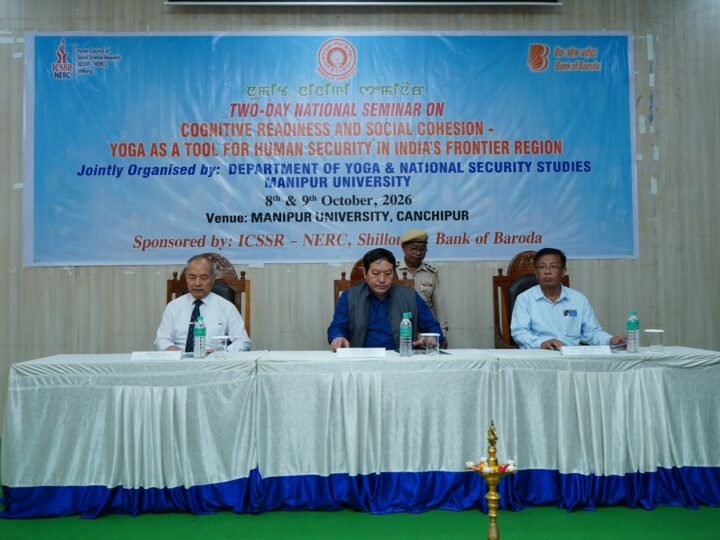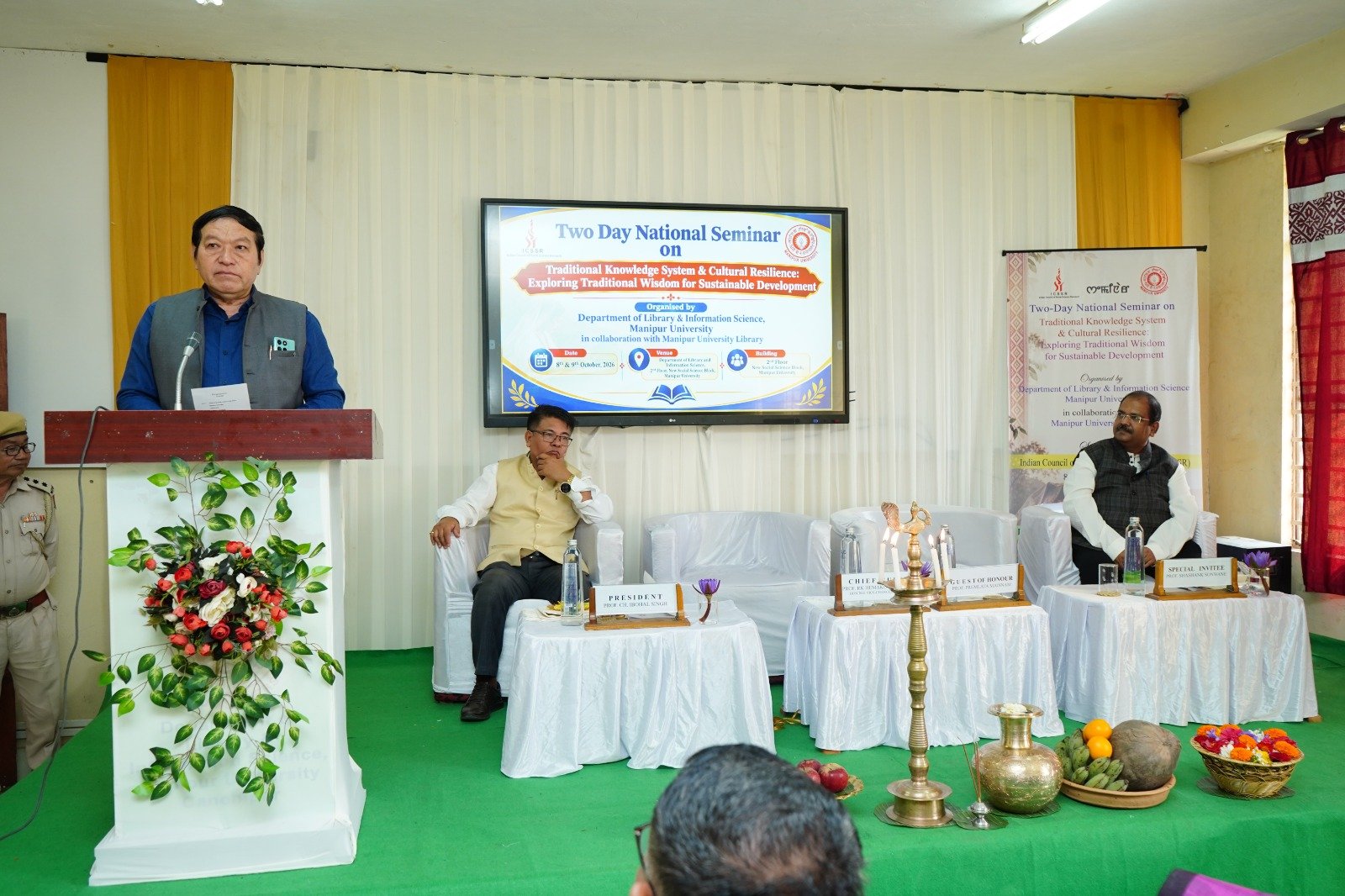
Manipur University on Thursday inaugurated a two-day National Seminar on “Traditional Knowledge System & Cultural Resilience: Exploring Traditional Wisdom for Sustainable Development,” bringing together academicians, researchers, library and information science professionals, and students to examine how indigenous knowledge can contribute to sustainable development, environmental conservation and cultural preservation in a rapidly changing world.
Organised by the Department of Library and Information Science, Manipur University, in collaboration with Manipur University Library and sponsored by the Indian Council of Social Science Research (ICSSR), the seminar placed particular emphasis on the relationship between traditional wisdom and modern scientific knowledge, including the emerging opportunities and ethical challenges associated with artificial intelligence.
Prof. R.K. Hemakumar Singh, Vice-Chancellor of Manipur University, inaugurated the seminar as Chief Guest, while Prof. Ch. Ibohal Singh, Head of the Department of Library and Information Science, presided over the inaugural programme. Prof. Premlata Maisnam, Dean, School of Education, attended as Guest of Honour, and Prof. Shashank Sawane, Head of the Department of Library and Information Science, Dr. Babasaheb Ambedkar Marathwada University, participated as Special Invitee.
In his inaugural address, Prof. Hemakumar Singh emphasised the contemporary relevance of traditional knowledge systems, particularly in the context of the National Education Policy (NEP) 2020. He observed that universities and colleges would increasingly be expected to demonstrate how the implementation of the policy benefits students and society. Describing the seminar theme as timely and academically significant, he expressed hope that the deliberations would generate meaningful outcomes for the University and the wider community before formally declaring the seminar open.
Delivering an extensive address, Prof. Shashank Sawane described traditional knowledge as the accumulated wisdom of generations, developed through observation, experimentation, adaptation and community experience. He observed that knowledge was not confined to laboratories, universities or books but also existed in forests, rivers, agricultural practices, traditional healing systems, handicrafts, languages, rituals and oral traditions. Referring to Manipur and the wider Northeast, he described the region as a living repository of ecological diversity, cultural plurality and indigenous knowledge systems deserving greater academic recognition and systematic documentation.
Drawing attention to Loktak Lake, Prof. Sawane explained how traditional ecological knowledge and modern scientific methods could complement one another in understanding and protecting fragile ecosystems. While hydrology, ecology, remote sensing and artificial intelligence could provide valuable scientific information about wetlands, communities living around such landscapes possessed generations of accumulated knowledge about seasonal changes, natural resources, livelihood practices and ecological relationships. He emphasised that modern science and traditional wisdom should not be regarded as competing approaches but as complementary systems capable of contributing to environmental protection and sustainable development.
A significant part of his address focused on the growing role of artificial intelligence in preserving traditional knowledge. Prof. Sawane observed that emerging technologies could assist researchers and information professionals in transcribing oral histories, translating indigenous languages, digitising manuscripts, generating metadata, developing knowledge graphs and documenting endangered languages. However, he cautioned that the use of community knowledge to train artificial intelligence systems without permission, proper attribution or equitable benefit-sharing could create new forms of knowledge extraction.
Calling for ethical, transparent and community-governed artificial intelligence, he stressed that technological advancement must respect the people, histories and cultural contexts from which traditional knowledge originates. He also highlighted the importance of multilingual information systems, indigenous language search facilities, ethical access protocols and community-centred information architecture, while drawing attention to the possibility of developing a Northeast Indian knowledge grid to support the preservation and accessibility of the region’s intellectual and cultural heritage.
Speaking as Guest of Honour, Prof. Premlata Maisnam described traditional knowledge as the accumulated wisdom of generations, preserved and transmitted through community experiences, observations, practices, skills, values and beliefs. She noted that such knowledge continued to find expression in indigenous agriculture, traditional medicine, handicrafts, handloom, literature, folk traditions and performing arts. At a time when societies were confronting climate change, environmental degradation, biodiversity loss and social fragmentation, she observed that traditional wisdom offered valuable insights into sustainable and harmonious living.
Delivering the presidential address, Prof. Ch. Ibohal Singh emphasised that traditional knowledge should not be treated merely as a relic of the past but recognised as a living knowledge system that had evolved through observation, experimentation, adaptation and community participation. He observed that communities had developed sophisticated understandings of agriculture, healthcare, water management, architecture, biodiversity conservation and ecological relationships long before the emergence of modern scientific institutions. The challenge before contemporary academic institutions, he said, was to explore how traditional wisdom and modern scientific knowledge could strengthen one another rather than treating them as competing systems.
Prof. Ibohal Singh further explained that cultural resilience involved the ability of communities to preserve their identity, values, knowledge and collective memory while adapting to changing social, economic, technological and environmental circumstances. Referring to the pressures of globalisation, urbanisation and changing lifestyles, he expressed concern over disappearing languages, declining traditional occupations and the growing disconnect between indigenous knowledge and younger generations. He also highlighted the responsibility of Library and Information Science professionals in documenting, organising, preserving and disseminating traditional knowledge through appropriate information systems and emerging technologies.
The inaugural programme began with a welcome address by Dr. Keisham Sangeeta Devi, while Dr. Moirangthem Lokendro Singh proposed the vote of thanks. A total of 25 participants took part in the seminar.
The two-day seminar, scheduled for October 8 and 9, provides a platform for invited speakers, resource persons, researchers and paper contributors to examine traditional knowledge, cultural resilience and sustainable development. The deliberations are expected to explore how academic institutions can contribute to preserving indigenous knowledge while ensuring that modern technologies support, rather than undermine, the communities that have sustained these traditions across generations.