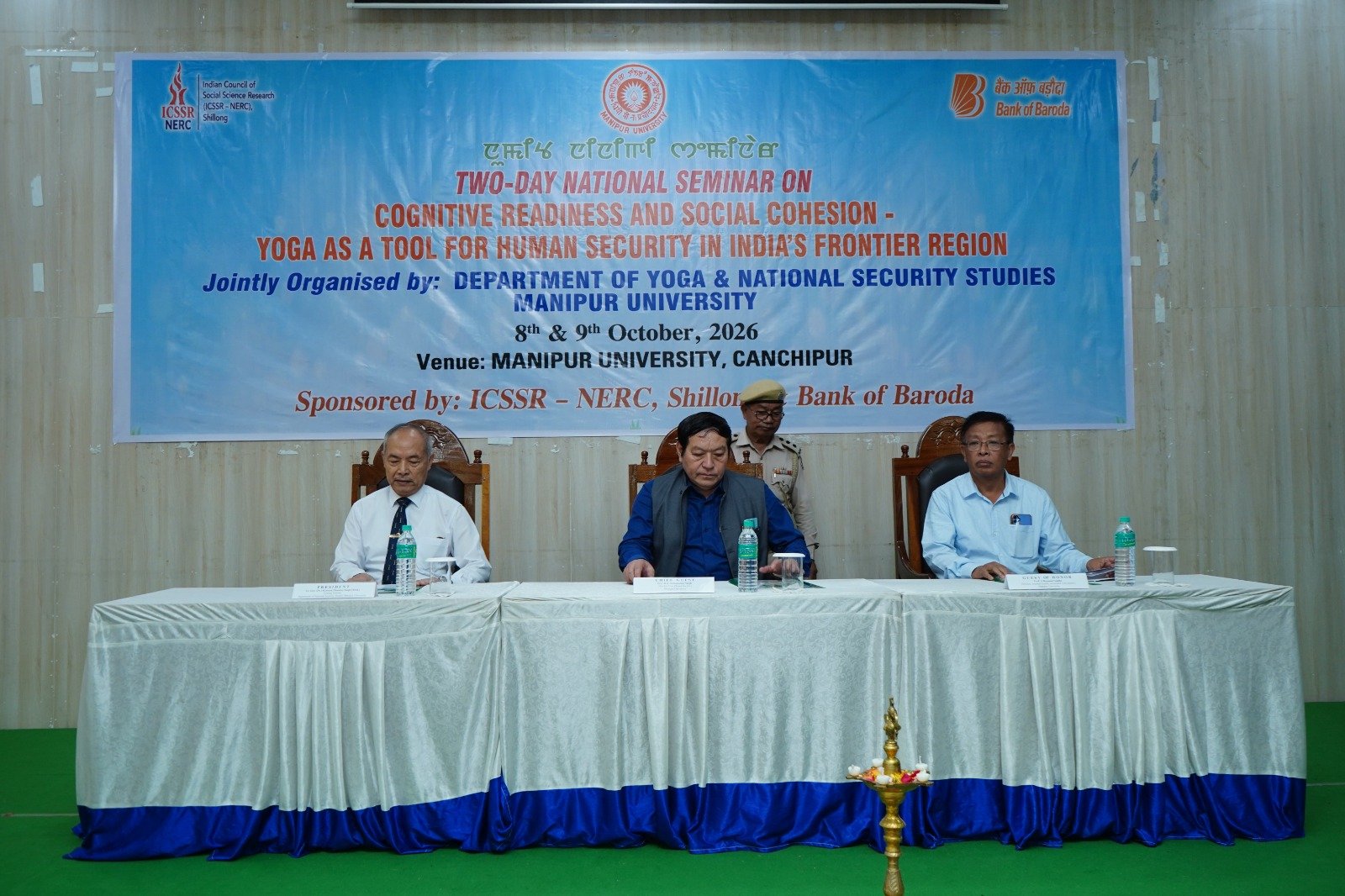
Imphal, October 8, 2026: Manipur University inaugurated a two-day national seminar on “Cognitive Readiness and Social Cohesion – Yoga as a Tool for Human Security in India’s Frontier Region” at the Vice-Chancellor’s Court Hall, Canchipur, on Thursday, bringing together scholars, researchers and practitioners to examine the relationship between yoga, mental preparedness, emotional resilience and social harmony, particularly in the context of Manipur and the wider Northeast.
Jointly organised by the Departments of Yoga and National Security Studies, the seminar has received 68 research papers, reflecting growing academic interest in exploring human security beyond conventional military and territorial concerns. Of the papers received, 30 relate to National Security Studies and 38 to Yoga.
The seminar is sponsored by the Indian Council of Social Science Research–North Eastern Regional Centre (ICSSR-NERC), Shillong, and Bank of Baroda.
Prof. R.K. Hemakumar Singh, Vice-Chancellor (in-charge), Manipur University, attended the inaugural function as Chief Guest, while Prof. A. Rajmani Singha, Director of the Internal Quality Assurance Cell (IQAC), was the Guest of Honour. Lt. Gen. Dr. Konsam Himalay Singh (Retd.), Visiting Scholar in the Department of National Security Studies, presided over the programme.
Universities Must Encourage Multidisciplinary Learning: Vice-Chancellor
Addressing the gathering, Prof. R.K. Hemakumar Singh emphasised that universities must move beyond conventional disciplinary boundaries and encourage collaboration between departments to address emerging challenges in education and society. Appreciating the initiative taken by the Departments of Yoga and National Security Studies, he observed that multidisciplinary learning could provide students with a broader understanding of complex issues while preparing them for future responsibilities.
He encouraged the organisers to explore how the discussions emerging from the seminar could contribute to curriculum development and new academic programmes. Drawing an analogy from chemistry, he compared cooperation between academic disciplines to a chemical bond, in which different elements come together to form a meaningful connection.
The Vice-Chancellor also urged young scholars and students to engage actively with experts, ask questions and develop independent thinking rather than remain passive listeners. Academic institutions, he observed, must not limit themselves to examining the past and present but should also identify new directions for education and society.
Manipur Needs Social Cohesion and a Comprehensive Youth Policy
Speaking as Guest of Honour, Prof. A. Rajmani Singha said the seminar’s theme was particularly relevant to Manipur, where prolonged conflict had placed considerable strain on relationships between communities. Referring to the disruptions caused by the COVID-19 pandemic and the subsequent years of unrest, he stressed that rebuilding trust, mutual understanding and social cohesion had become essential for the State’s future.
He explained that cognitive readiness involved the ability to adapt to changing circumstances, manage difficult situations and respond thoughtfully to challenges, while social cohesion required empathy, mutual respect and a willingness among individuals and communities to coexist peacefully.
Prof. Rajmani observed that human security should not be understood merely as the protection of territorial boundaries. It must also include psychological well-being, human dignity, emotional stability and the quality of relationships within society. In this context, he highlighted the importance of life skills such as effective communication, critical thinking, problem-solving, decision-making, interpersonal relationships and stress management.
He suggested that yoga could serve as a complementary practice for improving concentration, emotional regulation and mental calmness, helping individuals respond more thoughtfully to difficult circumstances.
Drawing attention to the challenges confronting young people, Prof. Rajmani also called for a comprehensive State Youth Policy in Manipur. Referring to his earlier involvement with the National Service Scheme and youth-related policy initiatives, he expressed concern over the absence of an adequate dedicated framework for guiding youth development.
He maintained that youth policy should extend beyond employment and career preparation to include skill development, social responsibility, peaceful coexistence and meaningful participation in society. A comprehensive policy, he suggested, could provide clearer direction for educational and professional opportunities while strengthening the role of young people in rebuilding social harmony.
Yoga Is More Than Physical Exercise: Lt. Gen. Himalay
Presiding over the inaugural function, Lt. Gen. Dr. Konsam Himalay Singh (Retd.) emphasised that yoga should not be viewed merely as a religious practice or confined to physical postures and breathing exercises. He described it as a broader discipline connecting the mind, body and inner strength, enabling individuals to develop greater control over their thoughts, emotions and actions.
Recalling his experience during the Kargil War, the retired Army officer said he had practised pranayama while serving at altitudes of approximately 18,000 to 19,000 feet, where reduced oxygen availability presented considerable physical challenges. What initially began as a practical response to difficult conditions, he explained, gradually helped him appreciate the relationship between physical endurance, mental discipline and human needs.
Discussing the challenges facing India’s frontier regions, particularly Manipur and the Northeast, he observed that historical circumstances, governance difficulties and social tensions had contributed to divisions between communities. Education alone, he maintained, would not necessarily overcome such divisions unless accompanied by compassion, mutual respect and a deeper understanding of human needs.
He suggested that yoga, when considered alongside a broader understanding of human security, could contribute to rebuilding social cohesion through sustained individual and collective efforts. However, he cautioned against expecting immediate solutions to problems rooted in complex historical and social circumstances.
Lt. Gen. Himalay also highlighted the relevance of mental clarity and emotional balance in leadership and decision-making, observing that people occupying positions of responsibility must develop the ability to respond calmly and thoughtfully under pressure.
68 Research Papers Received for Seminar
Delivering the keynote address, Dr. Subhan T. Jadhav, Assistant Professor in the Department of National Security Studies, Manipur University, raised the question of whether yoga could serve as a complementary tool for strengthening human security.
He observed that the subject required systematic academic investigation, particularly as contemporary security studies increasingly recognised psychological well-being, social stability and individual resilience as important dimensions of security.
Dr. Jadhav informed the gathering that the organisers had received 68 research papers, including 30 on National Security Studies and 38 on Yoga. The seminar, he said, had been structured around four components: research paper presentations, poster presentations, exhibitions and practical yoga sessions.
He stressed the need to strengthen connections between academic research, public policy and practical experience so that research findings could contribute meaningfully to policy development while remaining grounded in social realities.
Earlier, Dr. Md. Samir Hussain, Guest Faculty in the Department of National Security Studies, delivered the welcome address. The inaugural programme included ceremonial candle lighting and the release of the Book of Abstracts. Dr. I. Yaipharemba Singh, Head (in-charge), Department of National Security Studies, proposed the vote of thanks.
The academic programme also featured special lectures by Lt. Gen. Dr. Konsam Himalay Singh (Retd.) and Dr. Mantu Saha, former Scientist F at the Defence Research and Development Organisation (DRDO), Ministry of Defence. Dr. Saha participated online.
The seminar will continue on October 9 with further academic deliberations examining how yoga, cognitive readiness and interdisciplinary research may contribute to individual resilience, responsible leadership and social cohesion in India’s frontier regions.