Imphal, September 10: Educational institutions must create an environment in which students attend classes because they want to learn, not merely because attendance is compulsory, B.R. Shankaranand, Akhil Bharatiya Sangathan Mantri of Bharatiya Shikshan Mandal, said at a national conference in Imphal on Wednesday.
“Attendance is the failure of the teacher,” Shankaranand said, arguing that poor classroom attendance may also reflect a teacher’s inability to make learning meaningful and engaging for students.
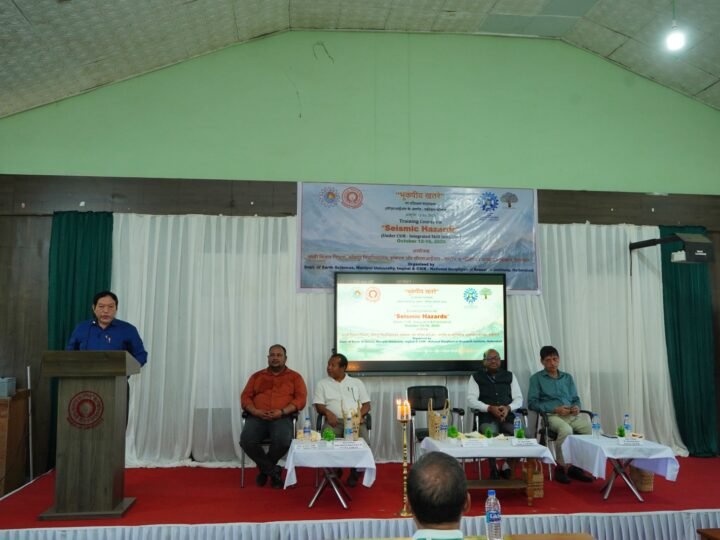
He was speaking at a one-day national conference on “Indigenous Knowledge System: Tradition, Knowledge and Contemporary Relevance” held at the auditorium of R.K. Sanatombi Devi College of Education, North AOC.
The conference was jointly organised by Manipur International University, Ghari; Bharatiya Shikshan Mandal, Manipur Prant; and R.K. Sanatombi Devi College of Education.
Shankaranand said the Bharatiya concept of education recognises that teaching can be demanding, but learning should remain joyful. A teacher, he said, should not restrict himself or herself to delivering lessons but should also become a parent, guide and friend to the student.
Unless teachers succeed in building a suitable learning ecosystem, he said, students may lose interest in attending classes. Affection and discipline must therefore work together in nurturing learners and supporting their overall development.
Shankaranand also spoke about the changing relationship between teachers and students within the Bharatiya educational tradition. He said a teacher must gradually grow from a shikshak into a guru and then an acharya, assuming deeper responsibility for the intellectual, emotional and moral development of the learner.
Referring to India’s indigenous knowledge traditions, he said ideas related to biology, chemistry and several other branches of knowledge could be found in ancient Indian texts and the Vedas. Much of this knowledge, however, is now understood through conventional Western academic classifications and associated with individual historical figures, he said.
He called for a renewed effort to study and understand indigenous knowledge systems and to strengthen the transfer of knowledge from one generation to another.
AI Must Remain a Tool
Dr Amit Dutta, Director at the All India Council for Technical Education, who attended the conference as Guest of Honour, spoke about the role of technology in contemporary education.
Technology is essentially an instrument created to perform tasks and make human work easier, he said. Artificial intelligence, which he described as a form of collective wisdom, can significantly reduce the time required to produce results.
Dutta, however, cautioned against becoming excessively dependent on technology. The use of AI should not weaken people’s capacity to think, analyse and exercise judgement, he said.
Technology must remain a tool in human hands and should not be allowed to replace human thought and decision-making, he added.
The conference examined the foundations of indigenous knowledge, its contemporary relevance and possible ways of connecting Bharatiya perspectives with present-day education. The organisers said it sought to encourage academic engagement with indigenous traditions and explore their contribution to education and nation-building.