Recognition carries meaning only when it reflects measurable public service. The Central Forest Division’s selection as Manipur’s Best Forest Division in Forest Protection during the 77th Van Mahotsav Celebration, held in conjunction with “Ek Ped Maa Ke Naam 3.0,” deserves appreciation because it is founded on performance rather than symbolism.
The Central Forest Division’s achievements are difficult to ignore. Between 2014 and February 2026, it removed 381 of the 481 forest encroachments cleared across Manipur, accounting for nearly 79 percent of all eviction drives undertaken in the state during the period. Following these operations, degraded forest lands were brought under plantation and ecological restoration programmes. The Central Forest Division also registered 65 forest offence cases, demonstrating that enforcement and conservation were pursued simultaneously rather than independently.
These figures represent more than administrative efficiency. They demonstrate that determined leadership, committed frontline staff, and consistent enforcement of forest laws can produce meaningful results even under difficult circumstances.
The obvious question now is whether this achievement will remain confined to one forest division or become the standard for every division in Manipur.
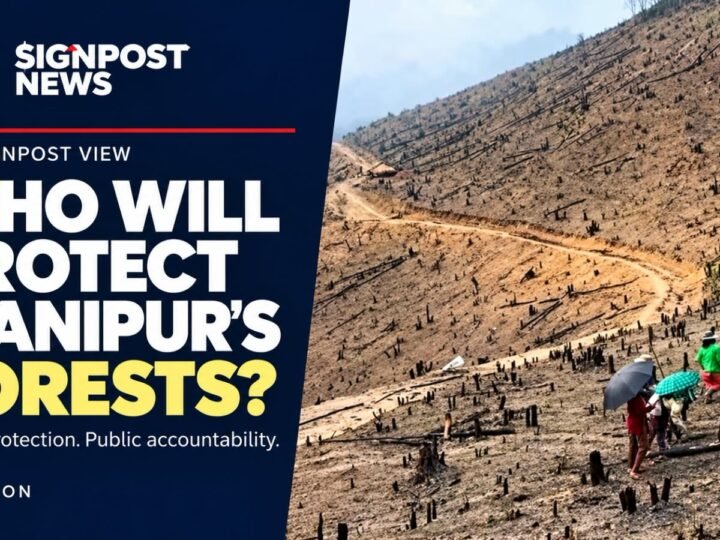
Illegal encroachments continue to pose one of the greatest threats to the state’s forests. Every hectare lost reduces biodiversity, destroys wildlife habitat, weakens watersheds, accelerates soil erosion, and increases vulnerability to climate change. Forest degradation is not merely an environmental issue. It directly affects water security, agriculture, disaster resilience, and the livelihoods of communities that depend on healthy ecosystems.
Protecting forests, therefore, cannot be reduced to annual plantation drives or ceremonial observances. It requires year-round vigilance, strict enforcement of the law, scientific restoration of degraded land, and above all, the courage to act against illegal encroachments wherever they occur.
That courage has not always come without resistance. In recent years, anti-encroachment operations in the hill districts have often become politically and socially contentious. The eviction of K. Songjang village from the Churachandpur-Khoupum Protected Forest in February 2023 triggered widespread protests by tribal organisations. Notices issued to other villages, including Kungpi Naosen, and subsequent forest protection measures led to demonstrations across Churachandpur, Kangpokpi, and Tengnoupal. Forest officials carrying out their statutory responsibilities frequently encountered protests, road blockades, and demands to halt eviction operations.
These incidents illustrate the complexity of forest governance in Manipur. Forest conservation often intersects with questions of customary land use, livelihoods, community identity, and local politics. Such realities require sensitivity and transparent engagement with affected communities. At the same time, they cannot become grounds for abandoning the rule of law.
Reserved and protected forests exist to safeguard ecological resources that belong to present and future generations. Where due legal process establishes illegal encroachment, enforcement must proceed fairly, transparently, and without discrimination. Forest laws cannot be implemented rigorously in one part of the state while remaining ineffective in another. Equal application of the law is the foundation of both environmental governance and public confidence.
The experience of the Central Forest Division demonstrates that eviction alone is not enough. Equally important is what follows. Vacated forest land must immediately be secured against fresh encroachment and restored through scientific plantation, assisted natural regeneration, and long-term ecological management. Conservation succeeds when enforcement and restoration move together.
The award should therefore serve another purpose. It should become an instrument of institutional accountability.
If one division was able to account for nearly four-fifths of all forest encroachment removals across Manipur over more than a decade, it is reasonable to ask why similar outcomes have not been achieved elsewhere. Every division operates under different geographical and administrative conditions, but every division shares the same statutory responsibility to protect reserved and protected forests.
The Forest Department should institutionalise performance benchmarking across all divisions using objective indicators such as encroachment removal, forest offence detection, restoration of degraded land, plantation survival rates, and community participation in conservation. Healthy competition backed by transparent evaluation would strengthen both accountability and public trust.
Forest conservation also requires public participation. Communities living around forest areas should be partners in protection rather than passive observers. Awareness programmes, sustainable livelihood initiatives, joint forest management, and continuous dialogue can reduce conflict while strengthening long-term conservation. Development and environmental protection need not exist in opposition when governance is transparent and equitable.
The Central Forest Division has demonstrated what determined administration can achieve. Its officers and frontline staff deserve recognition for translating policy into measurable action despite considerable challenges.
The real measure of this award, however, will not be the trophy displayed in an office.
It will be whether other forest divisions adopt the same commitment to removing illegal encroachments, enforcing forest laws without fear or favour, restoring degraded ecosystems, and protecting Manipur’s natural heritage with equal determination.
Manipur’s forests do not belong to one division or one district. They are a shared ecological inheritance. Their protection demands consistency, courage, and accountability across the entire state.
The Central Forest Division has set the benchmark.
The responsibility now rests with every other forest division to prove that this standard can become the norm rather than the exception.